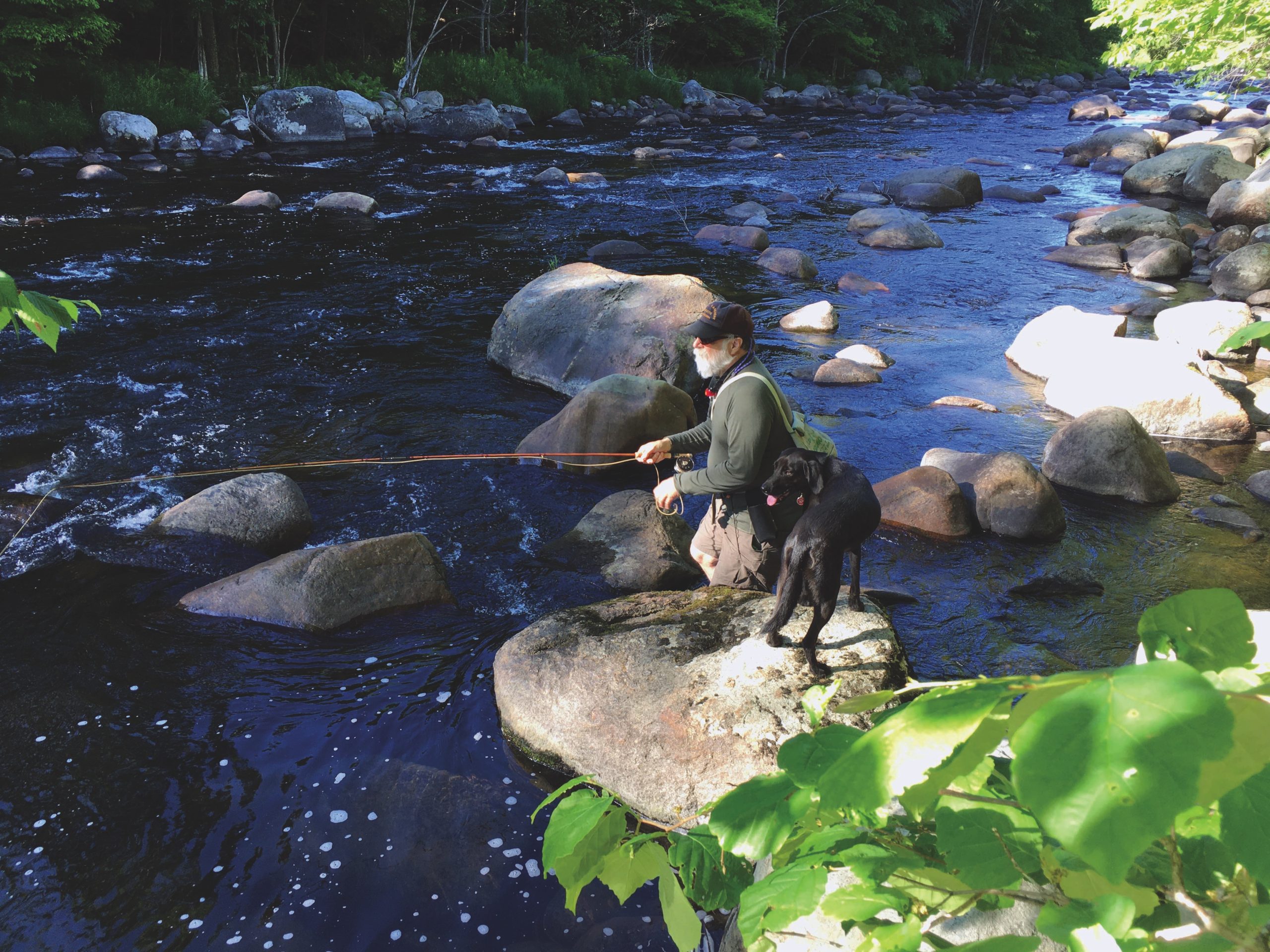
Joseph Grigely and his dog, Ollie, photograph by Anthony Elms
The Ausable River in Wilmington is not a gentle stream. Its rocks are smooth and rounded from centuries of glacial and hydraulic polishing, and when you wade into it, each step requires a negotiation—a slow transfer of weight, a reading of the current with your feet, your legs, your whole body. Fishermen who know it compare the bottom to bowling balls. You can fall, and when you fall in a river like the Ausable, the current decides what happens next.
One of the ways I keep myself upright is by listening. Faster water sounds different than slower water. A deep run has a lower register than a riffle. The hush of a pool tells you the current has slackened and the bottom is likely sand or silt, safer to cross. The roar between pools tells you to find another way around.
My friend Joseph Grigely has none of this. He has been deaf since he was 10 years old, when he rolled down a hill and a stick ruptured his eardrum (he had lost hearing in his other ear due to a severe fever as an infant). The Ausable—which he loves, which he returns to every spring and fall, which he has fished for years from a cabin he rents just downstream from the Flume Pool—roars in absolute silence for him. He wades it anyway, in wading boots and no waders, wet to the waist in water that would make most fishermen retreat, attacking the river, as our mutual friend Fritz once put it, like a bear.
I have watched him from the bank and wondered what he is seeing or sensing that I don’t. Something in long watching, in silence, releases the mind from the obligation to speak. Thoughts come the way fish do—unforced, arriving when you have stopped trying.
Joseph Grigely is an artist of considerable reputation—his work is in the collections of the Tate Modern, in London; the Stedelijk, in Amsterdam; MoMA and the Whitney, in New York. He teaches at the School of the Art Institute of Chicago. He has a DPhil from Oxford. He is a big man with a full white beard, the kind of presence that is immediately comfortable rather than imposing.
He is also, and not incidentally, a serious fly fisherman and fly tier, someone who can speak with authority about the history of the Neversink Skater and the hydrodynamic properties of deer hair, who grew up fishing the Farmington and the Swift Rivers in western Massachusetts and who now considers the Ausable his home water. When I first met him on the Ausable he was holding a bamboo fly rod, wearing just wading boots and whatever he’d fished in that morning. He looked like a soppy sasquatch, soaked and completely unbothered, his black Lab, Ollie, waiting on the bank with the patience of long practice.
These two things—the art and the fishing—are not separate pursuits for Joseph. They are, I have come to understand over years of friendship, the same inquiry conducted in different mediums.
His art is largely about what it means to be deaf in a hearing person’s world. For decades he has communicated with friends and strangers by passing written notes back and forth—on torn scraps of paper, bar napkins, Post-it notes, the backs of envelopes—and these notes, with all their swerving and missed meanings and hilarious miscommunications, have become the raw material of his practice. One of my favorites from his collection: someone scribbled in a hurried conversation, Alec loves me / Ellen is great / I have to piss so bad / can you wait? We can imagine Joseph’s responses in between, but in their absence the note becomes, through compression and urgency, an accidental poem. He has tens of thousands like this—what he calls the wreckage of conversations—each one a small monument to the beautiful chaos of trying to reach another person with words. He refers to the aggregate daily difficulty of moving through a hearing world as “disability shit,” said with a weariness that makes clear this is not self-pity but accurate accounting. During the pandemic, when masks concealed lips, his already narrow window onto spoken language closed almost entirely. Online lectures rendered through automatic speech-to-text translation get perhaps 70 percent right, he tells me, and the 30 percent that goes wrong—the jargon, the jokes, the accented speaker—makes the whole thing nearly futile.
When his wife, Amy, is not there to translate my words to sign language, Joseph and I communicate the old way, on paper. I write something down, pass it to him, he responds—sometimes out loud, his voice carrying the confidence of someone who learned speech before he lost his hearing—and sometimes in writing. The exchange is slower than conversation. It requires more precision, more thought. You cannot mumble on paper. You cannot trail off.
What I have learned, sitting on Joseph’s porch on the Ausable with a glass of whisky after a day on the water, passing notes back and forth in the dusk, is that you very quickly learn to decide what matters. You try not to waste words. I have kept some of my notes to him. I only have my side—Joseph’s responses exist somewhere, on other scraps, in other pockets, lost to the river and the season—but that feels right somehow. The note opens a space.
You tie the most beautiful flies.
For me fly fishing is about communication.
It’s a wand—there is magic.
It’s high art.
I have a feeling one day fishing will be banned.
I have found, over the years, that I use language in a different way around Joseph. I’m more self-conscious about the words I choose. And these thoughts on communication are the center of much of what Joseph and I are interested in.
Sit on the porch of Joseph’s rented cabin on the Ausable on a fall evening and the conversation will eventually arrive, as it always does, at the question of representation—at the gap between a thing and the sign we use to stand in for it. Joseph has been thinking about this gap his whole adult life, but he came to it, as many anglers come to their deepest ideas, through fishing.
In 2004 he published a piece in Cabinet magazine about the flies of Fran Betters, the legendary tier and fly shop proprietor from Wilmington whose shop sat a short cast from the Ausable for decades. Betters tied flies that bore no resemblance to any specific insect—disheveled, dowdy, tied with slapdash-looking gobs of deer hair and dubbed fur. His most famous pattern, the Haystack, doesn’t imitate a mayfly or a caddis or a stonefly. It doesn’t imitate anything in particular. And yet it catches fish—often more reliably than patterns tied with painstaking entomological precision.
Why? The answer, Joseph argued, has to do with the difference between appearance and behavior. A fly that sits in the surface film, that can be skittered and twitched and made to pulse with the current, that occupies the meniscus between air and water in the way living insects do—that fly communicates something to a trout that a perfect visual replica, motionless in the drift, does not. The fish is not reading a photograph. It is reading an event.
Joseph would return to this idea years later, with characteristic precision: “Fran recognized the hydrodynamic properties of a fly tied with deer hair; how it would sit in, rather than on, the surface film, and how a fly could be manipulated to create—from the perspective of the fish—a curious kind of surface disturbance that suggested the fly was something alive.” And then: “Fran’s flies, tied the way Fran tied them, looked like crap—but though bedraggled like a furball coughed up by a cat, they looked like nature itself.”
The Haystack as haiku: the minimum materials necessary to create the conditions for an experience, rather than a description of one. The fly ends and the trout’s mind keeps going, down into the current, toward something it cannot quite name but cannot refuse.
A fly, in this sense, is a communication device. When Joseph ties a fly—and he ties some of the most beautiful I have ever seen, messy, like nature itself, but in a very precise and intricate way—and casts it onto the Ausable, he is writing a note and passing it to the river. The angler’s brain thinks the lure looks like an insect, something a fish would eat. If a fish sees that lure and its brain acknowledges it as something edible, the mind of a human and the mind of a fish meet over this little representation in fur and feather tied to a hook. When it rises and takes, the life of that fish is telegraphed back up the line to his hand, and the communication has succeeded. Something has crossed the gap between species, between worlds, between a man standing in cold water and a creature living entirely within it.
This is not a small thing. It is one of the oldest forms of communication on Earth—older than alphabets, older than pictographs, older perhaps than spoken language itself. Every culture that has ever fished has understood this. Every decoy carver, every duck caller, every angler who has tied a hook with materials borrowed from the natural world to suggest something it is not, has been engaged in this same ancient act of cross-species rhetoric.
Joseph understands this more viscerally than most fishermen, I think, because communication for him is never unconscious. He cannot take it for granted. Every exchange—every note passed, every glance at a stranger’s lips, every lecture rendered into broken text by a computer—requires effort, attention, a willingness to work across the gap. The gap is always there for Joseph, always visible, in a way that for hearing people it mostly is not. We swim in language the way a fish swims in water, unaware of the medium. Joseph sees the medium.
The fishing fly is a representation of something a fish eats. The names we give things are not the things themselves. The map is not the territory. And the gap between the word and the world—that gap that Joseph lives in every day, that I have spent years writing around—is not a failure of language. Here is what took me a long time to understand: that gap is not a bug. It is an asset. The very imprecision of language—its inability to capture the thing completely—is what makes it generative rather than merely descriptive.
Think of what happens when you try to share a thought with another person. You translate idea into words, pass it across the gap, and hope something of the original survives the crossing. Often it doesn’t—not entirely. The other person misreads, misinterprets, hears something you didn’t quite say. And in trying to clarify, to reach across again, you sometimes discover what you meant more precisely than you knew before you spoke. The miscommunication sharpens the thought. If we could transmit ideas directly from mind to mind, bypassing language entirely, we would lose this—the friction, the beautiful inexactness, the thinking that happens in the attempt to be understood.
When Joseph passes you a note there is even more chance of slippage. He cannot say everything he might want to say. He has to choose. And in choosing, he opens a space—the words he doesn’t write, the things he leaves out—that you have to fill with your own imagination and experience. The note becomes a collaboration. Your mind meets his on the page and something is made that neither of you could have made alone. More pixels in a photograph might heighten detail and resolution, but it doesn’t mean that it communicates the image better. Often images with less information, more abstract, feel more emotional.
That is what a Haystack does. Fran Betters didn’t tie a perfect mayfly. He tied something suggestive enough that the trout’s own brain completes the picture. The fly is the poem. The trout is the reader. And the take—that explosion at the surface—is the moment of understanding. Close the gap completely—give someone a perfect replica, a photograph of a worm on a hook, a scientific description with every pixel accounted for—and you have left no room for them to enter. The Haystack has room. The haiku has room. The note passed across a dark porch table has room.
Language works not despite its limitations but because of them. Its failures are its beauty. And Joseph, who has lived almost his whole life in the gap between what we see and what we say, understands this more completely than anyone I know. Not because he is deaf, exactly, but because of what his deafness has taught him to see. He once said of his own disability that “what I lost in my hearing I gained in my deafness."
“Can you imagine fishing the Ausable without hearing the currents?” I asked Fritz one evening. Fritz knows the river well, has fished it for years, has waded its bowling-ball bottom and felt the same anxiety I feel when the current pushes hard against the leg and the next step is uncertain.
He thought about it. “No,” he said. And then after a moment: “Or the wind. The wind in the white pines.”
There is a particular sound the white pines make on the ridges above the Ausable Valley when a front is moving through—a low continuous rushing that blends with the sound of the river below until you cannot quite tell where one ends and the other begins. It is one of the sounds I associate most deeply with the Adirondacks, with fall fishing, with the particular quality of attention that comes over you when you are on the water and the world has narrowed to the length of a cast.
Joseph has never heard it. But he has felt the wind, and he has seen the pines move, and he has stood in the river while the light changed and the surface shifted and the trout began to feed. Fritz thought about this for a moment and then said, “When he’s on the river, he’s not the deaf guy. He’s just Joe. Another fisherman.”
I think Fritz is right, and I also think there is more to it. On the river, none of us is entirely ourselves. We are stripped of the identities we carry in the hearing world—the professor, the artist, the writer, the man with the disability. We become something simpler and older. Heraclitus, whom some call the Greek Buddha, said that you cannot step into the same river twice—not because the river changes, but because you do. The river is not just a place. It is a condition. And in that condition, a deaf man and a hearing man are, finally, fishing in the same silence.
All fishermen, in this sense, are a little like Joseph. When we pursue a trout, we are not using language. We are using something older—instinct, attention, the accumulated knowledge of the body, the reading of water and light and the drift of a fly on the surface. The trout does not speak to us, and we do not speak to it. Whatever passes between us passes in a medium that has no words.
The Ausable holds wild brook trout—the original inhabitants of these cold freestone streams—and a brook trout is not just a fish. It is among the most beautiful freshwater creatures in North America: vermiculate patterns on its back like dark topographic maps, no two ever the same; orange spots haloed in blue along its flanks; fins edged in white and black as precise as if painted on.
When a brook trout comes up through the dark water to take a fly—that sudden boil at the surface, the fish turning back down with the hook in its jaw, all that cold color catching the light for just a moment—you realize the brook trout’s colors are themselves a kind of language, and a complicated one. Communication is not one thing. To a mate in spawning season, when the colors deepen and intensify, they say the opposite—I am here, I am alive, I want to be seen. To a predator, those vermiculate patterns against the streambed say I am not here. The same signal means different things to different readers.
What does communication mean when the point of the communication is to speak invisibility—not wanting to communicate at all? There’s something profound in the fact that Joseph, who already lives a kind of invisibility in the hearing world—present but unheard, there but not quite reachable—finds in fishing a place where that invisibility is not a deficit but the whole point. The fisherman wants to disappear. The fly rod is a wand that renders you invisible. And the absence creates a kind of presence that is deeper than any other. That’s the real magic. Every fisherman who has ever stood in a river has felt it—in the best moments, the world forgetting they were there.
Joseph once wrote to me about his theory of what he calls textualterity—the idea that a work of art is not a static object but a process, constantly being remade by the circumstances that surround it. He was writing about paintings, but he could have been writing about a fly on the water. A Haystack drifting through a pool on the Ausable is not the same fly from one moment to the next. The current moves it. The light hits it differently. The meniscus flexes around it. It is always becoming. And the trout, below the surface, is reading not what it is but what it does—not the noun but the verb.
People, Joseph wrote to me once, are verbs. They move, they talk, they eat, they fish. He signed off that particular email, sent late at night after a long day that had started at 4:30 in the morning: “This verb needs some sleep.”
After the river, in the evenings, Joseph grills on the porch of the cabin—asparagus, steaks, whatever the day has called for—and we sit with a glass of whisky and pass notes back and forth by lamplight while the Ausable runs below us, loud enough sometimes that we would strain to hear each other even if Joseph could hear. In these moments I am very much at ease. Two men at the end of a day on the water, the words between us chosen carefully, nothing wasted, the river doing what rivers do even in the dark when we can’t see it.
There is something in Joseph and his day-to-day life that I find difficult to look away from. Not because it is sad—Joseph would find that condescending, and he would be right—but because it is clarifying. He is doing what all of us are doing only without the noise that the rest of us use to fill the silence. When he fishes he is reading the river with his eyes and his hands and whatever it is that connects a fisherman to the water.
The Ausable doesn’t care if you can hear it. The trout don’t either. They are reading the same thing Joseph is reading—the fly on the surface, the light, the drift. And sometimes, when the cast is right and the fly lands softly and the current carries it in just the right way, something crosses the gap. A nose breaks the surface. A line goes tight. And for a moment, across all the distance between a man and a fish, between the land and language, the world is vibrating with a sympathy that has no name. To participate in the living world at all is to converse with it, mostly in ways we never intended and will never fully understand. Even when communication misses its mark, new tendrils of connection are forged. In the failures of language are opportunities to fall backwards into the gap—into the space between words. This is what happens when Joseph wades into the Ausable.
The trout, bright as a painting in the cold dark water, is communicating something—just not to us, and not in any language we will ever speak. Two beings—a man and a fish—two entirely different universes of meaning, communicating completely different things to each other. And yet the connection is real. The line goes tight. It doesn’t matter that the trout thought it was eating and the fisherman thought he was reaching across the void. The gap closed anyway. Even when communication fails completely—when the two parties have nothing in common, no shared language, no shared world—something can still pass between them. Should we be surprised? We are all intercepting the living experiences of other beings, and they become part of us.
James Prosek is an artist, writer and naturalist whose work pays homage to the history of art and natural sciences while addressing contemporary environmental concerns. He has published more than a dozen books and exhibited his art globally, from the Yale University Art Gallery and the Philadelphia Museum of Art to the Asia Society Hong Kong Center, London’s Royal Academy of Arts, and Nouveau Musée National de Monaco.