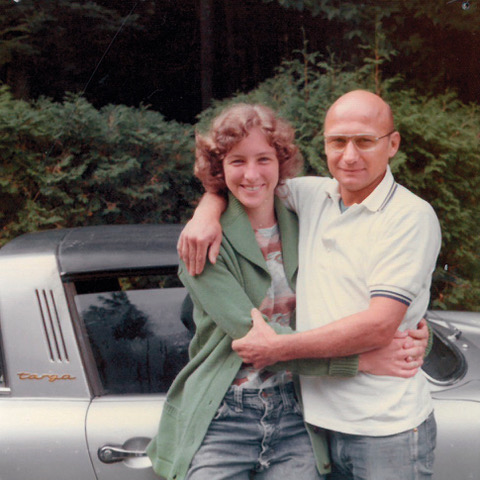
It’s a soggy March afternoon. The sky spits rain and the roads are slushy, lined in dirty snowdrifts. But inside Jim and Parmelee Tolkans’ Lake Placid living room—more an atrium, with its floor-to-ceiling windows and potted trees—it’s cozy and bright. Panza the Corgi barks and paces until Parmelee corrals him upstairs. Jim sits at a table, his walker within reach.
Jim is 94. He’s frailer, of course, than he was in the films Back to the Future and Top Gun, which made him a celebrity in the mid-1980s, but there’s no mistaking his smooth head and soft blue eyes. Jim’s roles in his movie heyday involved machismo—lines barked or ordered. In person his words are gentle, his hearing loss requiring space between conversation, his answers to questions delivered in soliloquies.
Jim’s sharing stories about his life, about how he landed in this moment, living on a knoll overlooking 41 Adirondack acres, mountains in the distance.
“I was born in the upper peninsula of northern Michigan,” he begins. “My family split up when I was 14. My parents got divorced. And then we started moving around. The next year I spent in Evanston, Illinois, a suburb of Chicago. It was the worst year of my life. Everything bad happened to me. It’s a miracle I didn’t end up in prison. I was getting in trouble, hanging around in a gang, so the next year my mother moved us to Tucson. And after that terrible year in Evanston, Tucson was wonderful. Everything changed. I became a local hero on the football field. I got a scholarship to play football at Eastern Arizona. I went there and I played a little football and then during the Korea campaign, I went into the service. And it was OK. And when I got out of the Navy, I just didn’t know what to do. I was terribly lost. But on the GI Bill I started school again and my major was art. I went back to school at Coe College, in Iowa. It was a wonderful school. Then I transferred to the University of Iowa. And that’s where I learned that if you want to be an actor you have to go to New York. So in 1956 I got on a Greyhound bus out of Iowa City to go to New York to be an actor. I had 75 dollars in my pocket, that’s it. And there I was. Going off just to see if I could do it. And it was very difficult at first. But it became some of the greatest years of my life. I was just so poor, but I hung it out, and I started to study with Stella Adler, the great acting teacher, and then later I studied with Lee Strasberg of the Actors Studio. I worked with all these great people.”
Jim takes a break, then continues.
“My first apartment I furnished with stuff off the street that was being thrown away. But I saved my money, I studied. And pretty soon I started acting. Different jobs: 35 dollars a week; 50 dollars a week; 150 dollars a week; 500 dollars a week; and even more at times. I had to learn the hard way. I had to learn my own way.”
And then the conversation drifts to Parmelee, his wife of 54 years.
“At the American Place Theatre, in New York, I was doing a play with Michael Douglas and Raul Julia. And Parm-elee, fresh out of Smith College [working as a prop girl at the theater], and I, we hooked up. And she asked me to marry her.”
He laughs, remembering. “I said, ‘OK, let’s try it out.’
“Her family had a place on the lake so she would have her summers here and so she introduced me to Lake Placid. Over the years I realized that Lake Placid was more than special. I feel it’s one of the great places to live on Earth. I really do. The beautiful landscape, the lake itself. But I found that the people here were just kind of right—friendly, open. I just feel so fortunate to be here, and I’ve made so many friends. I am grateful every day for what I have.”
Jim pulls himself up, pushes his walker in front of him, and shuffles forward, humming, pointing out objects on walls and tabletops: A horse weather vane, African masks, a massive Bennington pottery crock, sculptures he’s created from downed trees on his property. “Everything is art,” he says.
He maneuvers into what was his billiard room—he can no longer play so got rid of the pool table. A cardboard box is piled with fan mail, envelopes of all sizes with return addresses from around the world. A side table holds two wooden boxes, each with the cremains of Jim’s beloved Corgis Jango and Ella. A portrait of Abraham Lincoln hangs on a wall. Jim acknowledges it and recites The Gettysburg Address, his blue eyes steady and intense. He’s back on stage, performing for a captivated audience.
Time passes quickly, it’s raining hard, and Jim, smiling, blows goodbye kisses.
Two weeks later Jim Tolkan died in the Saranac Lake hospital.
He was a lover of everything. The great outdoors. Animals—most recently his cat Felix, a stray he rescued. The art he collected. The Lake Placid home he designed. His friends. His fans. Tennis, golf, pool. But most of all, Parmelee. Just before his last trip to the hospital, he scrawled on a piece of notepaper, “Parm, When I leave I will salute the magnificence of this earth. Most of all the magnificence of what we have and the magnificence of who you are. I salute you.”
And now, just after the weekend of his memorial service, Parmelee’s at the living room table with her great-grandfather’s inkwell, responding to condolence cards. “Everybody included an anecdote about how their lives crossed with Jim’s,” she says.
The funeral was at Lake Placid’s St. Eustace Episcopal Church, where Parm-elee was baptized and where she and Jim married, in 1971. In a wedding photograph, Parmelee is radiant in a silk gown and Jim wears what Parmelee calls a grin of “relief”—“there were more than a hundred of my family and friends.”
She did ask him to marry her while they were working at the American Place Theatre. Jim was acting in George Tabori’s Pinkville, a play about the brutality of American military training. (The New York Times described Jim’s performance as “outstanding.”) Their romance began in January and, by August, she was Parmelee Welles Tolkan. Jim had already spent a remarkable 25 years working in theater, and lived in a loft on Broadway. It was decorated floor to ceiling with his early American folk art collection: signs, furniture, pottery and, his favorite, weather vanes. When the couple later bought and renovated a loft in Tribeca, they paid for the overhaul by selling much of Jim’s collection, some of it purchased by the singer and TV host Andy Williams.
Jim was 17 years older than Parmelee, and they came from very different places. “Jimmy was half Finnish and a Lithuanian Jew,” says Parmelee. “His grandfather was a cattle, horse and mule dealer in Iowa who raised mules for the first World War for the Army. Jimmy’s father was a salesman, and went around to farming communities after the war.”
Jim’s parents met in Calumet, on a finger of Michigan’s upper peninsula that juts into Lake Superior. This was copper mining country, and today the community sits on thousands of miles of underground mine shafts. In Calumet the Tolkans had twins—Jim and Joan—and another son, Ronald. After the divorce, Mrs. Tolkan and her kids moved and moved again. Eventually Jim would board that Greyhound bus in Iowa to realize his dreams.
Parmelee’s father was in the CIA, a profession that stationed him in Greece, Ethiopia, Nigeria and Morocco. Parmelee attended the Madeira School, outside of Washington DC, then Smith College, but Lake Placid was a constant backdrop. Her great-grandfather bought land near Pulpit Rock in the early 1900s; when Parm-
elee and her cousins were kids the extended family owned and summered at Camp Abenaki, an estate at the southern end of Lake Placid. Among the cousins was Mark Wilson, who now lives in Saranac Lake and remembers, at age 10, meeting Jim—especially seeing Jim’s silver Porsche coupe—for the first time.
Parmelee’s dad cautioned her about a future with such an older man, “but Dad was really cool about everything,” she says. The entire family embraced Jim.
“Jimmy was the perfect husband,” says Parmelee. “He let me have my own life. He wasn’t demanding of me that I should show up to iron his clothes or make his dinner.”
Parmelee’s career flourished. She was a member of the United Scenic Artists and worked with costume designer greats such as Willa Kim. Parmelee painted costumes for Melina Mercouri and Mikhail Baryshnikov. She worked on the movie Hair, painted costumes for The Joffrey Ballet, Will Rogers Follies, Ain’t Misbehaving, Cats—was even sent around the world by the musical’s designer to teach other painters how to create those costumes—and for years painted Rafiki in The Lion King.
Meanwhile, Jim’s work was transitioning from theater to film. He told Parmelee, “I will never go to Hollywood until they ask me to come.” And then they did. He acted in Serpico, Woody Allen’s Love and Death, The Amityville Horror, WarGames, Iceman and Back to the Future and its sequels. “He said when he auditioned for Top Gun he really wanted it,” says Parmelee, “because he knew it was going to be a hit.” Then came Masters of the Universe, followed by some two dozen other films and many TV roles.
In 1986 Jim and Parmelee bought a place along River Road in Lake Placid. Jim was constantly on the road, and Parmelee wanted to socialize in her mountain town. So on Mondays she’d drive to Albany, take the train to the city and return to the Adirondacks for the weekend. She commuted until finding a studio at the Lake Placid Center for the Arts, where she could work, then ship her creations.
Their house was on an oxbow of the Ausable River and a former clubhouse for the U.S. bobsled team, back in the 1950s when those athletes were mostly Air Force men. “I loved it. It had a beautiful garden and terraces down to the river,” says Parmelee. The Tolkans lived there—Jim coming home between projects—until 1996, when they moved up the road, onto what had been the Thompson family’s Midrivers Farm. (The Thompsons’ daughter Isabella married John Brown’s son Watson who was killed while accompanying his father on the raid at Harpers Ferry.) The farm later belonged to the Lake Placid Club and was used to raise fodder for its cows. Then a section of it became a skeet field, followed by a place for anglers to learn how to cast fly rods, eager to fish nearby trout holes.
Jim and Parmelee fixed up an old Mount Whitney ski hut on the property—what had been repurposed as a restaurant for the skeet shooters. They later had it moved up the hill and Jim, with the help of architect Janet Mellor, designed a new wing with a wide deck. Parmelee calls it a merging of traditional and modern, with old pine and cement-poured floors and expanses of wall to accommodate their art. As the years went by, particularly as Jim worked less, the Tolkans settled in.
“Jimmy was the most competitive man in the world and extremely athletic,” says Parmelee. The Welles family were fierce tennis players while Jim “had never picked up a tennis racket in his life.” He wanted in—and to be good—so “he searched out a coach in New Jersey who had two sons,” Sandy and Gene, “who played on the ATP Tour. Every week he’d take the bus for lessons with Alex Mayer.” At age 70, when Jim hurt his knee, he switched to golf. Again, he’d never played, but joined a group of men who welcomed him. In winter, they shot billiards, and Jim was part of a pool league in Saranac Lake. “He was always active,” says Parmelee, “always walking with the dogs if he wasn’t playing golf or pool.”
Parmelee’s cousin Mark Wilson, whose relationship with Jim spanned more than 50 years, says, “Jimmy was always full of surprises.” There was the early American folk art, but Jim also collected good wine, learned to play guitar and quoted Shakespeare sonnets. “His creative impulses carried over to his appreciation for everything.” That included the surrounding natural world. On one occasion a friend of Parmelee’s, walking the Tolkan property, came upon Jim on his back in the grass. “She thought he was dead,” says Parmelee, “but he was just taking it all in, lying down and thinking.”
Jim was a sweet, thoughtful man, the opposite of the authority figures he depicted on stage and screen—Dave Moss in the original Glengarry Glen Ross, Mr. Strickland in Back to the Future and Commander Stinger in Top Gun. At five foot, six inches, he was physically diminutive, perhaps the reason he was rarely a leading man. But, says Mark, “he was the embodiment of ‘there are no small roles, only small actors.’”
Jim leaned into his fandom, attending Comic Cons all over the world—Wales, Germany, Scotland—where he’d pose with fans and sign posters and photographs. He appreciated the kindness, shrugging off the celebrity, though Mark says it did come in handy after Jim was pulled over for speeding. The officer, recognizing Commander Stinger from Top Gun, let him off with a warning: “You screw up just this much, you’ll be flying a cargo plane full of rubber dog shit out of Hong Kong.”
“He was just so good with the public and just really popular with them,” says Parmelee. “I’m so glad because many stars don’t want to be bothered.”
The Tolkans’ home faces northeast toward the Ausable Valley and Whiteface Mountain. “Every year on Jim’s birthday,” says Mark, “which—depending on the solar calendar—falls on the summer solstice, the setting sun reflects off the windows of the weather station on the summit of Whiteface directly into their living room. It’s blinding, like a bright star perching briefly on the mountaintop before disappearing. For Jim, whose roles never gained him a star on the Hollywood Walk of Fame, I think this was a suitable alternative.”