The Moose River makes its schizophrenic reach for the Black River from three headwaters. The North Branch sulks out of Big Moose Lake, perhaps mourning still the Grace Brown tragedy. Chaining through Darts and Rondaxe lakes, this lazy stream makes its way with so little effort it often forgets to go forward and retreats upon itself.
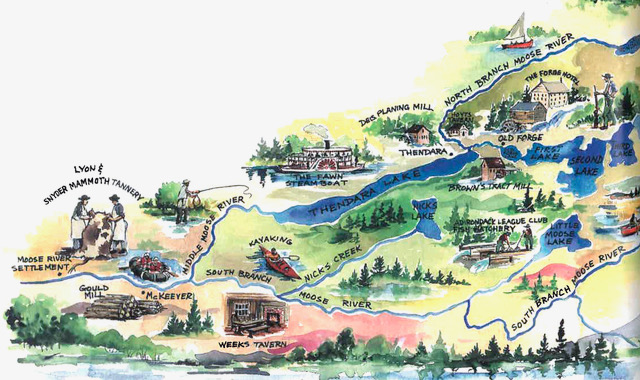
The Middle Branch links the Fulton Chain of Lakes. Eighth, Seventh, Sixth, Fifth, Fourth, Third, Second and First lakes—once known as the Moose Lakes—flow southwest and make their outlet at Old Forge. Passing through Thendara, the Middle Branch spreads wide and beautiful before it descends through Minnehaha and Singing Waters, where its character changes. At Nelson Falls cataracts of white water preview the turbulence that occurs after this stream meets the South Branch.
The South Branch has its source in the Moose River Plains and tracks through rugged terrain. The confluence of all three, just above McKeever, hurtles the Moose fitfully through rapids, falls and hydraulic holes to its junction with the Black River at Lyons Falls.
A true working river, the Moose was used very early as a transportation network and as a source of food. Though significant industries like logging and tanning flourished along the way, the river's lasting gift has been as a route to natural beauty.
The Mohawk people called this waterway ka-hu-ah-go or "clearing an opening." The phrase describes the river's power as passageway penetrating a land both beautiful and cruel, abundant of game and barren of crops. The Moose and its connected lakes enabled the Mohawks to traverse the Iroquois Confederacy; the stream was both politically and militarily important. The river country was a great source of game and provided quick conveyance back to the Mohawk Valley, where year-round settlements cultivated crops. Grasslands along the Moose appear to have been created by planned burning to prompt excellent browse for deer.
When John Brown (the wealthy Rhode Island merchant, not the abolitionist) began the task of developing his 210,000-acre tract of Adirondack land in the 1790s, his scheme was on the order of settling the moon. An almost negligible growing season and impenetrable forest awaited those who made the arduous journey along what did not yet deserve to be called roads.
Brown, a man of immense girth and resolve, subsidized the colonization of the area that centered around what is now Old Forge and Thendara. In 1799 today's Old Forge Pond was a narrow stream—the start of the Middle Branch—flowing from the Fulton Chain. Brown contracted the creation of a log dam, and three months later the water reached the top of the dam. A gristmill was built downstream on the south bank and a sawmill on the north.
Brown's efforts were the first industrial developments in the central Adirondacks. In 1811 his son-in-law Charles Herreshoff built an iron forge utilizing the same waterpower. The mine that supplied the ore filled up with springwater, prompting Herreshoff in 1819 to walk to a spot overlooking the river and kill himself. The thirty families who had come to work for him left for better prospects.
Herreshoff's legacy was a significant road—the Brown's Tract Road—and his abandoned Herreshoff Manor. Both played key roles in two related aspects of the waterway's place in regional development. "We now have two taverns established ... one six miles away on a very pleasant hill near the Moose River run by a Mr. Weeks," Herreshoff wrote in 1814.
Four years later he mentioned a "Mr. Hoyt agreed to move to Moose River to keep a public house immediately." The road that Herreshoff built not only prompted travel but also early hospitality, a backbone of the economy to this day. After Herreshoff's death the great manor with its view of the Moose River was left a ghost house until the arrival of Ed Arnold and family, who squatted with impunity and panache, setting up Arnold's (1837–1869), the first inn of note for miles around. Later the Forge House (1871–1924), with its view of the Middle Branch dam, provided even more of a destination and offered a convenient gateway to summer places on the Fulton Chain.
In the late 1800s the river was vital to the future of brook trout. Emmett Marks, a pioneering pisciculturist, established fish hatcheries below Old Forge dam and on the South Branch. The Adirondack League Club also built a fish hatchery, which is still productive.
The popularity of sportfishing grew just as camps and hotels arose along the Fulton Chain. As the region's popularity increased, public transport needed an upgrade. A buckboard ride over the Brown's Tract Road was sought after by the adventuresome, but was hideously uncomfortable.
Beginning in 1889 a narrow-gauge train, later called the "Peg Leg Railroad," began operation from Middle Settlement on the lower Moose to Minnehaha on the Middle Branch. William Scott de Camp's steamer, the Fawn, would await travelers at the Minnehaha terminus to take them upriver to Thendara, where carriages would carry them to the Forge House. From there steamers went to points north. Later, train service to Old Forge ended that complicated series of connections, but the Fawn continued as an excursion cruiser.
Logging along all three branches was immensely important from 1851 until 1948. Softwood was cut as far up the South Branch as the Moose River Plains, floated down and held in great mountains at the dam in McKeever—that is, until the dam blew out in 1947. Most of the logs headed further down the lower Moose to the large pulp mills at Lyons Falls and the great complex at Gouldtown owned by Gould Paper Company. The strangely beautiful ruins of the Gould Mill (later owned by Rice Veneer) at McKeever are visible from the Route 28 bridge.
In Thendara the wide expanse of the Middle Branch was used to hold and sort logs for several local sawmills and to send others downstream. The Deis Planing Mill, the Brown's Tract Lumber Company and Pullman Brothers Mill, which supplied the wood for violins and Steinway pianos, made for a very busy river.
The nineteenth~century tanning industry required resources the lower Moose offered in abundance: Water—inexhaustible and on the move—plus significant stands of hemlock trees combined at Moose River Settlement. Water was necessary for power and for the tanning liquor made of ground hemlock bark; once the hides were processed, hair, bones and other stinking flotsam were flushed downstream. The Lyon & Snyder Mammoth Tannery was a state-of-the-art complex from 1830 until 1878, noted for its enormous size and output. This capacity came at a price: it is said that the Moose River reeked for many miles.
When the Moose was hard at work making paper, running mills and tanning hides, it had a certain value. Our approach to water is different now. Dan Tickner, who runs a canoe livery in Old Forge, comments, "The entire view of rivers changed. They were once looked down upon, places to toss garbage and sewage. Look at the really old houses on the river; very few have windows at all. When I was a boy that was cheap property."
The public's perception of working rivers like the Moose eventually moved into a new commercial role, one that capitalizes on nature and recreation. For more than seventy-six summers Adirondack Woodcraft Camps, on the North Branch, has been sending boys and girls down the river, and generations of local paddlers have enjoyed what is one of the most peaceful streams in the country. In the late 1970s river rafting, canoeing and kayaking began an unprecedented spurt of popularity in the United States. Tickner's Canoes has been in the business since 1979, and has seen the Moose River share in that development.
The lower Moose contains rapids rated Class V or Class VI, exhilarating for rafters and kayakers. According to Old Forge-based Adirondack River Outfitters, it's one of the best whitewater rivers in the East.
The Moose River is mostly invisible to the typical SUV-ensconced traveler. At McKeever bridge there's a ten-second view, and the gorgeous sunsets to be seen from the bridge separating Old Forge and Thendara are easily missed. Catch sight of one and you'll be reminded how this classic Adirondack river—once a thoroughfare of industry—has come full circle co its peaceful beginnings.