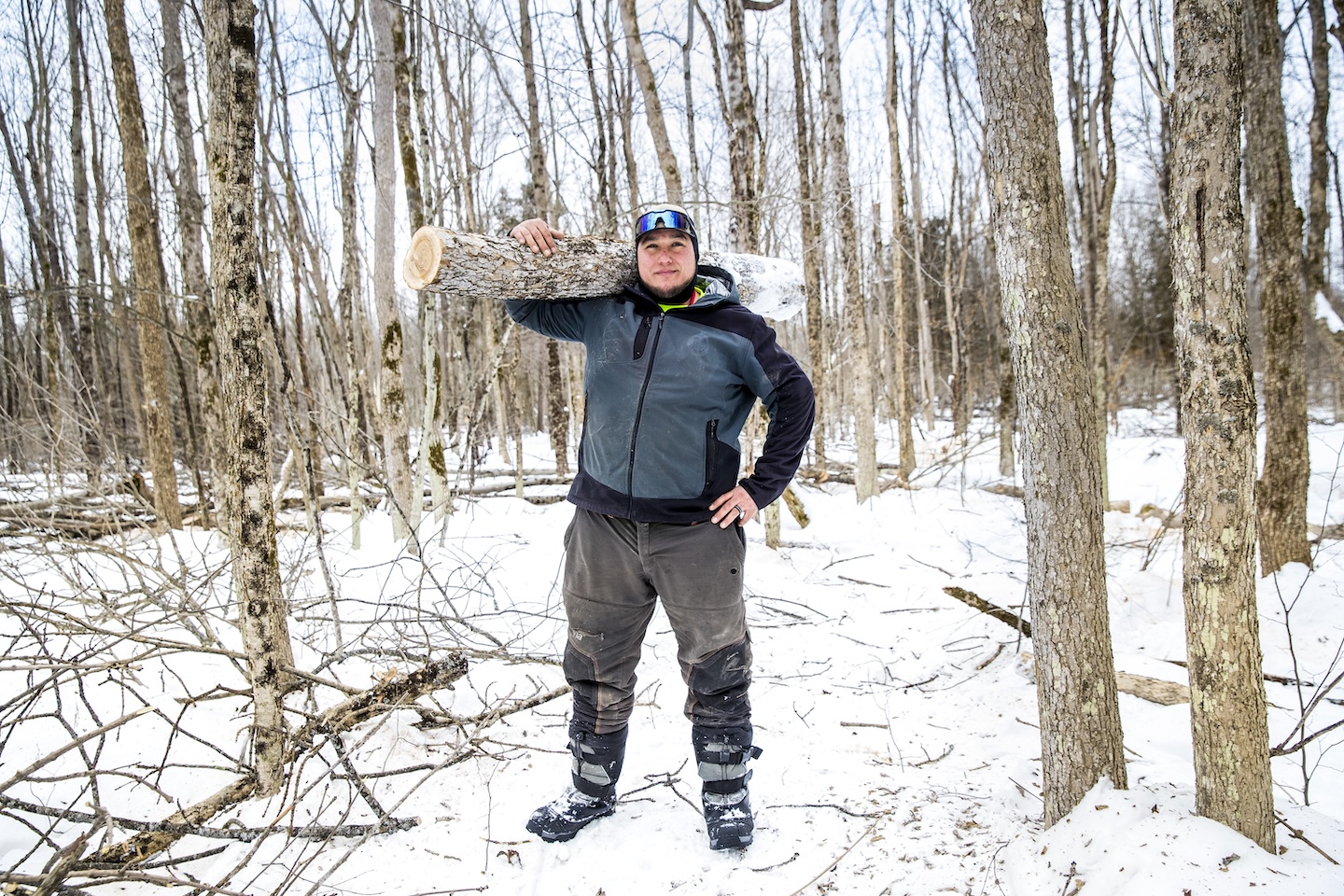
Angello Johnson burns the midnight oil. By day, he works in the land resource department of the Saint Regis Mohawk Tribe of Franklin County, of which he’s a member, at the northern edge of the Adirondack Park. On nights and weekends he teaches Mohawk tribe members the art of weaving long, pliable black ash tree strands into intricate baskets.
For six generations, his family harvested, pounded and peeled black ash trees to prepare wood for weaving, continuing a tradition that dates back 3,000 years. Johnson’s daughters, who are nine and three, are learning the craft. But Johnson is worried that soon there might not be black ash for them to weave.
The source of his fear is a tiny predator: a half-inch-long green beetle with a voracious appetite for ash trees.
The emerald ash borer is a wood-boring beetle native to East Asia, identifiable by its metallic, jewel-toned backside, its copper belly and the wake of destruction it leaves behind.
In the United States, the bug was first detected in 2002, in Detroit, Michigan, though it was likely introduced to North America in the 1990s through woodpacking materials or shipping crates from Asia. In China, Korea and Japan, local ash tree species evolved defenses against the emerald ash borer, so the bugs there rarely prey on healthy ash trees. But the North American ash species have no natural defenses.
The Adirondacks’ first emerald ash borer case was discovered in Warren County in 2020. From there, the bug spread quickly. There have now been reports of emerald ash borer in every county within the Blue Line. While ash makes up less than seven percent of Adirondack forests, according to the Department of Environmental Conservation, the species plays an important role in the regional ecosystem.
Ash are canopy trees, shading stream banks and the forest floor. Since they’re native to the region, other species—such as fungi—evolved alongside them and rely on the trees’ leaves or bark for their habitats.
Adult beetles nibble the tree’s leaves and are largely harmless. But they lay eggs beneath the bark, and when the larvae hatch, they burrow into the soft ash tree flesh, feeding on the tree’s vascular system and cutting off its ability to transport water and nutrients to its limbs.
Black ash thrives in boggy wetlands and is softer, lighter and more flexible than white ash, which grows in the uplands. Its pliable wood and thin bark makes black ash especially good for basketmaking. But among the ash species, black ash is especially sensitive to emerald ash borer attacks. When the larvae burrow, the ash trees protect themselves by walling off the internal infestation. Compartmentalizing the tunneling bugs stops the attack, but at a cost. Black ash is prone to overreacting to the bugs, often compartmentalizing more branches than it can stand to lose.
Typically, the black ash strangles itself to death before the ash borers can kill it. The beetle’s damage is quick and effective, with a more than 99 percent death rate for adult ash trees. A heavy infestation can take out an ash tree in as little as three years.
Since the beetle’s arrival in the Midwest, it’s spread rapidly toward the coasts. At least 37 states and the District of Columbia have reported infestations, resulting in tens of millions of dead ash trees and billions of dollars in damage. In Ontario, Canada, which borders northern New York, the black ash tree has been declared an endangered species.
Climate change isn’t helping matters. Extremely cold temperatures—below negative 30 degrees Fahrenheit for an extended period—can kill emerald ash borer larvae. But warmer winters extend the beetles’ feeding period and allow more larvae to survive and reproduce. And stress from extreme weather events like drought makes it more difficult for ash trees to withstand the pests.
None of that is lost on the Saint Regis Mohawk Tribe. Their territory, known as Akwesasne, or “Land Where the Partridge Drums,” straddles the St. Lawrence River, encompassing northern New York and Canada. It’s being overwhelmed by the emerald ash borer, which was first detected in Akwesasne in 2016.
“The bug does its thing and it’s a tidal wave seeping through,” Johnson said, adding, “It’s unstoppable.”
But Johnson’s not ready to give up. Neither are the state’s environmental scientists, who’ve watched species after species in Adirondack forests—chestnut, beech, elm, hemlock—threatened by invasive pests. Researchers hope they can play the long game by seeking out so-called “lingering ash,” or trees that survive even when clusters around them perish. If they can find the survivors, they can propagate them and reseed the forest with a new generation of beetle-resistant trees.
It’s not a sure bet. But it’s a North Star in an otherwise harrowing picture of the future.
For now, the Saint Regis Mohawk community is doing everything it can to protect the remaining black ash and their basketmaking traditions. “We’re trying to preserve this resource and stretch out our time that we have with it,” Johnson said.
Protector of the Black Ash
Saving the black ash is year-round work and the Saint Regis Mohawk Tribe’s land resource department takes a layered, seasonal approach.
In the dead of winter, Johnson and his three-person team harvest trees that are still viable and thin out black ash clusters, known as stands, so trees that remain have plenty of space to grow. Cutting out crooked and broken trees is like weeding a garden, Johnson said, adding, “When the sunlight is coming through the canopy, it’s helping the seedlings come up.”
The team waits until the ground is frozen to bring in machines. Black ash “really like their feet wet” and heavy equipment would leave deep ruts in the wet earth any other time of year, he said.
Springtime is tree planting and bug monitoring time. The team scouts for ash stands and injects the trees with a chemical that bug-proofs them for three to four years. But the treatment is costly, so the group is selective, often choosing to protect trees that need five or 10 years of growth to become basket-quality wood, while triaging others.
During the fall, the team collects ash seeds. Summertime is for projects like releasing parasitoid wasps into the tree clusters, which the department gets through a special program with the U.S. Department of Agriculture’s Animal and Plant Health Inspection Service. The wasps lay their eggs in the larvae or eggs of the emerald ash borer; when the wasp larvae hatch, they feed on, and ultimately kill, their hosts.
It’s too early to know if the program, which started about four years ago, has been successful, but if all goes well, the wasps will establish themselves in the stands, keeping emerald ash borer populations in check.
But even without the formal results, Johnson said he can detect progress visible to the naked eye, especially when compared to the rest of the forest. “They’re hanging in there. They’re nice thick canopies full of seeds,” he said of the ash stands treated with injections and wasps. “Two hundred feet down the road, the trees are just getting absolutely devastated by the bug.”
It’s a lot of effort to save the trees. “It takes so much coordination effort just to protect five or 10 acres,” Johnson said. Now 35, he’s been guarding the ash for upwards of a decade, through his work with the land resource department and by participating in a traditional ecological knowledge program. He’s been working with black ash even longer, since his teens, when he first started pounding logs for his great-uncle Clyde Cree Sr.
Johnson is clear-eyed about what’s next. “It’s a losing battle,” he said. “I don’t think there’s any way to eradicate emerald ash borer from the landscape. It’s going to have to work its course and find some kind of balance.”
As the bug’s habitat expands beyond the Adirondacks, through Vermont and New Hampshire and up the coast, Johnson’s already sharing plans and strategies with other tribes and nations in Maine and eastern Quebec to help them get ready for the bugs.
Maine is in its initial wave, with beetles first reported in 2018. Tyler Everett, a member of the Mi’kmaq Nation, who is focusing his University of Maine doctoral program on managing and responding to the emerald ash borer, is soaking up all the institutional knowledge he can from experts like Johnson.
“They’re leading the effort,” Everett said of the basketmakers battling the bug. “They’re keeping their foot on the gas.”
The Quest for Lingering Ash
Meanwhile, in Ithaca, Todd Bittner, a conservation scientist at Cornell Botanic Gardens, thinks there’s a way to stop the unstoppable bug.
For years, conventional wisdom was that North American trees had no resistance to the emerald ash borer. But that belief turned out to be wrong. The forest service set up monitoring plots and sampled thousands of trees. Every once in a while, they’d come across one relatively healthy-looking tree in a sea of dead ash. The service collected the healthy trees, propagated them and grew them up. Then they inserted emerald ash borer eggs in the grown trees. Up to a certain beetle threshold, the lingering ash were able to compartmentalize the larvae early and wall them off before the bug could complete its life cycle.
“Unlike our own immune systems, where we attack pathogens and try to get rid of them, trees and plants separate bad things off and don’t allow them to continue to create damage,” Bittner said.
Some lingering ash trees may have a different defense mechanism. Trees and plants give off organic compounds that attract the emerald ash borer, Bittner explained. If some lingering ash didn’t emit those compounds while adult beetles were present, or emitted them at lower concentrations, it’s possible the trees survived because they were temporarily invisible to the bugs.
An invisibility-shield defense mechanism hasn’t been validated with peer-reviewed research, Bittner said. But if future research confirms both mechanisms work, scientists could identify the genes responsible for those defenses. Then they could crossbreed trees with both characteristics, creating a new generation of ash bred to withstand the emerald ash borer.
There’s also a tipping point for the swelling bug population. At the rate they’re eating, eventually they’ll run out of adult trees.
“It’s a boom-bust thing,” Bittner said, describing a cyclical predator-and-prey relationship. Without enough ash trees to support the emerald ash borers, the bug population will eventually decline and stabilize. In the future, lingering ash may be able to tolerate the beetles at the lower level.
Still, it’s hard to watch the trees get wiped out, Bittner acknowledged. “There’s just threat after threat,” he said, ticking them off: chestnut blight, Dutch elm disease, beech bark and beech leaf disease, hemlock woolly adelgid, the Asian long-horned beetle.
“It’s kind of a depressing list when you put it all together.”
But in the world of environmental threats, where good news tends to be scarce, lingering ash is a bright spot. Cornell Botanic Gardens was drawn to participate in the Nature Conservancy’s “Trees in Peril” program, which aims to save North American tree species, partly because the research on lingering ash is so promising.
The program is building up its conservation bank to 750 trees, roughly 50 or 60 genotypes for white, green and black ash, with redundancy for each type. After growing the trees, they’ll graft them onto rootstock and do field tests in the wild. Then they’ll pick the top performers and breed or crossbreed them, eventually using the strongest trees to reforest the landscape of the Northeast.
Cornell Botanic Gardens is the primary propagation center for New York, but there are other groups, including in Michigan, working on similar initiatives. That’s a good thing, Bittner explained, since different regions will develop their own genotypes that perform best in their unique climates.
In the near-term, though, the basketmakers expect things to get worse. Of developing resilient, beetle-resistant trees, Angello said: “That’s going to take decades, easily decades, for that to reach fruition.”
Bittner acknowledged the long timeline: “It may not be as quick as some people would like, us included. It’s a long-term initiative,” he said. But he’s hopeful that the project will ultimately succeed and return ash to the region’s forests.
“There is light at the end of the tunnel,” Bittner said. “The science is there. There’s a clear roadmap of how we can move forward collectively to bring these species back.”
How to Help
Hunting down lingering ash is too big of a job for just one individual, or even one group. Want to get involved? The Monitoring and Managing Ash (MaMA) program, run by the Ecological Research Institute, is looking for people to join citizen science projects. Initiatives involve surveying ash trees for infestations, monitoring tree plots and reporting lingering ash. For more information, visit www.monitoringash.org or email outreach@monitoringash.org.
Above: Angello Johnson