

I remember the gloss of a fresh coat of varnish on a newly built boat. I remember the coziness of the shop from the woodstove in the dead of winter. But even without it, my dad’s energy filled the area. He was calm and focused, with a passion for his craft.
For years after he died, I dreamed of him. It was like a brief moment with him again. He’d always be happy and healthy, like nothing before ever happened.
It’s May of 2021. The traffic going in and out of the 37th Street tunnel screeches. The streets below are jammed. Though I’m 11 flights up, I can hear it all, from car stereos to jack hammers to horns.
I had just moved into a one-bedroom apartment after a painful breakup. My job in fitness took a major blow during the pandemic and my brother and I hadn’t spoken in a year. My life had changed enormously in a short span—it had completely fallen apart.
Sneakers on. Sunglasses. Earbuds in. As soon as I grab my phone, my friend Lauren calls.
“Hey, so, is your dad’s name Carl Mancini?” she asks.
“Ummm, yeah, how the hell do you know that?”
“Well,” she says, “I have a boat sitting in my garage with his name on it.”
Back in the ’80s my family had moved from Michigan into what we would forever refer to as “the yellow house,” on a hill in Keene. I was just two years old. My brother was five. Across the driveway from our house my dad built a woodshop with two huge bay doors and an upstairs for storage. His trade: boat building.
At the time, my mother was finishing a degree in psychology while working part-time as a waitress. My dad was a stay-at-home parent, and my brother and I spent a lot of time after school building wooden swords in the shop or watching my dad work.
He was a master woodworker. Other tradesmen would often visit his shop to absorb what knowledge they could. He trained several apprentices during his years in Keene, and one of his guideboats was featured on the cover of National Geographic Traveler.
He’d always have at least three boats in his woodshop, propped up on sawhorses. Sawdust blanketed the concrete floor, with larger patches throughout the shop from the floor-based power tools. The planer/jointer made cool sounds when the boards were put through, and my dad used it often. I felt like a part of it all when he’d let me take planks from the other end and hand them back to him, smooth with a fine coat of sawdust along their surfaces.
Two giant, rectangular windows sat along one side of the shop. Underneath them were two long workbenches packed with tools, and a giant vise at the end that I loved crushing things in. Planks and strips of wood and raw lumber were stationed throughout—the smell of cedar, ash, oak and mahogany filled the air.
If my father wasn’t cutting, sanding or measuring, he was rolling around on his stool, making his way down a canoe, meticulously screwing strips of cedar plank into the ash ribs on the inside. Anything from Ray Lynch and Loreena McKennitt to John McCutcheon and Dire Straits would play on the stereo.
He had a dinged-up cabinet with shelves full of cans and jars packed with thousands of different kinds of nails, tacks and brass screws. A single comic from a magazine was taped to the front. In it, a giant pelican had an entire frog in its mouth, ready to swallow. The frog was squeezing the pelican’s throat shut. The caption read, “Never give up.”
The woodshop was my dad’s happy place, and because of that, it became mine. I remember being asked by elementary schoolteachers, “What do you want to be when you grow up?”
Answer: “I wanna be a boat builder.”
Dad hand-built canoes and guideboats, but he also restored them. Canvas boats were still popular and many customers brought them in for re-canvasing. Or he’d replace cracked or bashed ribs on a canoe that had hit a rock. Sometimes he’d just replace rotted ribs that time and nature hadn’t been kind to.
An entire trailer with stacks of old canoes was parked outside the shop, with more boats lying around under cover, waiting for my dad’s hand.
My brother and I would play in the shop or yard until my mother came home, and then we’d be together for the evening, cooking dinner, watching my dad make funny faces and my mom roll her eyes and smile. The only painful memory of those years was my dad’s favorite dish, which he made every now and then: Mish Mosh. A combination of noodles, onions, peppers, strange-looking vegetables and anything else a little kid wouldn’t find appealing.
But when I was nine years old, my mom and dad split up. The happy family in our home on the hill had crumbled. I moved to a town five miles away with my mom and brother. My dad stayed at the house by himself and slipped further into the bottle.
I visited my dad every Tuesday and Thursday after school and often witnessed his deterioration. I missed the days of family Christmases and camping trips in one of my dad’s canoes. I even missed the Mish Mosh. Those years are hazy in my mind—snippets where I remember crying and not speaking a lot. Before the end of high school, my dad moved to Rochester, where my grandparents lived.
After I joined the Marine Corps, I would only see my father alive one last time. We did, however, play chess over the internet while I was posted in Lithuania. He’d set up his board at home and I’d set mine up across the world. We’d exchange our next move via email, with games lasting weeks.
I remember one time we were talking on the phone and I was feeling nostalgic, maybe even a little homesick. I said to my dad, “I decided when I get out of the Marines, I want to come live with you and learn how to build boats.”
“That’d be great, Bub,” he said.
He sent me a care package that included several “how-to” books on building wooden boats. My plan was set. All I had to do was get through three more years in the military.
Of course, things changed over those years. I met a girl in Lithuania and brought her back to my hometown for my mother’s wedding. My father wanted to visit shortly after, but I remember saying we’d be too busy. I was afraid the alcohol still had him in its grip, and I didn’t want to be embarrassed in front of my first love.
Later my brother and I went to visit Dad in Rochester. When we got there, we saw he wasn’t doing well. He’d married a nice woman who had left him a couple of years earlier. It was just like old times. Not the good ones.
He was never an angry drunk, nor abusive. He loved my brother and me more than anything and he often told us so. But he was a sad drunk, consumed in pain. More and more he became a remnant of a man who once had it all.
My brother and I decided it was time to go. Dad wasn’t well, but there was nothing we could do to make him better. We were there with him, but he was just as alone as if we weren’t. When we announced we were leaving and packed up, he slumped down onto the front step and began to cry, still inebriated.
I’d seen him in rough shape before—occasions where he wasn’t coherent. But there was something different about this one. As he sat there, defeated and sobbing, it was the look in his eyes. I saw the realization that came through his stupor and tears, that his only two sons, who he hadn’t seen in years, were leaving him.
It was the lowest I had ever seen him. And it was the last time I saw him alive.
I remember the phone call from my mother telling me he died. I had just spoken to him on the phone a week before, right after I moved to San Diego. He seemed to be doing OK, but it was often hard to know.
My plan on the West Coast had been to go to school and win back my Lithuanian girlfriend (which I never did). Now my desire for a new life in San Diego suddenly vanished. I wanted to be closer to family and my home, so I packed up and drove back to the Adirondacks.
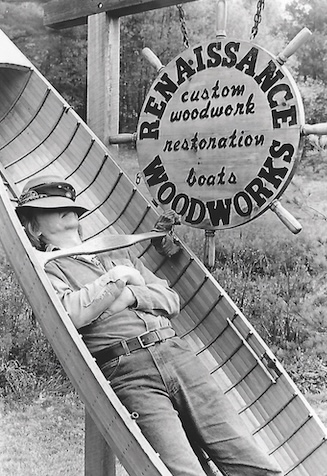
Dad had left behind relics from the shop in Keene. There were boat moulds, a generator, all his tools, and other random stuff. There was only one real thing of meaning, the handmade sign for his business. It was a giant steering wheel, just like you’d imagine on an old pirate ship. Engraved in the center in large letters was his business name: Renaissance Woodworks.
He hung it from a pole and crossbeam at the bottom of our driveway, and each day he’d carry down a one-person canoe he’d built and lean it there, as part of his advertisement for the business.
At least we got the sign. Everything else was sold at an estate sale.
Before my brother and I became estranged, we had spoken several times about my father and his boats. We’d once owned one of his smaller solo canoes, but it had been damaged and then shoddily repaired. It wasn’t his best work because it had been built during one of his lowest times, after he moved to Rochester. So we decided to sell it, knowing that he still planned on making us each a boat when he got back on his feet.
After he died, those hopes were shattered. The damaged solo canoe was the only boat by him that we knew still existed, and we had sold it.
I said to my brother, “If you ever see that boat for sale somewhere, just buy it and we’ll figure out the money situation later.” He agreed. At whatever cost, we just wanted that boat back.
Fast-forward to mid-pandemic. It’s my 11th year in New York City. I’m in my lonely Manhattan apartment when Lauren calls.
“What do you mean you have a boat in your garage with his name on it?”
“Well, my grandfather recently passed away and my family has been going through his estate and we found this canoe with a brass plate on the front that says, ‘Renaissance Woodworks,’ then underneath says, ‘Carl Mancini, Keene, NY.’”
“Holy shit … send me pics!”
A few moments later I see a pristine boat with the familiar brass plate that was my father’s signature.
“Lauren,” I say. “I want to buy this boat from your family.”
“Oh. OK, let me talk to my mom and see what she says.”
She calls me back the next day and connects me with her mother, who loves the story about my father and his boat. I ask if I could buy it from her.
“Well, I have eight other siblings who technically the boat belongs to now as well, so let me check with them first.”
Eight other siblings!
Convincing nine people to sell me a beautiful boat they just got for free is daunting. I’m prepared to drop some money, if they’re even willing to let such a beautiful thing go.
I offer to write an email that she can send to her siblings.
“Wonderful idea!” she says.
Two days later she calls back.
“Colter, all my family got together, and I read them your email and it was unanimous. We want to give you and your brother the boat. You even brought several of us to tears.”
It’s like finding a hidden treasure—one you thought didn’t even really exist or was so far out of reach that it might as well have been impossible.
Now I’m nervous. My brother has to know. Despite our issues, this was his boat just as much as it was mine. It warrants breaking the silence.
I muster up the courage to call.
He answers, sounding apprehensive but surprisingly welcoming.
My heart is racing.
“Hey, man. So, listen, I know we have a lot to talk about, but we need to put that aside right now because I have something amazing to tell you.”
He can’t believe it. It voids all the other issues we had. We end up arranging a time to go and retrieve the boat. Our good friend, Matt, comes along because he wants to be part of it too, since he knew our father and remembered his work. The three of us rendezvous at Lauren’s house in Lake George.
 It’s a sunny Adirondack day, and I’m giddy as I approach the garage. I turn the corner, and the 14-footer is resting on the concrete floor, varnish shimmering in the sunlight, accentuating cedar and ash patterns.
The wicker on the seats is in perfect condition, no rot, no wear. Every rib is intact and structurally sound, firmly holding in place dozens of thin strips of cedar that comprise the hull. Two perfect gunwales line the boat’s exterior, leading up to the deck plate on the bow, where my father’s brass plate signature is firmly attached.
Two slightly darker thwarts of a different wood hold each side of the canoe, with elegant curves that complement the overall aesthetic. My dad put in at least 1,500 tiny brass screws in lines down the hull that were drilled into the ribs inside for added structural integrity. To showcase his skill even more, each flat line of every flathead screw faces the same direction.
Two sets of paddles are inside the boat. One set can be attached together at the ends to paddle the boat like a kayak. The others are oars. I look at the center of the gunwales on each side to find the oar locks. This is my father’s unique design—his “guide canoe.” It’s a relatively narrow craft, fast, but not as stable as a traditional canoe. Though it would be hard to tip over in it, someone inexperienced might describe it as “tippy.”
But all these details are overpowered by what I feel at first sight.
My father’s hands built this. He had touched and manipulated every part of this canoe. It’s like the feeling after waking up from my dreams about him. I’m with him again.
This is some of his finest work, built at arguably the height of his career. He’d delivered it to Lauren’s grandfather in 1995. He’d sold it to him for $2,500. These days a canoe like this would go for more than $10,000.
And here it is—a time machine. I caress its surface and feel the smooth finish. Lauren’s grandfather had barely used it and kept it protected underneath a garage or structure of some kind.
We load the boat on the roof of the car, give hugs to Lauren and her mother and thank them profusely, then head north.
I’ve taken the boat out on multiple ponds and lakes. It glides through the water. Anyone who sees it compliments it and asks about it. I simply say my father, Carl Mancini, built it in 1995.
To me, this boat is my father. Every part of him that was good was put into this work of art, and every time I look at it or take it out, I feel close to him. His skill with his hands remains in this artifact that connects me to that happy life, long in the past.
The last time I saw my dad he was at his worst, a broken man. It’s a memory that has haunted me for a long time. This boat is his legacy. Now I see him again at his very best.











You must be logged in to post a comment.