Photograph by Nancie Battaglia
Fittingly enough, The Wild Center was inspired by a bear.
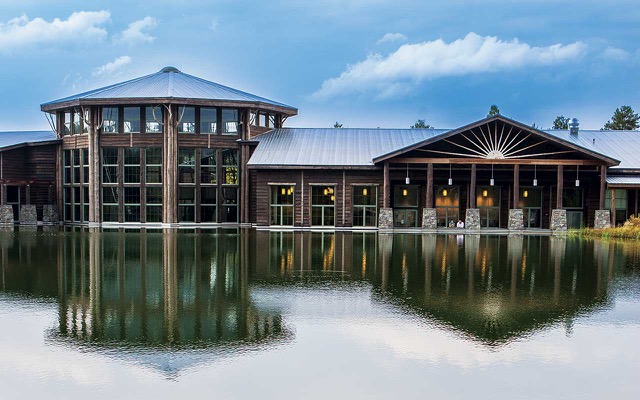
Today, Tupper Lake’s natural history museum, which turns 20 this year, is a flourishing center of learning, intellectual thought and plain old fun. It is the encyclopedia of the Adirondacks, a guide as essential to understanding the Adirondack backcountry as a map. By 2017, it had attracted its millionth guest, a youngster from South Carolina. Each summer more than 100,000 people are awed by The Wild Center’s soaring atrium; it has drawn international notice and been praised by President Obama. Quite a résumé for an establishment that’s not much older than its student-scientists.
But back to the bear.
In the early 1990s a forest ranger interrupted a meeting at the Department of Environmental Conservation (DEC) headquarters in Ray Brook with a message for veteran naturalist Betsy Lowe. “Word has it,” the ranger said, “your camp’s burning down.” The animal had broken into Lowe’s cabin on Long Lake and knocked over a refrigerator and severed a propane line, which was then ignited by a pilot light on the stove. The unapologetic arsonist later broke into the camp next door and ate all the frozen chicken.
It was a dry summer, and Lowe, a multitalented planner and program developer for the state, reflected that if the fire had escaped into the forest, things could have been much worse. Soon they were. A derecho in 1995 knocked down great swaths of forest in the central Adi-rondacks, and three years after that, an ice storm crippled the North Country for weeks.
Tragic as they were, Lowe noticed that these “stories of nature” were immensely popular. “I was doing some basic exhibits about ice storms and blowdown and different things, and people loved them,” she said.
Of course, not all Adirondack stories end with smoldering cabins and downed power lines. A million miracles, from the microbial to the mountainous were playing out every day with precious little commentary or explanation. Visitors had scant understanding of the machinations of a bog, the surprising mycelial circus act playing out in the forest duff or the amount of carbon sequestered in a downed log.
But while there was no shortage of stories, there was a shortage of space in which to tell them. As science centers in the 1990s were growing in number, Lowe believed such an operation would be a perfect fit for the Adirondack Park. She and her assembled board settled on a 54,000-square-foot museum. It seemed ambitious at the time, but it has grown to the point that there are now plans for an expansion.
It was a triumph of science, but it was also a triumph of community, which was in need of healing.
In the early ’90s, New York State land acquisition was worrying private property owners, who feared that what the state couldn’t buy, it would take through eminent domain. “Everybody was exhausted and sad and angry with each other,” said Brad Edmondson, author of A Wild Idea: How the Environmental Movement Tamed the Adirondacks.
Things began to change with the election of Governor George Pataki, who took office in 1995, and whose first Adirondack test would be that tree-splintering derecho with 100-mile-an-hour winds that shattered the central forests. Pataki, Edmondson said, deftly negotiated the disaster, making local communities happy with an effective storm response, while making environmentalists happy by refusing to allow downed trees to be salvaged on Forest Preserve lands.
Preservationists were also pleased that Pataki was continuing to add land to the state Forest Preserve, but local officials and residents demanded economic development opportunities in re-turn. And in the latter part of the 20th century, economic development in the North Country meant prisons.
Those prisons were being handed out like candy by the late senator Ron Stafford, a lawyer from Plattsburgh and son of a Dannemora prison guard. (He’d also been instrumental in bringing the 1980 Olympics to Lake Placid at a time when the regional unemployment rate was flirting with 20 percent.)
Through some savvy political wheedling in Albany, Stafford had gained near authoritarian powers over the Adi-rondacks, and so long as the state kept feeding the North Country prisons, he was willing to look the other way when the state acquired new lands.
Job-starved communities lined up at Stafford’s door begging for prisons, so it seemed a dream come true in 1997 when Tupper Lake was slated for a $130 million, 750-bed maximum security prison that would have employed 350 people. But adding to Adirondack acrimony, a fierce resistance broke out among environmentalists and seasonal residents who thought Tupper had more to offer than to become known as a “prison community.”
The state ultimately agreed. The DEC found reason to believe the prison would be a threat to the groundwater, and the project was moved to Malone. Local officials glumly spoke of the news in apocalyptic terms, but Stafford himself was curiously restrained. In a brief statement he said he was “disappointed” that the effort had failed, but hinted that something else might be in the works.
It was. By then, Lowe’s idea was taking shape. She felt Long Lake wasn’t big enough to support such a large museum, while Lake Placid already had an Olympic identity. Tupper Lake was a Goldilocksian choice that caught fire in a community that was feeling neglected.
Taking a grassroots approach, Lowe began faxing out funding requests and notices of public meetings. She enlisted influential Adirondack partisans, including actor Sigourney Weaver, environmental advocate Frances Beinecke and, maybe most importantly, conservationist Clarence Petty, whom one wag described as the “St. Peter of the Adirondacks.”
The state and federal governments were generous with their funding, but Lowe believed the key to success was effectively making The Wild Center a neighborhood project. She left the DEC and worked for the museum full time, direct-mailing a funding appeal to every property owner in the Tupper Lake region. The initiative yielded a half-million dollars to pay for a master plan, but just as importantly it gave The Wild Center a sizable, invested constituency. “Every museum has its own way, but we were very broad-based,” Lowe said. “And I think that was really good for its long-term sustainability to have all that support at the beginning.”
The more people heard, the more they wanted to know. “I kept getting calls to give a talk to a board or a community about what this crazy idea was, so that really helped with our outreach and fundraising,” she said. By the time all was said and done, two-thirds of the $30 million price tag had come from more than 5,000 private donors.
It was an astonishing unification of diverse interests, and Edmondson said there was no one else in that time and place who could have pulled it off. At the DEC it had been Lowe who worked in the trenches as state and private interests contentiously hammered out agreements over land use.
“Betsy was right in that room,” Edmondson said. “She was facilitating the discussions between the property-rights people, the local officials and the environmentalists who worked out a compromise. She had standing and credence and trust on all sides—not very many people back then had that.”
When the doors opened in 2006, Pataki and then-senator Hillary Clinton were there to help celebrate, as was an overflow crowd that even the big, new building couldn’t hold. The center completed, Lowe stepped back and turned the directorship over to Stephanie Ratcliffe, a seasoned exhibits expert from Maryland.
While it’s the museum’s frisky otters that often steal the show, Ratcliffe and the board have steered The Wild Center in directions that are both playful and impactful. Visitors can stroll along an elevated walk in the tree canopy and roll wooden balls down a whimsical obstacle course (children occasionally having to tug at their parents’ sleeves for a chance to play the Raquette River Roll).
But where other centers have had to soft-peddle serious but sensitive issues such as climate change for political reasons, The Wild Center has addressed them head-on and won international respect in the process.
Jen Kretser, their director of climate initiatives, recounted to the educationally focused nonprofit Omega Institute that she’d invited some high school students to one of the center’s climate-change conferences. “One of the students e-mailed and said, ‘Hey, that conference was awesome, but it was all old people. Can we do a youth summit?’” The Youth Climate Summit, inspired by Lake Placid student Zachary Berger, is now in its 15th year and has expanded to 27 states and 10 countries.
Yet it is the Adirondack backyard where The Wild Center continues to have its greatest impact. “We’re the perfect visitor center to understand where you are, and we tell this story really well,” Ratcliffe said. “I think it makes people appreciate the Adirondacks and hopefully want to protect them for the long term, along with our small communities, which are valuable too. We want you to see the Adirondacks with new eyes, adding depth to what you’re seeing and understanding the science beneath it.”
Wild Celebration
Singer/songwriter Martin Sexton, who per-formed at The Wild Center’s opening in 2006, will headline the natural history museum’s 20th birthday party on July 11. The celebration, which runs from 10 a.m. to 7 p.m., offers presentations, paddling outings, animal encounters and other experiences for all ages. Find a schedule and reserve your tickets at www.wildcenter.org.