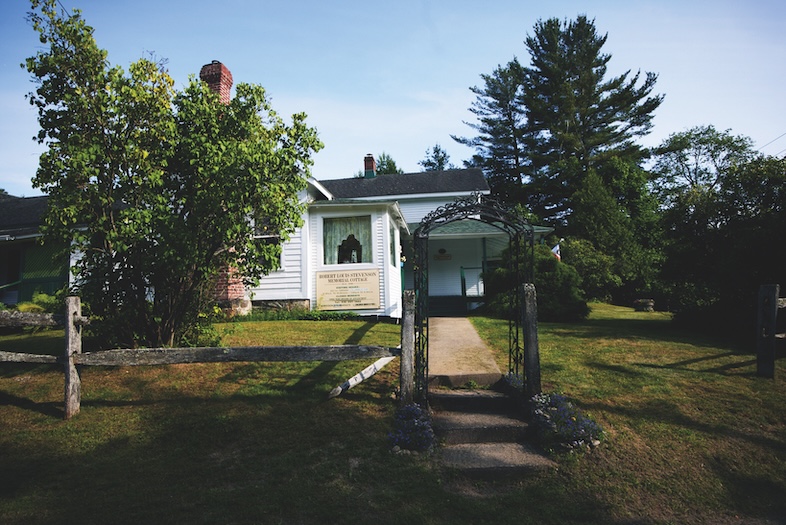
Photograph by Yvonne Albinowski
Eighty-five years before the Beatles, the sickly Scottish author Robert Louis Stevenson arrived in New York City to a pulsating throng of adoring fans and, like John Lennon, pondered whether he might be more popular than Jesus.
This was far better treatment than he had received across the pond, where he’d been fleeced by publishers, and highbrow Europeans had wrinkled their noses at his newly released tale of Jekyll and Hyde. Stevenson was bound for the Rocky Mountains in hopes of reclaiming his health, but his fragile constitution was so rattled by the cacophonous city, it was feared he wouldn’t make it that far. Instead, he was assigned to the care of Dr. Edward Livingston Trudeau, of Saranac Lake, who was said to be working miracles on tuberculosis, then the world’s leading cause of death.
In late 1887, Stevenson and his entourage stepped off the train in the heart of the Adirondacks and found a modest cottage for rent, owned by a family named Baker on a quiet country lane free from the crowds.
Or so he thought. Fame had beaten Stevenson to this remote outpost, and fans streamed to his door, so many that he could frequently be found, not on the cure porch, but hiding from his adoring throngs in a little room off the kitchen.
Today the cottage, now a museum, remains, but the crowds are gone. Stevenson of course is long gone too, except he’s there in spirit, his memory kept alive by 74-year-old Mike Delahant, a salty live-in curator with a shock of white hair and a passing resemblance to actor Lloyd Bridges.
The Delahant and Stevenson trajectories have entwined since 1953, when Mike’s grandfather took control of the cottage from an increasingly disinterested town.
“I’m confident we wouldn’t have the cottage today if not for the Delahants,” said Trenton B. Olsen, an associate professor of English at Brigham Young University–Idaho and a leading Stevenson scholar. Olsen first set foot in the cottage in 2023 and was amazed at the breadth and rarity of the collection, which includes, to pick one, a bas relief of Stevenson created by Gutzon Borglum, sculptor of Mount Rushmore.
These relics jam the rooms where Stevenson once paced in search of plots, and where Delahant once played as his grandfather and then father did what they could on a shoestring budget to keep the place alive.
“I felt like I knew him when I looked up at his bust,” Delahant said. “He just seemed like a cousin, somebody in the family that brought us all together every summer.”
But as a teen, Delahant was over it. Preserving all this “crap” was someone else’s calling, not his. Disappointing his Yale-educated father, Delahant wanted to get away from the cottage, so he went out West, earning money cleaning hotel carpets.
Olsen sees echoes of Stevenson in Delahant, both sons of engineers who struggled to meet expectations. In Stevenson’s case, there would be no one to continue the business of designing lighthouses. In Delahant’s, no one would be left to, say, tell the story of how a signed photo of Stevenson lounging in the cottage bedroom had been given to magazine magnate Sam McClure, who in turn gave it to the great novelist Henry James.
Somehow that photograph found its way back to the Stevenson Cottage. And somehow Delahant did too.
For both Robert Louis Stevenson and Saranac Lake, the winter of 1887 to ’88 had been transformative. Stevenson got better and went on a writing tear that produced some of his most critically acclaimed work. And his visit brought to Saranac Lake publicity that money couldn’t buy. If Trudeau could cure the notoriously poorly Stevenson, surely he could raise the dead, or at least make them twitch.
Stevenson probably did not have tuberculosis, but his improved health was endorsement enough to inspire a parade of wealthy and influential consumptives who came to the Adirondacks and often maintained a lifelong connection. In fewer than two years Saranac Lake’s population soared from a couple hundred to 768. By 1930 it would reach 8,000.
By the time of Delahant’s return in 1980, antibiotics had driven a stake in both tuberculosis and the Saranac Lake medi-tourism trade. Its population had receded to less than 6,000, and jobs were scarce, so a pending offer of free housing was not one to be taken lightly.
The free house, of course, was the Stevenson Cottage, which was in need of a watchman to see to it that no one grabbed any relics and put them on whatever the 1980 equivalent of eBay happened to be.
To Olsen, it’s the best Stevenson collection in the world, and it’s certainly the oldest. For 30 years, when anyone anywhere had a piece of Stevenson memorabilia with no particular destination for it, they sent it to Saranac Lake.
But the Stevenson Society never had money to organize it all, or to keep the cottage in half-decent repair. When Delahant returned in 1980, the boiler didn’t work, nor did the bathroom plumbing, and plaster was falling from the walls.
More for his own comfort than the collection’s, Delahant picked up some tools and got to work. And he picked up something else: a copy of The Strange Case of Dr. Jekyll and Mr. Hyde.
Gradually, all that “crap” from his youth began to speak to him. A few decades of research later, the former carpet cleaner is considered to be among the world’s leading Stevenson scholars. With his wife, Karla, he continued to make improvements and repairs, as he learned the stories behind each relic.
“I learned to see artifacts, not so much on their own, but in context,” Delahant said. “The inscribed Treasure Island, the only one on public view in the world, is right in this room. How did that get here? Well, because the Bakers outlived all five of their kids. Ralph Baker was 15 when Stevenson personally gave him the book for Christmas, and he was 22 when he died of typhus. So, naturally, the mother ain’t gonna throw that book out.”
With no living Baker heirs, there was no one to leave the cottage to, no one to remodel those sacred rooms, sell off the furniture or sand down the mantelpiece burns from Stevenson’s cigarettes. A family’s loss was history’s gain.
In Olsen’s view, both the cottage and Delahant are national treasures, something no Adirondack visitor with any literary bent should miss. (Delahant, in turn, said his dad would be thrilled that an actual English professor is now head of the Stevenson Society.)
So with quiet urgency, Olsen and a reinvigorated board have set out on a quest to pump new life into the cottage. A capital campaign has raised $90,000, about a third of what is needed for a new roof and repairs to the foundation and such. The collection is being cataloged with plans for a more structured display, interpretation and protection.
Delahant has now spent 45 years as curator, a year longer than Stevenson walked the Earth. He’s poured all his time and money into the cottage, a tribute to Stevenson, but also as a way of making amends to his father for youthful transgressions.
“My father, without saying, I knew he was hoping that I would take to this place,” he said. “So I figured, well, if there’s one thing I have an opportunity to do, I can make sure this place doesn’t disappear. And if he could come back now and see the [stuff] that’s been done, he’d be pretty happy.”
The Robert Louis Stevenson Cottage Museum (518-891-1462, rlscottagemuseum.org) is at 44 Stevenson Lane.