More Articles From

Events

Powerless

A January thaw is nothing out of the ordinary here. The very term bespeaks of a well-earned punctuality: a couple months of hard, cold weather, then January shows up, and for a few days the mercury sails to equatorial heights. It’s as if winter has exhaled and is sucking in another huge breath to last until April. No big deal.

And so it was, on January 2, when temperatures in many parts of the North Country completed a near­ly sixty-degree upswing in a little over twenty-four hours. With the warmth came rain and fog. And more rain. In Long Lake, town supervisor Thomas Bissell reported that the lake rose four feet in twenty-four hours, something he had never heard of happening before. In Essex County, man-made Minerva Lake was in danger of breaching its dam. Instruments in Newcomb would eventually catch more than four inches of liquid precipitation.

But to the north, the rain was starting to freeze on contact. According to meteorologist Cindy Fitzgibbon, of News Channel 5, in Plattsburgh, what made this winter rain unique was a massive Arctic high-pressure system to our north and east that funneled cold air into the region. At the same time, the jet stream was positioned further north than usual—on a southwest-to-northeast tack-which fun­neled moisture-laden warm air from the Gulf of Mexico along a stationary front.
Reveries of Camp Deerlands

As you drive north on Route 30, between Long and Tupper lakes, you enter a tract of vast private woodlands extending all the way to the Adirondack Park Blue Line on the west. With the road stretching through dark boreal forests on either side, it looks like you could be driving through northern Ontario or Quebec. Here and there a tannin-stained creek or glacial pond bordered by cranberry and Labrador Tea. It is the land of the last moose and panther shot in New York State, of the old canoe routes made famous by George Washington Sears—Nessmuk—and now it is largely the land of Whitney Park, 51,000 acres of managed forest and 38 ponds and lakes. After the leaves fall, the signs of well-conducted timber harvesting are visible behind a wall of protected trees.

At Whitney Park’s southern extremity, 12 miles from the village of Long Lake, is Camp Deerlands, originally built and established by a cousin of William West Durant, and for 90 years the summer hideaway of one of the United States’ most revered and influential patrician dynasties. You might have seen Cor­nelius Vanderbilt (Sonny) Whitney and his wife Marylou on Life Styles of the Rich and Famous, or in the Clubhouse at the Saratoga Racetrack. Last summer Marylou was profiled for her reputation as a hostess in Vanity Fair and she was highly visible from Albany to Long Lake in her role as a sort of minister without portfolio for charities, benefits, balles des nuits, and as symbol and mascot of everything that summer in Saratoga Springs stands for—especially everything rich.

A Glass House of Our Own

Among the great camps, peaked roofs and proud lodges of the Adirondack Park, an early modernist work by one of America’s most influential architects remains overlooked and underappreciated by all but a few historians, neighbors and design buffs. The minimalist house has flat roofs, high ceilings, expansive open spaces and walls of windows. These are common characteristics among contemporary homes, but this one stands out for the area and era in which it was built. Philip Johnson, the renowned architect, designed the structure erected on Willsboro Point at the same time he completed his own world-famous residence, the Glass House, in New Canaan, Connecticut.

It was 1949. Johnson’s career as a practicing architect was barely underway. He was 42, had completed only three other homes, and was already hard at work on the Glass House when a well-heeled young couple commissioned the Willsboro residence. George Eustis Paine Jr. and his bride, Joan Widener Leidy, both in their 20s, belonged to prominent, art-loving families from New York and Newport society

One Simple Life

Oct. 21, 1933. Twenty one years old. Received for my birthday one pair leather gloves, one dollar, one cake and five bananas, also one pair of shoe insoles. Helped to dig Hilda’s grave. I had my birthday dinner at grandfathers. I have this date nine dollars and seventy-four cents. Beginning reading the Bible through, also to write it through. Saw the airplane … both ways.

So begin the chronicles of Frank Lillibridge, the last master of Maple Grove Farm in Thurman. The third gen­eration of his family to reside there, this unassuming man documented events from 1933 to 1978 in diaries that serve as a time capsule of a simple, quiet life on a southern Adirondack farm.

Light the Tower

Light the Tower

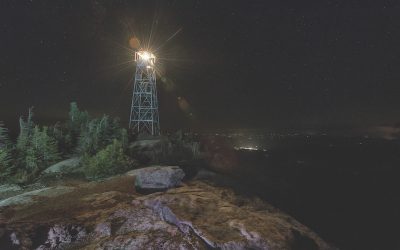
honor fire towers and observers by lighting the towers’ cabs at 9 p.m. on September 1. (St. Regis and Stillwater fire towers also participated.) 

I left the Route 9N trailhead about 5:30 p.m., planning enough time for hiking the 3.4-mile trail to make it to Hurricane’s summit for magic-hour light over the mountains. About halfway up, I met Mary Jean Bland, the official tower lighter.

When the News Was New

n’t move; it doesn’t have to. What changes is the world around it: Hemlines, buildings, entire civilizations rise and fall with the seeming speed of light while the time machine itself sits there like a bump on a pickle, and the Time Traveler gets to watch war and apocalypse pound his beloved garden into rubble.

Now, I’m not saying reading microfilms of old Adiron­dack small-town newspapers turns me into Rod Taylor on a joyride through history. First, when he made time, he booked. For my part, no matter how cleverly I work the knobs, I can’t do better than reverse, and then only lurch as far back as the last quarter of the nineteenth century. Second, the Time Traveler rode in high style, his cock­pit a cross between a chariot and a lavishly upholstered English club chair. Me, I use a straight-back pull-up chair in the drab cubby of a library, and the only music is a thin fluorescent buzz.

Still, I figure I’m entitled to a pinch of kinship. We’re both trailblazers, a couple of armchair explorers. He finds a lost world and a cute, if addlepated, girl, to boot. My idea of gainful plunder is more modest: a few good head­lines—”Catholic Church Opposes Tango” or “Another Italian Ever-Ready Knife Fight”—and the delicacy of some antique obituary that describes a hapless home handyman as “an upright Christian, a good citizen and an ardent patriot, but with limited information with regard to circular saws.” Even material that falls under the rubric of There’s Nothing New Under the Sun is gold dust of a kind, like the case of teacher harassment circa 1878, in which a schoolmaster, fed up with boys playing catch in class, confiscates his students’ baseballs, includ­ing one that had been pitched into the wood stove and which, on hasty retrieval, turned out to be packed with enough gunpowder to blow the school to smithereens.

March Past

March Past

Decades after I last played John Philip Sousa’s “Stars and Stripes Forever” on a trumpet, with its thrilling strains still echoing in my head, I was hungry for a good Sousa story. I found one in Alfred Donaldson’s two-volume A History of the Adirondacks, originally published by the Century Company in New York City in 1921.

In two sentences, Donaldson delivers a tale widely repeated by historians, guides and yarn-spinners ever since. Of the maiden voyage of the steamboat Water Lily, based at Martin’s Hotel on Lower Saranac Lake, he wrote, “The first official trip of the Water Lily was made on July 4, 1878. She had on board Sousa’s Band—which was playing at ‘Martin’s’ that summer—and people came from miles around ….”

Icing the cake, Donaldson adds, “On pleasant evenings … [the Water Lily] was frequently chartered, with the band, for excursions on the lake.”

Rise and Fall of a Company Town

Standing on Main Street of Au Sable Forks today it is almost impossible to imagine the town as it looked and was lived in forty years ago, near the end of the reign of the Rogers family. The local equivalent of royalty, the Rogerses came to Au Sable Forks in the 1830s, built not one but two major industries there (the first in iron, the second in paper), sold out in the 1950s and finally left in the 1970s, when the last of their mills closed for good. In between, they made a great many things happen in the town, took credit for even more and were blamed for everything else.

Growing up there, as I did, during the slow death of the J. & J. Rogers Company—after the family had lost control but before the final locking of the doors—one could feel a sense of loss everywhere but could hardly make out what exactly was being lost. Jobs, of course, but more than that. Every once in a while you’d hear a sweet and nostalgic story about a long-ago Rogers social event, or a flash of anger at a costly and, in retrospect, pivotal mis­take at the mill, ordered by a Rogers son who “didn’t know paper”—the ultimate insult.

Ben & Helen

Ben & Helen

The whitewashed walls in Ben Gocker’s Tupper Lake studio are hung with large wooden boards, each almost entirely covered in small sticks and scrap wood pieces. The sticks, painted with bright pastels and bold matte primaries, have been assembled into intricate and dreamy word-search-game mosaics. There are subtly formed rivers and movements of color dancing behind jumbled letters, somehow calming despite the immediate chaos of the puzzle itself. The words “Flamingo” and “Dianthus” pop from a work in progress.  The piece borrows the terms from a puzzle titled “Think Pink” that Gocker found in a children’s book.

Outside, falling snow blankets the residential street of modest homes tucked just behind the village center. This is the first time in Gocker’s life he has had a studio of his own. It is allowing him the space and flexibility to experiment with scale, to make bigger and more complex work.

The Long View

The Long View

Growing up among the woods and waters of Long Lake, the Hosley brothers’ heads always swirled with notions of worldly adventures. With locally famous parents—Lorrie and John Hosley, owners of Hoss’s Country Corner—who were unafraid of a bit of rolled-sleeves derring-do, the boys were steeped in a kind of fearlessness. Now men who have indeed been around the world, Matt and Nate Hosley have decided to dial it down a notch, reconnect with their roots and return home to raise families, care for aging parents and pump new life into the century-old Long View Lodge just outside of Long Lake.

On Sale Now

June 2026

Southern Adirondack waterfall hikes, a funky renaissance in Onchiota, bootlegging adventures, a mysterious island and more.

Adirondack Life Magazine

Subscribe Today!

Latest Articles

Follow Us

Adirondack Life Store

for calendars, apparel, maps and more!