Moose. They are so much a part of the iconography of the Adirondacks that you would think the state’s largest land mammals were ubiquitous. There is the Moose Tooth Grill in Lake George, the Big Moose Inn on Big Moose Lake and, of course, countless coffee mugs and magnets etched with their image.
Nature and Environment
Ice Out
Just as parents measure their children’s height over the years, marking it with a notch and a date in a doorway, Pete McConville measures the ice on Upper St. Regis Lake. He notes the dates of ice-in and ice-out on the cabinet door of his woodshop, a ritual he’s performed since 1990 as the caretaker at Camp Woodmere.
McConville continued the record-keeping from his predecessor, but it’s become more than just a weather log. He’s also noted when the loons came back from their migration, when his father died, or when the Twin Towers fell. “It’s just like a story pole for me,” he said.
But those dates—marking when the lake’s middle is frozen and when McConville can take a boat from the landing to the camp—also represent decades of data about a piece of the Adirondack Park and how it is impacted by climate change.
Bark Eaters
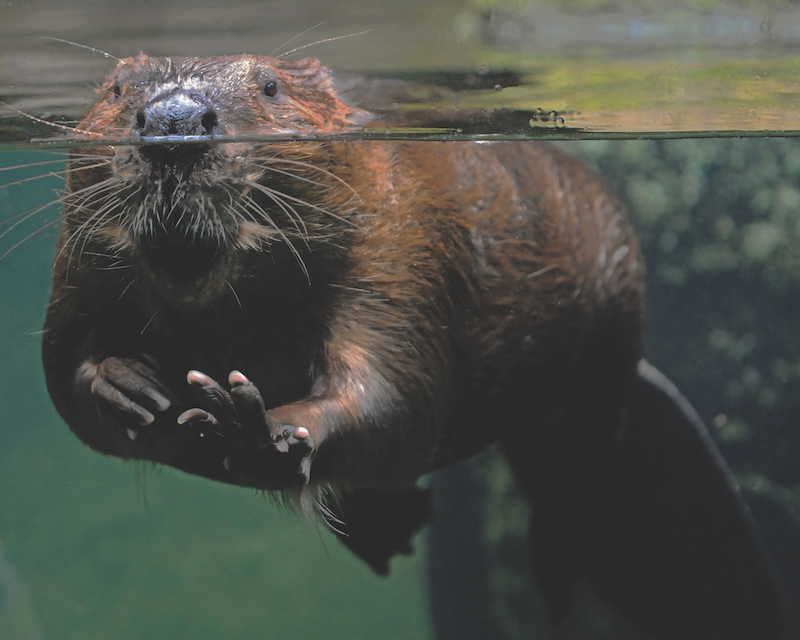
On April 27, 1905, a four-man “Army of Liberation” departed from Old Forge for the Fourth Lake of the Fulton Chain, two zinc-lined crates stowed aboard their rowboats. After a day of rowing, the men ditched their vessels and hiked 12 miles down a snowbound trail—“over hills, through swamps, and across rivers,” wrote Harry Radford, the quartet’s leader. The party lugged the ungainly boxes in shifts, switching handlers every 10 minutes to ease the burden, and spent the night at a cabin owned by a hermit named Frank Gray. The next morning, the group toted their crates to a nearby stream to release their cargo: a pair of beavers. A year later, Gray spotted a lodge of mud and sticks in the same spot. The beavers had settled down.
Four centuries ago, a beaver colony in the Adirondacks wouldn’t have warranted a second thought. Once, wrote Radford, “every river, brook, and rill… [was] thickly peopled with these industrious and prolific animals.” But the fur trade—so influential that Albany was once known as Beverwyck—spelled doom for the aquatic hordes. By the 1670s, 80,000 pelts were flowing down the Hudson River annually, bound for Europe for felting into fashionable hats. When the state finally banned trapping in 1895, fewer than 10 beavers remained in New York.
The beaver’s story, however, wasn’t over yet. In 1904, the state devoted $500 to beaver reintroduction and bought seven live animals from Canada’s display at the Louisiana Purchase centennial in St. Louis. The acquisition, like the Louisiana Purchase itself, proved a spectacular bargain: the imports, along with other relocatees, flourished and bred. Scarcely a decade later, the Adirondacks hosted a stunning 15,000 beavers. These days up to 70,000 paddle-tailed builders swim the region, nearly as many as greeted Samuel de Champlain. And we’re just beginning to figure out how profoundly their return has restructured our forests.
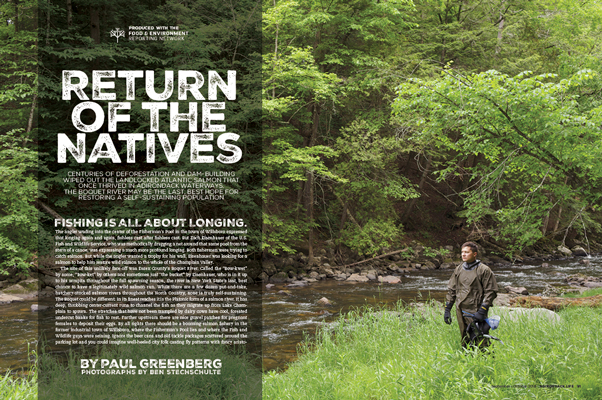
Return of the Natives
Fishing is all about longing. The angler wading into the center of the Fisherman’s Pool in the town of Willsboro expressed that longing again and again, fishless cast after fishless cast. But Zach Eisenhauer of the U.S. Fish and Wildlife Service, who was methodically dragging a net around that same pool from the stern of a canoe, was expressing a much more profound longing. Both fishermen were trying to catch salmon. But while the angler wanted a trophy for his wall, Eisenhauer was looking for a salmon to help him restore wild salmon to the whole of the Champlain Valley.
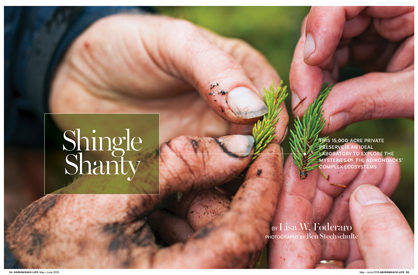
Shingle Shanty
For someone coming from the suburbs of New York City, the first thing that jumps out at Shingle Shanty Preserve is the silence. It washes over you, envelops you—the utter lack of thrumming, clatter, barking or bits of conversation. Just simple, sublime quiet.
Then there is the seemingly endless expanse of untouched nature: 15,000 acres of privately owned conservation lands at the top of three watersheds, with hundreds of acres of boreal wetlands, thousands of acres of northern hardwood forests and nine lakes and ponds, much of it surrounded by state-classified wilderness and primitive areas. It is remote even by Adirondack standards—an island within an island. As such, it is an ideal laboratory to plumb the mysteries of an ecosystem whose vast complex of peatland bogs more closely resembles landscapes hundreds of miles to the north.
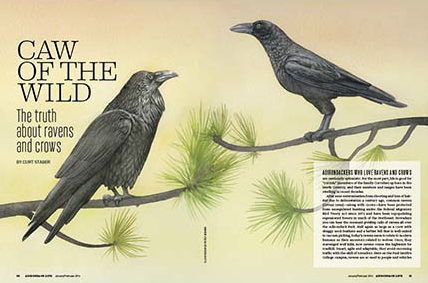
Caw of the Wild
Adirondackers who love ravens and crows are cautiously optimistic. For the most part, life is good for “corvids” (members of the family Corvidae) up here in the North Country, and their numbers and ranges have been swelling in recent decades.
Staying Alive
Long before the snow flies, all but the hardiest birds have left, the bears are deep in slumber, insects have transformed to protective pupae and toads have buried themselves deep in the mud. Only the stalwart plants remain in a winter world inhospitable to life itself.
Why They Stay: Soaked, Shell-shocked and Still Here
Jodie Frederick’s birthday cake had been baked and decorated, ready on a platter in her new refrigerator. Frederick’s family had planned a party that also celebrated the success of her recent hip replacement.
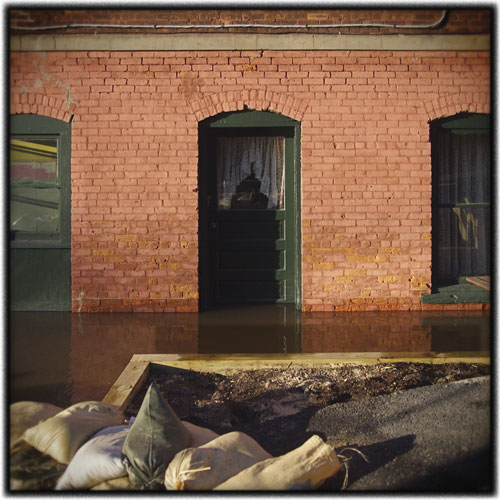
But there wouldn’t be any kind of celebration. That day—August 28, 2011—Tropical Storm Irene dumped seven inches of rain on the northern Adirondacks, saturating the High Peaks and pummeling the river valley settlements below. With floodwaters gauged at 18.5 feet, about seven feet above the riverbank, it was one of the worst natural disasters to hit the region since the freshet of 1856 swept away mills, homes, livestock and human lives.
VIDEO: Rattlesnake Encounter in Lake George
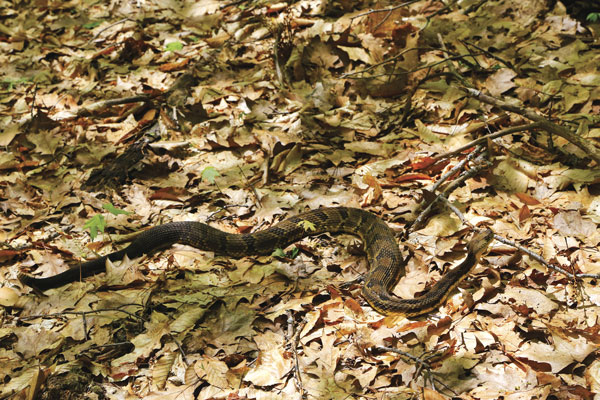
Photographer Johnathan Esper was hiking near Lake George when he nearly stepped on what he thought was a tree root. When it started rattling, he realized it was actually an eastern timber rattlesnake, which is a threatened species in New York.
Rattled
Eastern timber rattlesnake photograph by Johnathan Esper Adirondack snake encounters Photographer Johnathan Esper has traveled the world. In recent years he’s stayed months at a time in Iceland, where he teaches visitors how and where to shoot the stunning...
Mountain Lions in Our Midst?
In Adirondack Life’s June 2016 issue, “Vanishing Acts” chronicles the disappearance of charismatic megafauna—like elk, puma, moose and wolf—from our woods. Wolves and mountain lions were systematically removed thanks to generous bounties paid by counties, while other animals were hunted for meat and fur. Despite extirpation, cougars do occasionally appear here, igniting old controversies and adding mystery to the wilds.
WATCH: Crow Enjoying “Blackbird” Performance
x
Latest Articles
Follow Us
Advertise in our November December 2026 Issue
Learn about advertising opportunities in Adirondack Life Magazine.