Photograph by Phil Brown
The Massawepie Mire, located near the tiny hamlet of Gale, which lies just east of the tiny hamlet of Childwold, deserves a place on every Adirondack bucket list. The wetland complex includes a 740-acre peatland, the largest in New York State—a remarkable habitat easily accessible by an old railbed. The bog harbors several avian species sought after by birders, including the endangered spruce grouse.
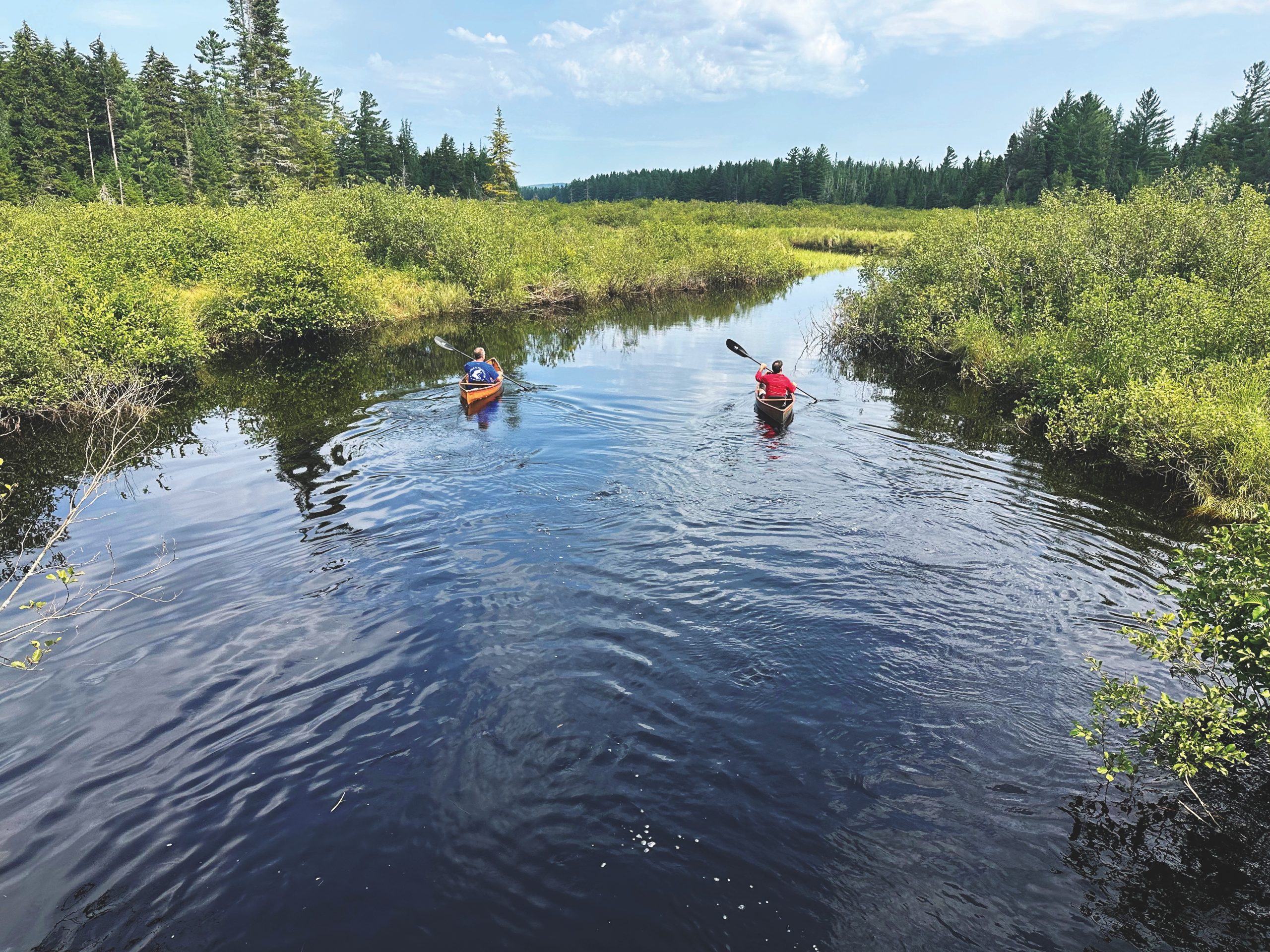
I had canoed through the mire and biked through it, but not on the same day. So last summer I enlisted two friends—Tim, a fellow retiree, and Clem, a youngster at 56—to join me on a two-sport adventure that would immerse us in the wild for nearly six hours.
We put in at the South Branch of the Grass River on conservation easement lands south of the Massawepie Boy Scout Camp, canoed and carried to an inconspicuous takeout on Route 3, and then pedaled back to our vehicles, following the bed of the former Grasse River Railroad. The canoe leg was 10 miles; the bike leg, nine miles.
Careful readers will have noted the variant spelling Grasse. This is an old debate. Some people insist that’s the river’s real name, derived either from the French La Grasse or in honor of Comte de Grasse, a French admiral who fought in the American Revolution. Although the U.S. Board on Geographic Names settled on Grass way back in 1905, road signs, maps and official documents remain inconsistent.
Whether you prefer Grass or La Grasse, you will see plenty of the stuff on this serpentine stream, along with tag alders, cardinal flowers, Joe-pye weed, spotted touch-me-not, and tall white pines. As for wildlife, we flushed many ducks, a great blue heron, and a beaver. Clem watched the last critter swim from its lodge and slip into the alders, slapping its tail in annoyance.
The water was high, thanks to the summer’s heavy rains. I hoped we would float over all the beaver dams in our solo canoes, but this proved too optimistic. We came to the first one a half-mile from the put-in. Tim and I disembarked to clear a passage. Then my phone rang, and for the first time in my life I carried on a conversation with a state official while balancing on a beaver dam. My business concluded, we all paddled through a breach in the leaky edifice and continued on our merry, meandering way.
Clem had canoed only once before in the Adirondacks, when he and Tim paddled to an island on Lower Saranac Lake. Navigating a wild stream, fending off alders and scooching over dams was a fresh experience. “Spectacular, just like being at Disneyland,” he remarked a few miles in. The comparison struck me as off, but the enthusiasm was spot on.
Despite the river’s remoteness, we saw occasional reminders of civilization, such as a footbridge and the camps of the Grass River Outing Club. After three miles, we passed beneath a bridge on the old railbed, which we would later cross on our bike ride. In another mile, we came to Burnt Rock, a 25-foot cliff shooting straight out of the water, a geological curiosity in this swampy flatland. We examined fractures in the rock, imagining how it might be climbed. If the cliff were not on private land (with a posted sign nearby), we might have given it a try.
A mile below Burnt Rock, we went under a logging-road bridge. The alders began to thin out, eventually yielding to marsh grass, and as we drew near to the Grass River Flow, the grasses in turn gave way to emergent reeds. Crossing this small lake we scared a raft of ducks into flight, thereby transforming the raft into a flock. Our vista no longer constricted by alders, we observed a number of low peaks on the horizon. On the north shore was a poor fen, a wetland similar to a bog but richer in flora (so why is it poor?).
At the foot of the flow, the Grass spills over the rocky ruins of an old dam. We landed to the left, scrambled up a steep bank, crossed a logging road, and lugged and dragged our canoes down the opposite bank to calm water. The carry was a thrash, but mercifully short. The state Department of Environmental Conservation (DEC) could do paddlers a solid by creating a carry trail here.
The Grass below the dam differed in character from the river we had become accustomed to: it was wider, less twisty, with forested banks and fewer alders. We had less than a mile to the takeout, but twice we encountered blowdown jams blocking our passage. The first we carried around; the second we managed to squeeze past, thanks to our refined scooching skills.
At 9.5 miles, we spotted a carry sign and exited on the right bank (it’s possible to paddle another half-mile downriver before reaching rocky rapids). By now, Clem was growing tired of Disneyland and wasn’t thrilled when I mentioned that after a short portage we still had to paddle across Balsam Pond. “I thought we were done,” he said. He brightened, however, upon seeing this little jewel glittering in the afternoon sun, adorned with yellow pond lilies. “I could do this backwards,” he remarked. It took only a minute or two to paddle to the opposite shore.
At the end of another short carry through a fern-rich forest, we put down our boats and picked up our bikes. We cycled west on Route 3 (wide, good shoulder) for 1.5 miles to a logging road on easement lands, marked by a DEC sign, on the south side of the highway. Though gated, the road is open to hikers and cyclists. We followed it for 1.6 miles, paralleling the Grass, until reaching a junction with a grassy road. Here we veered left.
After four miles on the bikes, we came to a gate at the boundary between easement lands and the Grass River Outing Club. Because the state owns the former railbed, cyclists and hikers have the right to continue beyond the gate if they stay within the corridor. Pedaling along the grass-and-dirt thoroughfare, we occasionally felt a rhythmic bumping caused by buried railroad ties.
The Emporium Forestry Company built the Grasse River Railroad to haul logs, but starting in 1915, it also took passengers the 16 miles from Childwold to Cranberry Lake. The train stopped in Conifer, allowing travelers to dine at the Conifer Inn, where a breakfast of cereal, pancakes, bacon and eggs cost 50 cents or a dollar, depending on whether you were a local or a tourist. Most of the tracks were removed in the 1940s, but the train continued to run two miles between Childwold and Conifer until the late 1950s, usually at a loss. A 1957 corporate annual report poked fun at “overzealous stockholders who stubbornly continue to associate railroading with profit.”
Approaching the Massawepie Mire, we passed a sign on a tree alerting visitors to the presence of spruce grouse, which in the Adirondacks survive only in scattered patches of boreal habitat. In recent years, the DEC has tried to check the population decline by introducing birds captured in Canada and Maine. As of last year, the department had released 200 adults and 565 chicks in the Adirondacks, many of them in the mire, where they are now breeding.
Soon we emerged from the woods. At 7.3 miles, we pedaled over the Grass on the same bridge we had earlier paddled under and began traversing the peatland. Wild grasses, black spruce and tamaracks lined the way, creating a sea of green set against the blue sky. Our chances of seeing a grouse, always slim, were diminished by the condition of the railbed, many of its ties now visible. The birds sometimes bathe in the corridor’s dust to get rid of lice and parasites, but the summer rains had dampened the soil and created miniature lakes.
On earlier visits, I had encountered small puddles that I was able to bike around. On this day, we had no choice but to plow through the water, which in places was deep enough to submerge our pedals. It was daunting at first, but we came to enjoy it. Tim later described our puddle pedaling as the highlight of the ride.
Eventually, we sighted dry land. At 8.6 miles, after crossing a mowed clearing, we came to a vehicle barrier. Shortly, we were back at the cars. Our adventure over, we retrieved our canoes and drove back to Saranac Lake for cocktails and conversation—a little sore and weary but with nothing to grouse about.
IF YOU GO
This Massawepie Mire combo is a paddling trip with a bike shuttle through wild lands. You leave your bike at the takeout, drive to the put-in, do the paddle, bike back to your car, and then drive to the takeout again to retrieve your canoe or kayak.