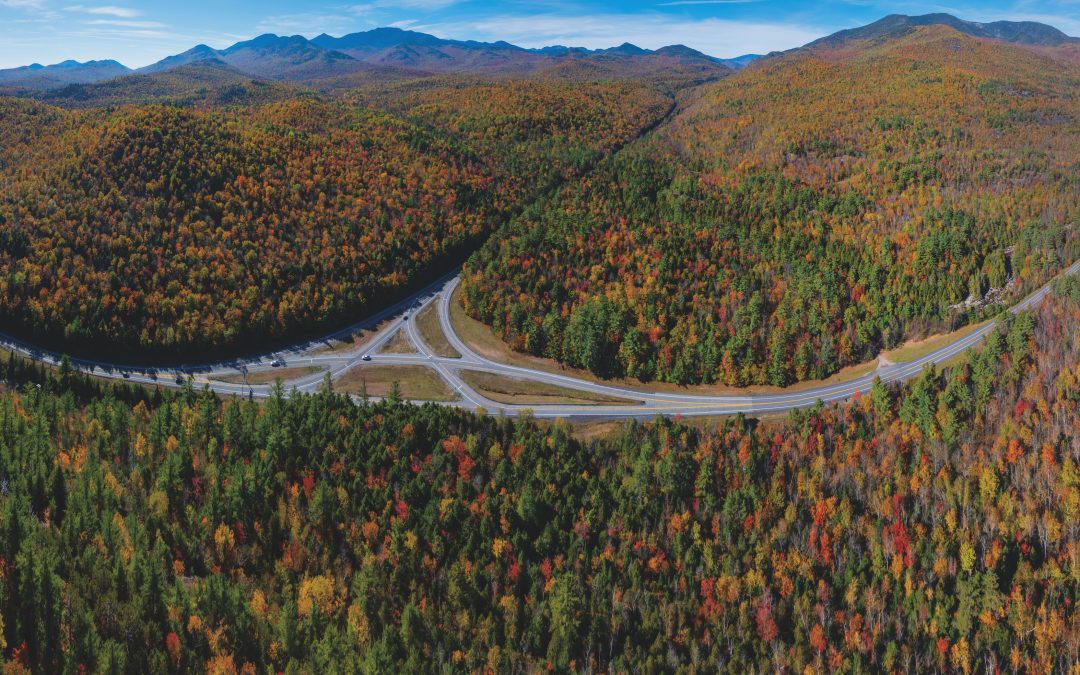
There were times during his retirement to the Adirondacks when my grandfather, the 20th century’s greatest classical percussionist, Saul Goodman, fell silent behind the helm of his large automobile. With a half-smile on his lips he would take in the sweep of the Great Range while his fingers drummed out something specific on the rim of the steering wheel. “What’s playing, Dad?” my mother or her twin sister would ask. “Schubert!” he would reply. Or Mendelssohn or Brahms or a score of any of the dozens of composers whose works he’d mastered in the course of his 46 years with the New York Philharmonic. He’d then let out a little laugh at the distance he’d traveled in his mind and bring himself back to the mountains rising up ahead and the fluidity with which his Cadillac Brougham ate up the open road. “Nice smooth ride, right?” he’d say.
Nice smooth ride.
Though my grandfather lived through two world wars that claimed the lives of his only brother and their extended family in Warsaw, “nice smooth ride” could justifiably be applied to the attitude he brought with him to Lake Placid. In that town that, in the 1970s, still felt small and far removed from Manhattan, he came to fit right in. But why, exactly? Why after half a century of performing at Carnegie Hall, recording at Columbia Records and teaching at Julliard did this Brooklyn-born,
matzo-ball-soup-loving metropolitan decide to spend his last summers in a place that was known for its natural beauty (which he could take or leave) and its WASPy culture whose most famous club did not admit Goodmans, Greenbergs or Bernsteins no matter their sophistication?
Outside observers might suggest that the region’s old money and Great Camps acted as a kind of magnetic north, pulling musical talents farther from the City than they might otherwise consider. They might mention Ivan Galamian’s Meadowmount, in Lewis, or John Severance’s Deerwood, on Upper Saranac—summer music academies that drew promising young performers throughout the season. They might point a finger to a small “cure cabin” perched on the high ground between lakes Flower and Colby, where Béla Bartók wrote his third piano concerto for his wife and quietly succumbed to leukemia. A road named for the composer Victor Herbert, which passes just below where my grandfather’s cabin stood on Signal Hill, gives yet another clue.
But the real reason Saul Goodman, normally a debt-phobic meticulous conservator of funds, chose to blow a lifetime’s worth of treasure on building a mountain retreat lies somewhere within and without music. The center of this irrational rationale was a beautiful Swiss-German cellist whom he married and to whom, in a sense, he owed everything.
It’s often said of the cello that it is the instrument that most closely emulates the human voice. Shapely and nearly human-sized, it also has classical music’s greatest octaval range. It is, in other words, full of potential.
The same can be said of my willowy grandmother, Lillian, who at nearly six feet and the child of a gifted German-born conductor, had the ability to wrap her long arms around the instrument’s body and draw out the most dramatic of tones. Where this depth of sound came from is, like all great artistic output, complicated and mysterious. She traced her maternal lineage to a Swiss noble family called von Treichler who, before emigration, had its seat on an estate near Zurich. Relocated to a modest home outside Chicago, my great-grandmother recounted again and again stories from before America, of summers spent with her Aunt Lilly (a Lutheran nun who was Lillian’s namesake), strolling along the shores of Lake Lucerne. One was always aware of a certain unrealizable longing within my grandmother, a sehnsucht for an aristocratic dignity which seems to have evaporated upon expatriation.
That this dignity might somehow be reconstituted through classical music was, I think, very much on my grandmother’s mind when she emerged as a major talent in the 1920s. She appeared as a soloist with the Chicago Symphony Orchestra at 15 and won the prestigious Naumberg Award at 21. After her first recital at New York’s Town Hall in 1931, The New York Times declared her “a new artist who seems to have something to say and the means in which to say it.” But somewhere in the process of emerging she lost her ability to articulate herself. An early teacher inappropriately involved her in a liaison when she was only 12—something which may have contributed to her fleeing Chicago for New York around the time of her Manhattan debut. When Pablo Casals, one of the cello’s greatest masters, assented to hear her audition he did not endorse the furthering of her career. “Go home and make babies, Miss Rehberg,” he told her.
Had it been another time, my grandmother might have gone public with such a crude remark. But it was 1931 and, instead, she listened. She moved in with the young tympanist she was dating at the time. She converted to Judaism, married him and swore to herself that she would bear a son who would become a great cellist.
She had twin daughters.
When my grandfather took us out in his yellow speedboat (christened Lillian, of course), there were only three places on Lake Placid we would go. First he’d blast out of Paradox Bay over to the dam at Outlet Brook. Then he’d hydroplane across Sunset Straight over to the adjoining boathouses of the Neuman and the Herman families on Buck Island, where he’d accept a scotch and soda, the tinkling of ice providing a tenor melody to accompany the tremolo of birch leaves fluttering in the wind. Finally he’d roar northwest and anchor at Pulpit Rock. “The deepest spot in the lake!” he’d announce every time. We’d bob in the waves for five minutes or so and my grandfather in his captain’s hat would take on an oddly puzzled aspect as he stared down into the unknowable depths. At last he’d clap his hands together and a little smile would purse his lips. “Let’s go,” he’d say. “Grandma’s cooking supper.”
My grandfather would often say that he was “lousy with talent” but the depths lying beneath that natural ability were seldom plumbed (if anyone did any plumbing down there it was my grandmother). That said, for “Sauly” (as she called him when either charmed or enraged) this was of little importance. There was nothing in his character that allowed the questioning of his own ability. He was that rare artist who was completely and totally unblocked. When the U.S. banned the import of German kettle drums during World War II, my grandfather began building them in his basement. When any of a multitude of dispossessed composers fleeing the Nazis showed up at the recording studio with a brand-new score, my grandfather would sight-read the tracks and often lay them down in a single take. Conductors, from Toscanini to Boulet, came and went during his tenure at the Philharmonic, but always my grandfather stayed at the back, acting as a kind of rhythmic conscience and memory for the orchestra.
Nice smooth ride, right?
Right. Except a lot of that smooth ride was attributable to how my grandmother flattened the road ahead for him. This was not an easy thing to do, since in their journey together there was as much competition as there was collaboration. When my grandfather wrote Modern Method for Tympani, still in print today and the standard audition text for aspiring classical percussionists, my grandmother wrote The Development of Cello Hands, a slim, overlooked volume that tried to surface her profound understanding of her instrument. When my grandfather assembled all his orchestral remembrances into a memoir called A View from the Rear, my grandmother could barely get down a handful of pages about her own life. At the table when my grandfather would hold his guests in rapt attention about playing Bartók’s Sonata for Two Pianos and Percussion (“the notes were like pepper sprinkled on the staves!”) or Gershwin (“a lovely man!”), my grandmother would get only a few words in edgewise, often in the service of fleshing out or correcting Sauly’s story.
That said, she once did try to step back out into the limelight. In 1958, at the age of 40, after her daughters were grown and gone, she managed to secure a solo appearance at Carnegie Hall and for the first time in 27 years she appeared in the pages of The New York Times. “Her tone rang true,” wrote The Times’s Harold Schonberg, “with fine rhythm and cohesive sense of phrase.”
What happened after that is subject to conjecture. In one version told to me by my mother (who tended to side with Lillian), the booker called the next day to discuss the possibility of my grandmother giving another concert. My grandfather answered the phone and told him to leave them alone. That Mrs. Goodman was cooking supper.
In another version the booker doesn’t call. Or my grandmother herself refuses the offer. Or nothing happens at all.
Whatever the case, Lillian Rehberg Goodman never returned to the stage of Carnegie Hall.
And so, for his sins, real or imagined, my grandfather built my grandmother a cabin in the Adirondacks.
Why the Adirondacks? That story also has layers. My grandmother was certainly aware of a classical music zeitgeist in those faraway mountains. As president of New York’s Violincello Society she probably crossed paths with cellist Gregor Piatigorsky, who lived in New Russia. Bartók may have mentioned to my grandfather that he was headed up to the sanitarium in Saranac Lake following their joint recording session in 1941. My grandmother’s constitution was as fragile as my grandfather’s was robust and for all his bravado he knew that her loss would be hobbling; a place historically associated with convalescence must have seemed like a good idea. And then there was the bridge to Bavaria the region’s boosters were trying to make, with beer becoming brau and hotels turned into häuser on kitschy signage across the North Country. Warren County’s Lake Luzerne is a pale reflection of Switzerland’s Lake Lucerne. Whiteface is no Magic Mountain. But the Adirondack equivalents bore enough of a resemblance to the Swiss prototypes to make the sale.
The sale itself was an acre parcel that had been part of the golf course for the old Stevens Hotel. Paradox Bay could be seen sparkling below. My grandmother visualized what the sunset would look like through the epic picture windows she had already imagined on the yet-to-be-built cabin’s west-facing wall. “Sunset Hill, The Goodmans” read the sign that she hung from the Tyrolean-styled eaves after the design passed from her imagination into real-life timber and glass. Not grand in any way, it felt noble; a structure incorporating what The Encyclopedia Britannica says is particular to Swiss chalets—“a frank and interesting manner in which its principal material, wood, is used.”
Sunset Hill became for her many things all at once; an echo perhaps of one of Mahler’s Austrian Komponierhäuschen, in which she could finally find her voice; a meditation retreat where, after discarding Judaism and becoming a Unitarian, my grandmother communed with nature in keeping with that hybrid faith’s transcendental belief system; a place where the next generation gathered to accrue memories that connected us all back to our distant roots and the von Treichlers ambling along the shoreline of Lake Lucerne.
In the end, though, it would also be a sanitarium. Both romantic and modern in her ethos, my grandmother believed as much in the restorative power of fresh mountain air as she did in clinical medicine. Even after shingles, emphysema and cancer hollowed her out she still ventured north to take a final cure in her ersatz Alps. It was in the Adirondacks in 1984 that she took her last, labored breath.
My grandfather continued to summer in Lake Placid long after she died. He lived another dozen years. He even found a new companion—a nice Jewish woman who helped him while away his closing decade. He tried to do the usual things with her. He took her out to Pulpit Rock aboard his speedboat but he hit a wave and broke her leg along the way. Lillian was sold soon after. Accidents aside, one could say he continued to ride smoothly. He always appeared happy. He always laughed. But one could also say the waters above his depths had, in late life, frozen over. As a student who worked with him at the time of my grandmother’s passing put it, “When Lilly died, Saul was lost.”
Paul Greenberg is the author of six books including The New York Times bestseller Four Fish and, most recently, The Climate Diet. He wrote “An Acre of Dreams” for our 2023 Adirondack Homes & Camps issue.