More Articles From

Events

Charley’s Back Yard

A Chat with Charley

You may wonder what a graduate engineer is doing in a cabin all by himself back in the wilds of the Adi­rondacks. “Im doing what I always wanted to do since I was a little boy,” noted Charley in a conversa­tion we had at his cabin just three days before this issue went to press, “living in a cabin in the woods.” Unfortunately, the original log cabin is no more and the solitude of the woods is slowly vanishing. Charley is thinking of moving on, “maybe to Alaska, although that may be ruined in a few years.”

But it is not just the loss of his cabin or the increase in the number of campers each year that bothers Charley. It’s the frustration: “I have no authority to enforce the laws. People are chopping up picnic tables for firewood, littering the woods so fast that I can’t keep up with it, cutting live timber, and in general, destroying the woods. And then there are the hikers who head out on a trip with no map, no compass, and no idea of the dangers in the woods. I don’t know how they survive out in civilization.”
Road Scholar

Road Scholar

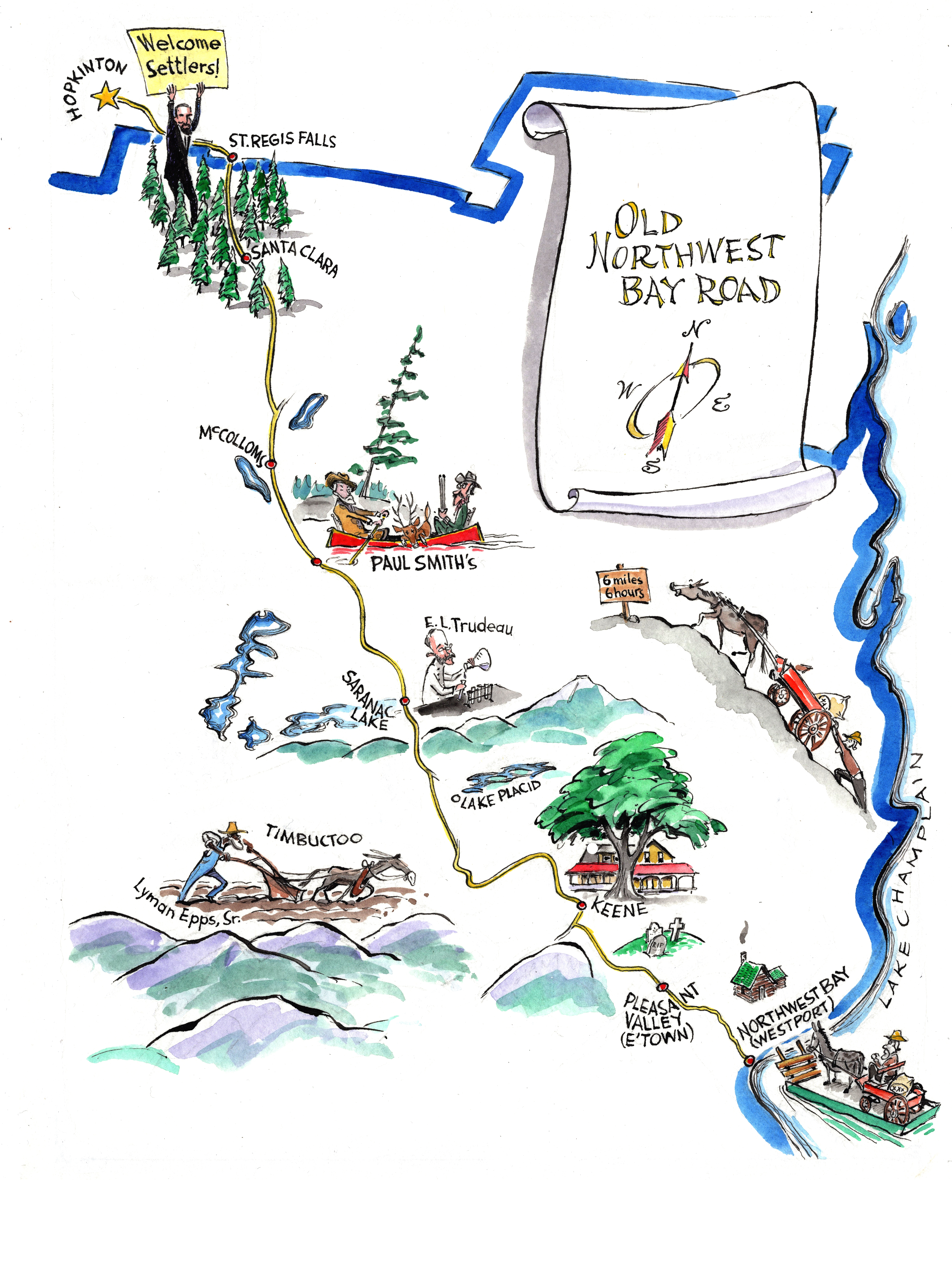
In the early 1800s, Reuben and Phoebe Davis carved out a homestead deep in the Adirondack wilderness. Their first child, Elisha, died at four years old, in 1819. Then Reuben Jr. died at age three, in 1825; Joseph, a couple of years later, at two; Nathrum in another few years, age one. We know only this about the Davis family from the stones of a tiny cemetery embedded in woods on a dirt section of the Old Northwest Bay Road, the first road to penetrate through the Adirondacks, where life held death in a cold, tight hug.

Jacques Suzanne

Although thousands of chap­ters have been written about the history of the Adirondacks, the story of one of its most famous citizens still remains untold. Jacques Albert Suzanne ( 1880–1967) epitomized the “call of the Adirondack wild” for those who remember this fur-bedecked dy­namic character. Known as an explorer, painter, animal fancier, musician, actor, and renowned authority on dog sledding, this world traveler’s great yearning for the North led him to settle in the boundless beauty of the Ad­irondacks near Lake Placid, where his legend grew and flourished.

Suzanne was born in the French providence of Normandy in the small village of Deauville. He received a formal education at Bourgeon University in the fine arts of painting and sculptur­ing, studying under Rodin and Moutiers. He also studied paint­ing at the Gislain College of Bourgoin in the French Alps under Lede and Paul Helleu.

His paintings reflected the ex­citing adventurous mood of the early twentieth century, but even more so, they epitomized his overpowering desire to play a vital role in the exploration of some faraway land. “As an art student in Paris,” he wrote, “I read many books about explorers. I was so taken with them I put my studies aside and set out to dis­cover the North Pole, striking toward it across Siberia.” Driven by this desire for exploration, the young adventurer started out to explore the world; and before his travels brought him to the Arc­tic regions, he visited numerous countries, venturing into the role of tiger hunter in Bengal, Gaucho in Argentina, commissioned painter for the Russian Tzar, Nicholas II, adventurer in Aus­tralia, Java, South Africa, and for a short term, French “good will” ambassador to Russia.

Tongue Twisters

Tongue Twisters

Snow-covered terrain is a layer cake of frost and creatures. Last winter, particularly cold and snowy, the white frosting rose almost three feet atop the Tongue Mountain Range along Lake George. The mice and voles lived beneath the flakes, at ground level. Another four feet of earthy frost below that, in crannies and caves, Tongue’s rattlesnakes denned. They could not get at the rodents, nor to us; they were torpid, hibernating, unable to twist along.

The mice and voles were scurrying about, making ends meet in that narrow, ice-ceilinged air pocket called the subnivean zone. Winter predators like fox, weasel or owl had to listen hard and pinpoint their pounces to make a catch. Unwittingly, we sometimes whomped that snowy roof in as we climbed and glided along the ridge.

This was a mid-February trek for five of us—four on skis, one on snowshoes. Photographer Carl busted trail on the steep ascents, and we clambered up after him. We four careened the descents, and he sashayed on down behind. My wife, Betsey, our friends Scott and Marcy, and I came south from Keene Valley to traverse this wild and woolly Lake George ridgetop. Scott, a formidable skier, yet novice to these southerly wilds, was skeptical there could be any respectable terrain outside of his High Peaks. He was in for a more than pleasing surprise.

Mystery at Bog River Falls

More than a century ago a mysterious affair was reported from Bog River Falls.

Bog River country is lonesome land. It lies south and west of Tupper Lake on the sunset side of the Adirondack Park, and only solitary fishermen and hunters speak its tongue.

Bog River itself is a solitary stream. Its two narrow branches, by turn savage and swift, deep and lazy, pass through pond after pond and twist like water snakes through the black bush. The famous old guide Harvey Moody pronounced this stream, along with Follensby and Little Wolf, “the confoundest crookedest con­sarns in the woods.” Yet the Bog does have its own peculiar charm. By a strange alchemy of color and light, every leaf, and tree, and stone ashore is mirrored in the dark stream with wonderful ac­curacy. The underwater land­scape seems even sharper and more three-dimensional than the real thing.

Saving The Hedges

It’s hard not to be romantic about The Hedges, on Blue Mountain Lake. Some of us first fell in love at the old Great Camp and then with the place itself. It’s a place that’s so part of our identity that, even if we stay just a week or two each summer, it feels the most like home.

The nearly 13 acres comprising The Hedges were once part of several hundred acres owned by Civil War colonel Hiram Duryea, who built a family summer retreat in 1880, when Duryea was president of the National Starch Company. The first structure put up on the property was Main Lodge, with four bedrooms and living space. Some years later, Duryea built Stone Lodge with seven bedrooms, along with a horse barn, carriage house and Upper, the caretaker’s cottage. In the 1920s the Collins family bought the place at auction for $22,000. They renamed the Duryeas’ camp The Hedges, and converted the family’s getaway into a resort, adding the Main Dining Hall, then cabins in the 1940s. Today the property—1,600 feet of waterfront, a private beach, two docks, tennis court, and 21 buildings with 31 bedrooms—is listed on the National Register of Historic Places. This landmark is a sacred place.

Movie Stars to Missing Persons

Throughout 2019, in celebration of Adirondack Life’s 50th anniversary, we’re sharing an article per week from our archives—one for each year since 1970. Kathryn E. O’Brien, who wrote this Fall 1972 portrait of the Warren County Mounted Patrol—which is still active today—was best known as the author of The Great and the Gracious on Millionaire’s Row, a 1978 book about Lake George’s grand mansions and their owners.

No sight compels more admiration than a smartly uniformed man rid­ing a spirited horse; and when that one is multiplied 25 times, you have the Warren County Sheriff’s Mount­ed Patrol. The organization was founded 16 years ago through the vision of the late Carl McCoy, then Sheriff of Warren County, and a group of enthusiastic horsemen who saw this as a unique opportunity to be of service to the area. They have been called upon to handle increased traffic during holidays; to assist in finding lost persons; to patrol camps closed during the winter months; to act as honorary escorts for visit­ing celebrities; to search the moun­tains for downed airplanes; and of­ten to act as “extra man” in the Sheriff’s patrol cars.

A Dairy Tale

A Dairy Tale

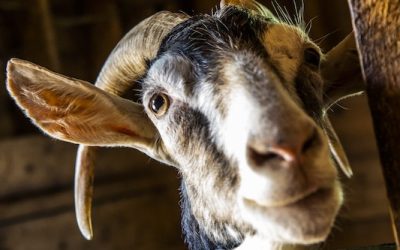
etirees live,” said Lorraine Lambiase, a short, 62-year-old farmer wearing barn boots and a black Nettle Meadow T-shirt.

“Why Jersey Shore?” I asked.

“I’m originally from Hoboken.”

The rust red barn, built for draft horses in 1903, is the second-oldest  structure at Nettle Meadow Goat Farm and Cheese Company, in the town of Thurman in western Warren County and a world away from North Jersey. The property dates to the late 18th century, when the woodland was first cleared for farming in a wilderness area defined by Crane Mountain and the boulder-strewn tributaries of the Hudson River. Leading into this glen from Route 8, houses visible from the winding road sat next to stacks of firewood and pickup trucks plastered with NRA bumper stickers. Chain-saw black bears squatted on lawns. Maple sugar houses and a turkey farm lay over the next hill. “Don’t Tread on Me” flags, faded Trump slogans, VFW halls festooned with true blue bunting—the southern Adirondacks wearing politics on its sleeve. An odd place, perhaps, to find two aging pacifists who have “Lady Liberty is Crying, End the Madness, Stop the Hate” scrawled on the back windshield of their van. 

Women Have Been Voting Ever Since

Throughout 2019, in celebration of Adirondack Life‘s 50th anniversary, we’re sharing an article per week from our archives—one for each year since 1970. This week’s selection is by Robert F. Hall, who was president of an earlier publication called Adirondack Life that was included in the weekly newspapers of the Denton Publications chain. That magazine ceased publication in 1968, and the name was sold to Eustis Paine and Richard Lawrence Jr., who started the independent magazine that continues today.

The impending centennial of women’s suffrage has brought renewed interest to the story of Inez Milholland, whose grave in Lewis became the site of the annual Adirondack Women’s March starting in January 2017.

The town of Lewis in Essex County for more than a half century was hometown for the Milhollands, that enormously talented family whose activities and accomplishments made frequent news in the Eastern daily papers.

The most colorful was the highly gifted Inez, the older of two daughters of John and Jean Milholland, who grew up summers at the family home Meadowmount, on the Lewis-Wadhams road. By 1913, when she was 25, she was already known on two continents for her militant activity in behalf of women’s rights. At her death in 1916, ratification of the Nineteenth Amendment was four years away but for its realization she shares credit with Carrie Chapman Catt, Anna Shaw and Harriet Stanton Blatch.

Adirondack Birdman

Adirondack Birdman

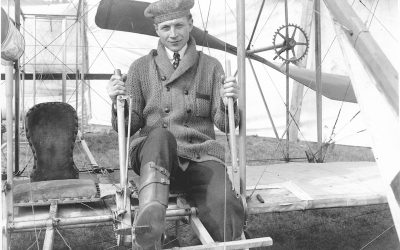
As the sun was setting on October 2, 1912, a half-frozen George A. Gray successfully landed his Burgess-Wright Model B biplane in a level field of grain stubble about 100 feet from a small house and a large barn. It was the first suitable landing place he saw after descending through the clouds and fog that had obscured everything below. He had no idea where he was. He had been lost, he was exceedingly cold and his plane had a fuel leak. It had not been a true emergency, but it had been close.

Upon landing, he was quickly surrounded by the property owner—referred to as Farmer Martin in contemporary newspaper accounts—and three or four of his children, all excited to see a flying machine unexpectedly descend from the clouds. Gray switched off the gasoline to save what he had left (and to avoid the possibility of a fire) and apologized profusely for the fright he had given them. Martin said he was glad that Gray had landed safely, and that it was a thrill to have an airship at his farm. He invited Gray into his house to warm up.

On Sale Now

April 2026

The Wildlife Issue! A peek inside the secret lives of Adirondack moose by Jeff Nadler, wildlife portraits by Pamela Underhill Karaz, an opossum search party led by best-selling author Kristin Kimball, plus loons, turtles, turkeys, chipmunks, coyotes and more.


Adirondack Life Magazine

Subscribe Today!

Latest Articles

Follow Us

Adirondack Life Store

for calendars, apparel, maps and more!