More Articles From

Events

Adirondack’s Big “Sticks”

When big Dave Winfield stepped into the batter’s box for his first official appearance as a New York Yankee, most of the 55,123 spectators at the Yankees’ 1981 opener wondered whether he could justify his much-publicized $1.3-mil­lion-a-year contract with a hit. But at least one baseball fan in Dolgeville, New York, had a more personal con­cern: if Winfield connected, would his bat be up to the task?

Winfield walked that first time up, and not until the fifth inning did a single off Texas pitcher Jon Matlack provide the answer: both Winfield and the bat were doing just fine. That was good news to Bill Steele, a skilled craftsman who hand-turns bats for Winfield and dozens of other major-­league players whose “lumber” comes from Rawlings Adirondack Co. of Dolgeville, makers of “Adirondack”­-brand baseball and softball bats.

The Movie Man

The Movie Man

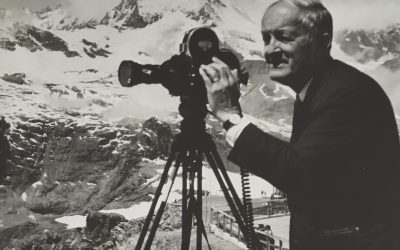
Working from a lab and factory in Essex, Ken Richter invented and built specialized aviation and camera equipment that was used around the world. As a globe-trotting pilot and cinematographer himself—in 1974, The New York Times named him one of the top travel film–lecturers in the country—many of these inventions were born of his own desire for better equipment.

Even as a youth in Randolph, Massachusetts, in the 1930s, Richter was obsessed with the clarity of images. He ground his own telescope lenses, and earned a scholarship to Harvard to study astronomy. It was a short leap to photography, where he experimented with both still and motion-picture cameras. After college, Richter worked as a cameraman in Hollywood, shooting everything from comedy shorts at Columbia Pictures to outdoor scenes used in montages.

Within three years, Richter left to film travelogues, those 15- to 20-minute tours of places like Mozambique or the Yukon that were once part of a typical night at the movies. He wanted the freedom to wait for the right atmospheric moment despite what the weather or budget said, to invent his own equipment when nothing available was good enough. And he wanted to see the world on his own terms, to portray places like the Alps and the Sahara accurately, not as backdrops to imaginary stories. Maybe the idea of shooting slapstick falls and punches on a sound stage felt too confining.

Ready for the World

Most people admire Paul Vin­cent’s optimism. He says bob­sledders from the Adirondacks will win two Olympic medals this year.

Handicappers would rate that a­chievement a stunning upset, but de­spite the long odds the 28-year-old Keene Valley resident and his local teammates stand the best chance of any competitors from the region to capture honors on the home grounds. Vincent has been the top American driver in the World Four-Man Bob­sled Championships the past two years, and his sixth-place finish in 1978 at Lake Placid is the closest any current competitor from the Adiron­dacks has come to international honors in any winter sport.

The 1980 Games will give Vincent an opportunity to fulfill a lifelong am­bition and he is not particularly bur­dened by any added pressure to keep some of the Olympic hardware from leaving the area.

“This is why bobsledders compete seriously. An Olympic medal is some­thing we all dream about.”

Dreams are what the 1980 Winter Olympics in Lake Placid are all about. For many people in the village and in the Town of North Elba, it is almost impossible to imagine that February 25 will ever come and the Games will be over. It has been more than five years since the October day in 1974 when the church bells rang and the sirens sounded, signaling to citizens that the International Olympic Com­mittee, meeting in Vienna, had award­ed the 1980 Games to the local organiz­ing group. The successful effort capped two decades of trying, attempts that had been squashed repeatedly on the international level and even snubbed here in the U.S. Despite the failures, and the frustration of witnessing the Denver debacle and the refusal of Salt Lake City to take up the crusade, the local group persisted.

The Elm Tree Inn

At the main intersection in Keene, New York, sits the Elm Tree Inn, the menu of which describes its setting as “beautiful downtown Keene.” Buildings in the immediate area include the Keene Library, a gen­eral store, a hiker’s supply store, a motel and a gas station. The cen­ter island at the crossroads, plant­ed with pansies in the summer, has six road signs giving distances to neighboring towns, which suggests that Keene is a stopover for the traveler on his way elsewhere. The Elm Tree Inn has been banking on that idea since it was first opened for business in 1823, and Wil­mot “Monty” Purdy, who owns Monty’s, or Purdy’s, as the Inn is alternately called, carries it on to­day in what has become one of the region’s best-known havens for the hungry and thirsty.

Homegrown Talent

Homegrown Talent

In most family businesses, the lines are clear from the outset. A patriarch or matriarch hatches a plan, succeeds, and then inevitably brings the children into the line of work. John D. Rockefeller Jr. followed his old man into oil and finance. The New York Times gets handed down from Sulzberger to Sulzberger.

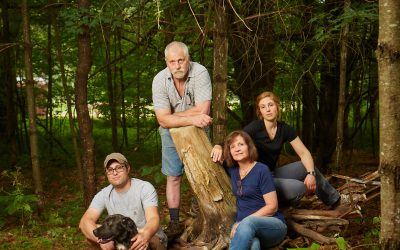
Not so the Posts of Au Sable Forks. Larry Post literally fell into his business, by way of what could have been a tragic accident. In April of 2003, he took a nasty tumble and hit his head while skiing at Whiteface. A slow-bleeding subdural hematoma caused a stroke that nearly killed him and wiped out much of his short-term memory. He couldn’t concentrate, couldn’t remember things, couldn’t even recite the alphabet. “It was like being with somebody with Alzheimer’s,” recalls his wife, Joann.

The Way It Is in Beaver River

First the waters rose, cutting off the one, tenuous road connec­tion. Decades later; the railroad stopped running. And so Beaver River, once a bustling lumber camp in the western foothills of the Adirondacks, became an isolated island in a sea of trees, the only settlement in New York State today which is accessible by neither road nor trail.

For some communities, the loss of rail service is a major misfortune, and the lack of any road links to the outside world would mean certain death. And, indeed, at first glance Beaver River appears to have borne fortune’s blows poorly. In physical appearance the town is little more than a clearing in the woods, crisscrossed by narrow dirt roads and the rusting railroad tracks, dotted by the homes of its IO permanent residents and the “camps” of nearly a hundred seasonal residents.

Lapland Lake

Lapland Lake

In Fall 2013, my boyfriend, Keith, and I arrived at Lapland Lake Nordic Vacation Center in the southern Adirondacks for the first time. We were greeted by a black-and-white cat, Little Bit, as well as Kiva, a Karelian bear dog, who bounded onto the scene, his tail wagging. Along with our welcoming party, the bright foliage, the rushing stream in the background, and the smell of pine signaled that we were home.

Then again, Keith and I both knew Lapland would be “our place” before we ever left our apartment in Brooklyn. After combing through lists of places to stay in the Adirondacks, we surprised each other by both picking this resort in Benson, about nine miles from the village of Northville. For Keith it was the description: spring-fed non-motorized mountain lake, miles of forest trails, little housekeeping cottages—or “tupas,” as they’re called in Finnish—and most important, peace and quiet. 

Maple on the Menu

My husband and I make a few gallons of maple syrup every year, enough to encourage kitchen experiments. We put it over ice cream, in hot cereal, even in chai. Syrup flavors baked beans, salad dressing, salmon glaze as well as before- and after-dinner treats. Below you’ll find homemade versions of the value-added items you can purchase at a North Country sugarhouse; shortcuts to a couple of classic time-consuming desserts are here too.

Eden Without Snakes

The 1960s were a little late for an argument over whether Lake George belonged in the Adirondack Park. A major extension of the Blue Line had enfolded that lake, which Francis Park­man once called the most beautiful in America, as early as 1931. But old men have long memories.

The Adirondacks are big and diverse. It is no wonder that notions about the true Adirondack experience vary widely with place, time, and person. Kenneth Durant, who was 83 at the time of his death in 1972, had spent the summers of his youth at a family camp on one of the headwater lakes of the Raquette River. Ironically, this area might have become the Lake George of the central Adiron­dacks if trends started by senior mem­bers of the Durant family had continued beyond the turn of the century and fallen into hands of less discrimination and taste.

The Saga of Sam Pasco

He was taller than average, as though he competed with the pines of his native Northwoods or the high peaks of the Adirondacks that he knew so well. His muscles were hard from use, like those of the wild creatures who foraged and fought for food; and his will to survive equalled that of a twisted tree clinging to a rocky, wind-swept cliff. Violence was his teacher, and he was an apt pupil, terrorizing an entire area of Warren County, New York, for more than 30 years. He was known widely, but not well, as Alvin (Sam) Pasco, and the terms “bad man” or “outlaw” were frequently added for further distinction.

In 1872, when he was born, the upper reaches of Warren County were populated by descendants of those hardy pioneers who had migrated from the New England States, or who had come down from Canada to settle where land was readily available and fish and game abundant. There were still the vast, trackless forests, slowly bowing to the lumberman’s axe, but there were also small towns teeming with activity—towns like Stony Creek which, in 1870, had three times its present population. The frontiersman explored the land, often exploiting it for quick gain, then passing on to other sites. Hard-working farmers tried to make an adequate living from the soil’s meager resources; the more enterprising formed an elite of mill or tannery owners and mine operators. Into this life of toil, competitiveness and frequent violence came Alvin Pasco.

On Sale Now

April 2026

The Wildlife Issue! A peek inside the secret lives of Adirondack moose by Jeff Nadler, wildlife portraits by Pamela Underhill Karaz, an opossum search party led by best-selling author Kristin Kimball, plus loons, turtles, turkeys, chipmunks, coyotes and more.


Adirondack Life Magazine

Subscribe Today!

Latest Articles

Follow Us

Adirondack Life Store

for calendars, apparel, maps and more!