
Whiteface Mountain stands almost alone, nuzzled by the lesser peaks of Esther, Marble and Lookout mountains, rising sharply from the Wilmington valley and the waters of Lake Placid. The sight of the 4,867-foot mountain, New York’s fifth highest peak, is enough to stir the imagination of any visitor, but the mountain holds a particular fascination for the skiers who flock to its high country and steep trails. The history of this place, though, doesn’t play out in a straight line from the top of the mountain to its base, nor does the story of Whiteface’s development as a ski center open, as some might imagine, with a tale of an inspired schuss down a majestic virgin run. It begins, instead, at the bottom of the hill, with the enormous task of cutting of an Olympic cross-country trail around the mountain—a trail that would never become part of Olympic lore.
More Articles From
Events
Derby Days
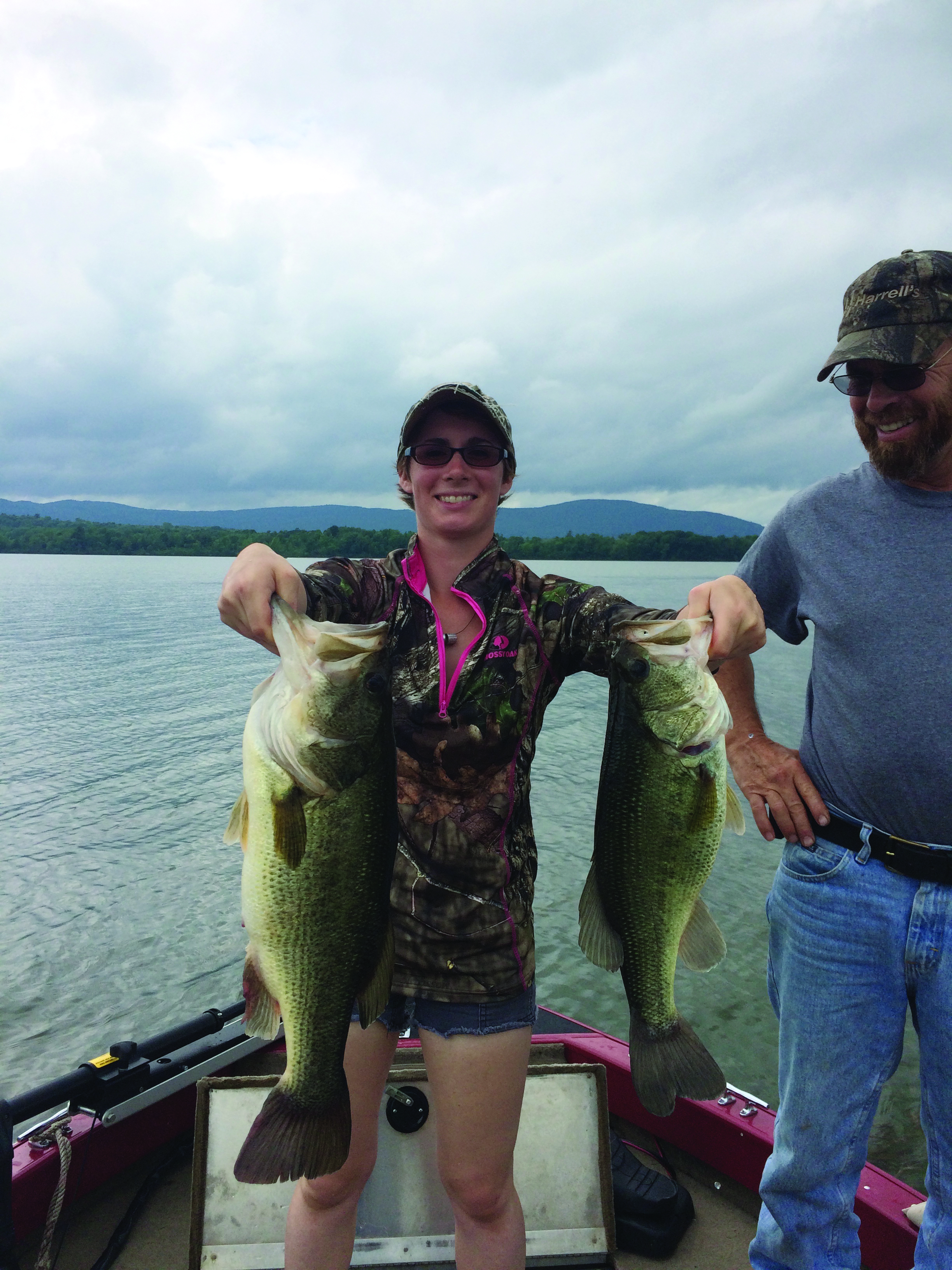
I don’t remember when I first learned how to hold a fishing rod. By the time I had learned to walk, my father already had me standing on the dock, pulling up panfish with him. There are generations of fishermen in our lineage, so it was only natural that my two older brothers and I followed suit. My sister, the eldest child, and my mother don’t enjoy fishing the way the rest of us do. Yet, it is our family tradition to experience it all together and fill the days at our Ticonderoga camp with laughter, smiles and fish stories told around the campfire on clear, starlit nights.
Behind the Blue Line
It was the 1890s, the Gay Nineties, and the country was immersed in characteristically American enthusiasms: in new urban parks men and women exercised on a newfangled device called the safety bicycle; boisterous crowds cheered wildly for their baseball heroes; in Chicago and New York, thirty-story skyscrapers suddenly pierced the horizon; in the countryside, anti-saloon leagues preached the gospel of abstinence; and people everywhere, from every walk of life, seemed to be worrying, and bickering, about the fate of the nation’s forests.
From coast to coast, conservation was a hot topic. America’s first native-born forester, Gifford Pinchot, was appalled by the prodigious wastefulness of American loggers and was frantically promoting the creed of wise use, while the Forest Reserve Act, passed by Congress in 1891, began the process of creating national forests. The states—especially those east of the Mississippi River, where the forests were literally disappearing—joined in. In the South, people were agitating for protection for southern Appalachia. In New England, sentiment to save the White and Green mountains was gathering steam. Conservationists in Pennsylvania pushed their legislature to establish a commission to investigate the need for a state forestry policy.
Right at the forefront of this crusade to save the nation’s forests was the state of New York. A century ago, on May 20, 1892, Governor Roswell P. Flower inscribed his name on a bill passed by the assembly and the senate, and created the Adirondack Park. One of several steps taken in the 1880s and 1890s to protect what remained of the state’s forests, the establishment of the Adirondack Park was part of a complex cultural drama, with local peculiarities layered on to the national conservation enthusiasm. The key players were muckraking journalists, wealthy businessmen, cut-and-run loggers, government officials, aristocratic hunters and anglers trying to protect their sport, and transportation interests worried about water levels in the Hudson River. Just about everyone—except the more ruthless of the loggers—wanted to protect what was left of the North Country, and good intentions were everywhere. But the outcome was less than what many people had hoped for.
Ned Buntline, or the Blighter of Blue Mountain Lake
“The life history of Col. Edward Zane Carroll Judson (‘Ned Buntline’) is more thrilling than romance, as his career, from boyhood to middle age, was a succession of adventures by land and sea; as a sportsman and angler in the then primitive wilderness in the Adirondacks, as a midshipman in the Navy, a soldier in the Seminole war, the Mexican war, the four years of warfare between the North and the South and finally in the Indian Wars of the wild west!’ (From Life and Adventures of Ned Buntline by Fred E. Pond (“Will Wildwood”), New York, 1919)

Your Essential Vacation Guide
The choices for outdoor recreation are endless in the Adirondack Park. For just a taste of what the region has to offer, try one of these adventures:
At 3,156 feet, Hopkins Mountain, in Keene, is in the elevation sweet spot—a challenging hike but too low for patch-seeking 46ers. With views of the Great Range and surrounding peaks, you’ll want to linger at the top. And because the round trip is only 5.4 miles, there’s no need to hurry.

Little Peak
Colden is cliffy. Algonquin is steep. Marcy is the biggest of big girls. Gothics is the gnarliest of gnarly boys. And then, south of the High Peaks, in the Vanderwhacker Mountain Wild Forest, between the towns of Minerva and North Creek, overlooking Route 28N, there’s Moxham, which is—well, to be totally frank about it, a forested lump shy of 2,500 feet tall that I probably wouldn’t bother visiting if it weren’t for my niece, Daisy.
The Great Blowdown
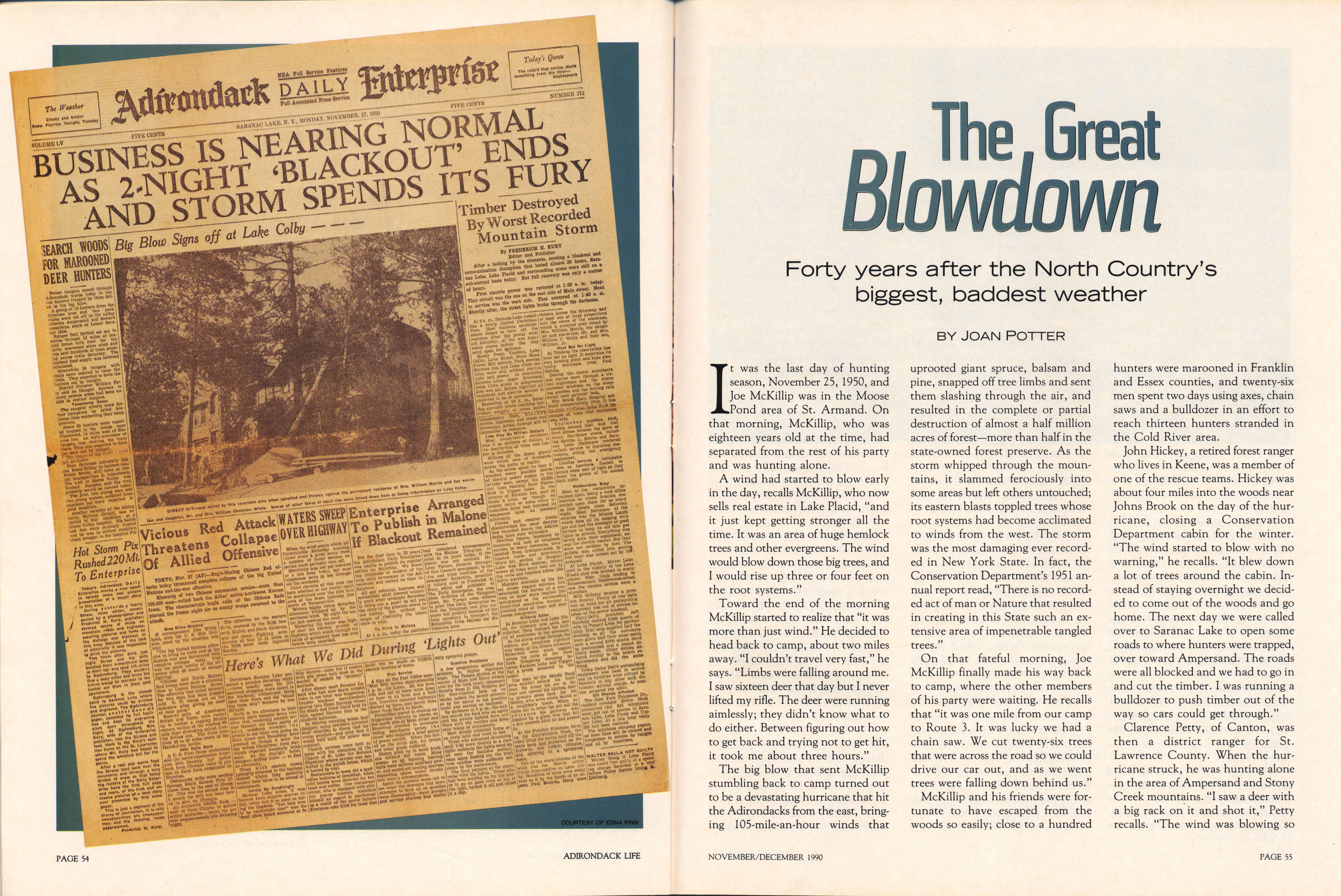
It was the last day of hunting season, November 25, 1950, and Joe McKillip was in the Moose Pond area of St. Armand. On that morning, McKillip, who was eighteen years old at the time, had separated from the rest of his party and was hunting alone.
A wind had started to blow early in the day, recalls McKillip, who now sells real estate in Lake Placid, “and it just kept getting stronger all the time. It was an area of huge hemlock trees and other evergreens. The wind would blow down those big trees, and I would rise up three or four feet on the root systems.”
Toward the end of the morning McKillip started to realize that “it was more than just wind.” He decided to head back to camp, about two miles away. “I couldn’t travel very fast,” he says. “Limbs were falling around me. I saw sixteen deer that day but I never lifted my rifle. The deer were running aimlessly; they didn’t know what to do either. Between figuring out how to get back and trying not to get hit, it took me about three hours.”
A Bark Eater’s Odyssey
Lake Luzerne, May or June, 1969: We always ate breakfast at Walt’s Country Corner Restaurant. Walt, a gnomish Dane, baked fresh sourdough loaves for toast and sandwiches every morning. Rich and amber, the bread was laced with pockmarks where melted butter pooled deliciously. It was easier for us to eat at Walt’s than to cook over the campstove at our summer homestead three miles outside of town on the Sacandaga River—not to mention the availability of his flush toilet.
Like clockwork at nine a.m., Irv crossed Rockwell Street from Parker’s Garage (gone) for coffee at Walt’s. I don’t remember Irv’s last name, and I didn’t know him very long, but his gravelly voice I never forgot. He wore mechanic’s blues, well stained with honest grease, and smoked hand-rolled Bull Durhams. The string of his tobacco pouch always hung from his shirt pocket, below the red and white oval crest that spelled his name.
Irv was an Adirondack version of a griot, that is, a keeper of the tribe’s memory. Every morning without fail his black coffee and strong tobacco produced a story, and if one of the village blowhards held the floor for too long about the TV show he watched the night before, we felt cheated.
I don’t remember how the subject came up, but one morning he started talking about his youth on Lake Clear in the 1930s. “I’d get out on the water early every morning and troll for smallmouth black bass,” Irv said. “A junebug spinner and a worm was the ticket. I’d get my limit and my mother would cook ’em for breakfast. I was usually alone on the lake, until one day this guy with long white hair starts showing up. You’d think that one more fisherman on the lake wouldn’t attract much attention, except there aren’t that many men with long hair up here—” here he cast a scowl in our direction—”at least in those days there weren’t. Another thing about him, he paddled around in this old kayak and he’d be out there with a fly rod just flailing away like anything, only he didn’t know how to cast, so he’d always wind up with his line in a horrible mess. He never caught a thing.
After the Fall
“It’s almost beer time, Mellor!” I stopped for a moment and looked back down the rope at Charley Berry. He was about 20 feet below me and slightly to the left, tied into three ice screws and standing on a small ledge we had hacked out of the ice 600 feet above Chapel Pond, near Keene Valley. I turned and looked up at the remaining 30 or so feet of blue ice between me and the snowfield which topped the route. At the line where ice met snow, footprints led onto the flats above; footprints I had made only a few days before when I raced up the route, unroped, to try out a new pair of crampons. This time, when I swung my axe into the ice, something funny happened. Things slowed down. With a dull groan, a crack in the ice snaked up and to the right away from my pick; another took off in a squiggling line toward my feet. What had been a flawless blue-green sheet of ice was transformed into a proliferating web of cracks, with a bulge growing in the middle. In the next half-second I was standing upright in a deluge of falling water and ice blocks, some the size of suitcases, others closer to mattresses, and actually thinking for the moment that I would be able to fight it all off and remain attached to the mountain. The wave grew to about the level of my head, and I was off, riding down the chaos toward Chapel Pond.

Great Pines
This 14-acre spread perched on Fourth Lake between Old Forge and Inlet has been welcoming guests since 1896—first as Camp Onondaga, then as various iterations of the North Woods Inn. It had been well loved and well worn by the time Britta and Devlin Hennessy, along with their partner Keir Weimer, bought it in 2015.


On Sale Now
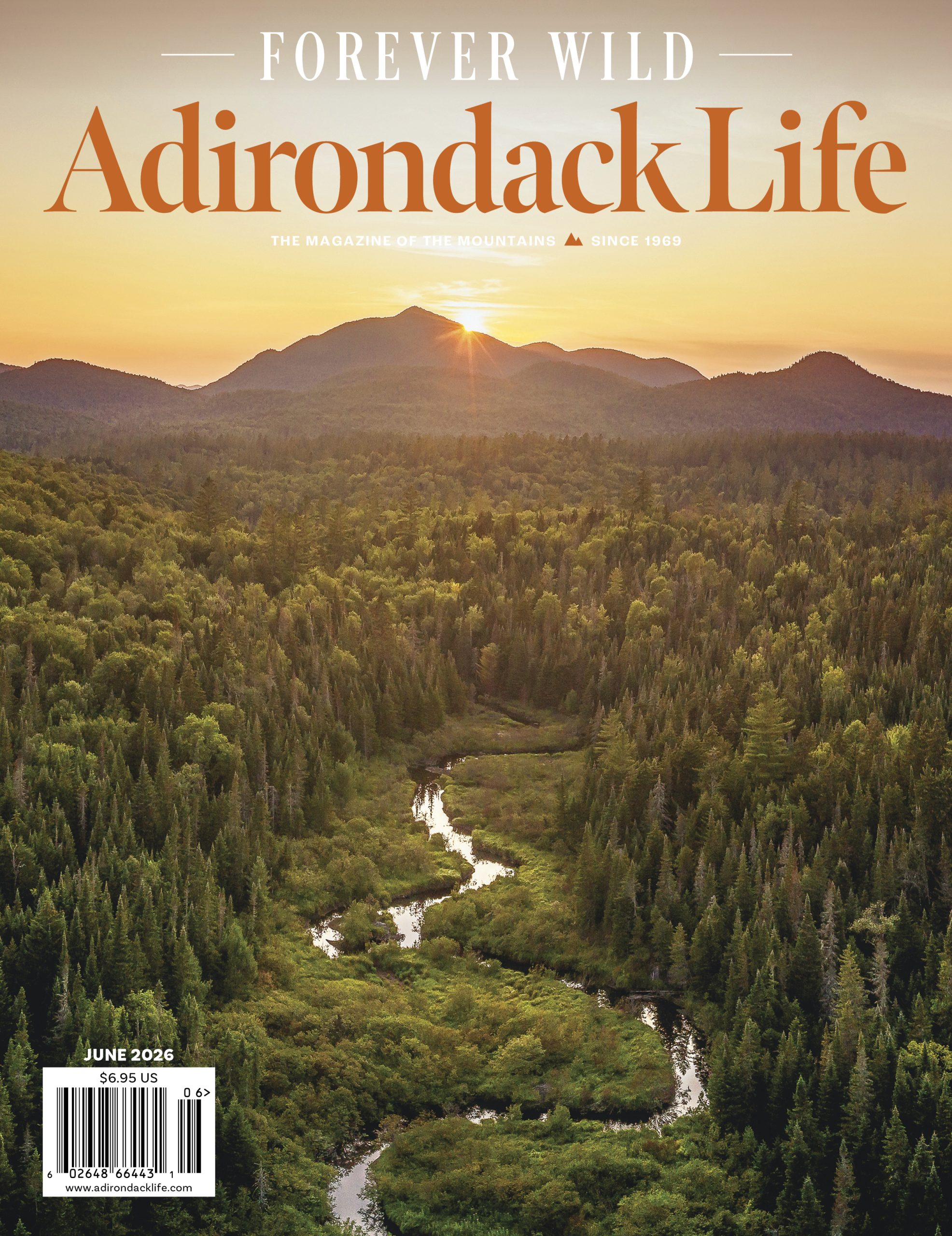
June 2026
Southern Adirondack waterfall hikes, a funky renaissance in Onchiota, bootlegging adventures, a mysterious island and more.







Adirondack Life Magazine
Subscribe Today!
Latest Articles
Follow Us

Adirondack Life Store
for calendars, apparel, maps and more!