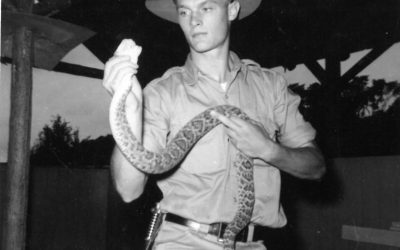
“NOT JUST A DISPLAY … BUT THRILLING SHOWS where LIVE REPTILES are HANDLED BY PROFESSIONAL HUNTERS. BRING YOUR CAMERA. YOU’LL WANT PICTURES.” How could a tourist driving busy Route 9 through the town of North Hudson escape the siren call of the New York Serpentarium? Opened in 1956 during a boom in Adirondack attractions, and marketing itself as “between Frontier Town and North Pole,” this small seasonal reptile zoo was well-positioned to capture attention.
History
The Town that Generosity Built
He was dying. And after caring for his brother eight years earlier—comforting him until his last gasp—he knew how this would end. But if consumption would soon kill him, leaving behind his beloved wife, two babies and a happiness and stability he could only have imagined, he wanted to spend his last days in the mountains and the forest. In his 1915 autobiography, Dr. Edward Livingston Trudeau wrote that such surroundings “seemed to meet a longing I had for rest and the peace of the great wilderness.” Weak and feverish, Trudeau endured the trip from his home in New York City to the remote, rugged northern Adirondacks. He was jostled and slammed in a horse-drawn wagon the last 42 miles from Au Sable Forks to Paul Smith’s hotel, where he was carried like a sleepy child to his room.
When the NFL Summered in Saranac Lake
For a handful of Augusts, Saranac Lake was the summer home of professional football in the Northeast. Between 1946 and 1951, the Philadelphia Eagles and then the New York Football Giants held their training camps in the village.
The Lost Generation in Saranac Lake
Glazed off-white bricks were chosen, 125 years ago, for the interior of the first laboratory devoted to the study of tuberculosis in America, because they were easy to clean. Some of those bricks are now etched with names—in plain, black lettering—just inside the entrance to the Saranac Laboratory Museum, forming a stark memorial to “Patients who Cured in Saranac Lake.”
Gone but Not Forgotten
The leads have all ended the same—evaporating like smoke against a landscape that holds the promise of beauty and the threat of violent indifference for those who cross its threshold.
Millionaire’s Row
The view from the top of Lake George’s Prospect Mountain is amazing. You don’t have to take a long, sweaty hike to enjoy it, either, because of the Veterans Memorial Highway that opened in 1969. It is the only scenic drive through the state-owned forest preserve that Laurance Rockefeller built in the Adirondacks. He wanted more, but Harold Hochschild stopped him.
The Girls Next Door
It wasn’t a very polite question to ask an older gentleman—one of the last of the Adirondack lumber-camp generation—who’d invited me into his home for an oral-history project. But it was a question that had been on my mind for years: “What about prostitutes?”
Uncle Fitz
The first thing I notice about the watch is its weight—it seems heavy for a timepiece, maybe more than a pound. Made of solid gold, roughly 125 years old, it’s about two inches across.
Leading Ladies
Taylor, Tankard and King
February is Black History Month. What this means in Adirondack classrooms is pretty much what it means everywhere: Students learn about the Middle Passage, Crispus Attucks, the Ku Klux Klan, the civil rights movement and Malcolm X. Videos of Dr. Martin Luther King’s “I Have a Dream” speech, episodes from public television’s “Eyes on the Prize” and scenes from “Roots” monopolize school TV monitors. Young readers get their first taste of storyteller Zora Neale Hurston and poet Langston Hughes.