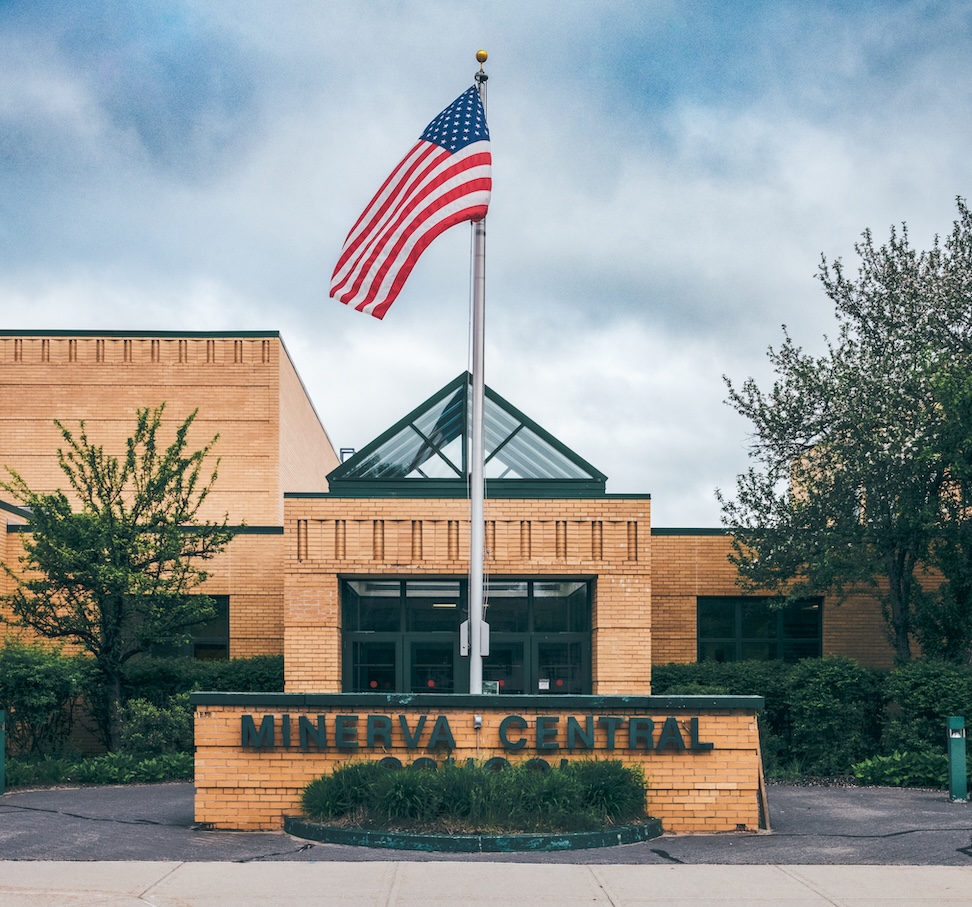
Photograph by Carrie Marie Burr
On a Friday morning in March, Devon Harris—one of the original members of the Jamaican national bobsled team—addressed a group of about 100 K–12 students in Minerva Central School’s gymnasium. A motivational speaker, Harris told the story of his improbable journey from the streets of Kingston (“I was just a kid from the hood,” he said) to the national stage. And of course the team’s immortalization in Cool Runnings, a 1993 film starring John Candy.
Harris had been brought to Minerva by his longtime friend, Tom Cavallaro, a transplant from Long Island who now owns the Alpine Homestead, a five-room inn just down the road. Cavallaro, who worked for years in media, is trying to breathe new life into a community that has been plagued by a steady outmigration of young adults and economic stagnation. He wants nearby North Creek, which sits at the foot of Gore Mountain, to invest in an industrial park and says the state should reestablish rail service between Warren County and the Capitol Region. There aren’t enough jobs, Cavallaro says. Which means little incentive for young people to stay. Which in turn fuels declining enrollments—a problem endemic to the Adirondack Park and much of New York State—as costs to keep schools operating continue to rise. It is a vicious cycle.
Cavallaro was hoping to use Harris’s visit to generate some excitement for a fundraiser to buy a couple dozen Chromebooks for Minerva’s senior class. After the event at the school, Harris gave a talk at Cunningham’s Ski Barn in North Creek before heading up to Lake Placid to visit with Jamaica’s newest Olympic team. Cavallaro said turnout was poor—he was too embarrassed to tell me how many people showed up.
“We both left there in shock,” Cavallaro told me, noting that Harris frequently does outreach work in some of Jamaica’s poorest schools. Cavallaro wants to help but isn’t even sure about the future of his own business. He said he’s charging half of what rates should be—the inn is 10 miles from Gore Mountain—and hasn’t been completely booked for four years.
“We’re dead,” he told me. “We’re starving.”
Minerva’s woes point to a dilemma facing many small schools in the region: they are the lifeblood of their communities—in some cases the only public institution left standing—and yet perennially under resourced, which is largely a function of New York State’s funding formula. Unlike most states, the bulk of school funding in New York—about two-thirds—comes from local property taxes. This means poorer districts, or districts with a smaller tax base, have much less to work with. “Small rural districts aren’t going to be able to provide anywhere near the educational experience as their wealthy counterparts,” said David Little, Executive Director of the Rural Schools Association of New York State.
Minerva, a town of under 800 on the southern edge of Essex County, has seen its enrollment decline for the last two decades. The school has essentially been operating on an austerity budget since 2014, when the town twice voted down a tax increase that would have funded a series of capital improvements. (If a proposed school budgets exceeds the tax cap by more than two percent, it requires a 60 percent majority of voters to approve it.) And things are now looking shakier than ever, with deep cuts to federal spending and potential state-level reforms that could reduce funding for rural schools.
Minerva’s not an outlier. Even the largest districts in the Adirondack Park, such as Saranac Lake, have seen a steady drop in enrollment and are beginning to discuss the possibility of school closures. Or mergers.
“I think every community will get to that point,” said Dan Mayberry, superintendent of Keene Central School. “As you vote on your school budgets and you vote to keep the doors open to comply with this two percent tax cap that has been pushed by New York State for roughly the last 13 years, it gets more and more difficult.” But the decision to merge or close a school can take many years to work through and is often divisive. Schools have deep historical ties to the communities they serve and the families that have lived there for generations.
Beyond educating kids and providing other important services, such as pre-K and counseling, many schools have come to serve as a kind of social welfare network. Lynn Green, who grew up in Minerva and has worked at the school for more than 35 years, organizes a shoe drive every year. She gathers donations from the community that allow the school to purchase about 30 pairs of sneakers for kids to start off the year.
“If a kid needs something, we make sure they have it,” Green said. “That’s the kind of community and school we are. That’s us.”
It is hard for her to imagine what it would mean for Minerva if the school were to close or merge with another district.
“I think we’re kind of the glue that keeps the town going,” said Green. This puts a lot of pressure on schools—and educators—especially at a moment when rural communities are struggling to stay afloat.
Last fall school boards at Minerva and neighboring Johnsburg Central voted on a merger proposition that left open the possibility of school closure. For Candice Husson, who has spent well over half her life learning and working in Minerva’s two-story brick building, this was a difficult discussion. Husson attended Minerva through the eighth grade, when her family moved to nearby Newcomb (population 381); she returned to the area after college to teach fifth and sixth grade at the school before being named superintendent, a position she has held since 2023 (she actually serves as principal and superintendent, a result of cost cutting efforts in the district).
But Husson supported the merger. She knew there was a good chance it would lead to the closure of her beloved school. But she also believed it would be a boon for students and perhaps a long-term solution for both districts, which are grappling with declining student enrollment and rising costs.
Though the feasibility study on the merger explicitly stated that both buildings would remain open, there were fears in the community that Minerva would eventually be swallowed up by the bigger school in Johnsburg (this is in fact one of the only ways to achieve a meaningful reduction in expenses).
But Husson thought merging the two districts—both of which are K–12 schools—was a good idea. It would have led to an infusion of funding for a school that has been struggling to meet the needs of its students. It would have increased the number of faculty and staff available to teach classes. And there would have been a wider range of course offerings and extracurricular activities, especially for high-school students. The two schools already share sports teams and are only about six miles apart, which would make the project much easier than in other parts of the park where distance and geographical features (think mountains) often serve as insurmountable barriers. In short, Husson felt it would provide better opportunities for students, which at least in theory is central to every school’s mission. Minerva—the Roman goddess of wisdom—seemed to be pointing in the direction of bringing the districts together.
The process also overlapped with an effort by the state to encourage districts to “reorganize.” A couple of months before the vote, the state agreed to significantly boost the amount of money it provides to schools that merge (an incentive that other districts in the state have taken advantage of). Under the new formula, a unified Minerva-Johnsburg district would have received approximately $1.4 million a year for 14 years, nearly five times the amount previously on the table, according to Husson. It seemed like a winning proposition.
But the schools were split. On the evening of September 23, the school boards held meetings in their respective buildings. Johnsburg, in a 4-3 decision, narrowly approved the proposal. Minerva’s board voted it down unanimously, meaning there would be no town-wide referendum. The merger proposition is dead, at least for now.
Rachel DeGroat, who has served on the Johnsburg board for more than a decade and whose five children have all attended the school, voted in favor of merging. But she wasn’t surprised by the outcome.
“I knew we had an uphill battle,” she said. “These schools are our communities’ identities. And huge employers. People were afraid we would lose our identity and that jobs would be lost. And I can understand that.”
Nellie R. Halloran, president of the Minerva board, said in an emailed statement that there were too many unanswered questions. “There was no way to know what the day-to-day, real outcomes of a merger would be, as all of those decisions would have been left for a new school board to decide,” she wrote.
Still, it’s unclear how the broader community would have voted. According to Husson, public sentiment seemed to be pretty evenly divided, even though turnout at meetings was often subdued. Johnsburg superintendent Mike Markwica, who has been at the school for more than 20 years, said the process was open and ultimately productive. And he sees it as the beginning of a conversation, not the end. “The questions aren’t going to go away,” he said. But schools and communities may need to come up with new solutions, new ways of approaching the crises they face. “I don’t think the only question is—or I don’t think the only question should be—should our school stay open,” Markwica says. “It is looking at educational practices and what is good for students.”
After Harris’s talk, Husson gave me a tour of the building, which sits on Route 29 just outside of the hamlet of Olmstedville, a former mill town settled in the early 19th century. It was lunchtime so most of the classrooms were empty and teachers were busy prepping their afternoon lessons. Husson pointed out the pre-K and kindergarten classroom, which has only seven students this year, a somewhat grim reminder of just how difficult the next five to 10 years will be. At the moment, the largest class in the school has only 12 students. The trend at Johnsburg has been similar. Markwica said enrollment has declined from about 440 students when he arrived in 1996 to under 250.
In the wake of the no vote, Husson and Markwica are doing what they have always done: finding ways to provide opportunities for their students. Husson believes small schools, short of merging, can invest in what they do well and share those resources with other districts, something schools in the Adirondacks are already doing. But she’s not sure if it is a long-term solution.
“I believe Minerva Irish,” Husson told me, standing in the first-floor hallway lined with black-and-white photos of graduating classes going back to the early 1930s. “I’ve been here my whole life. I love it. I love the community … I love the school.… But I also want to think big picture about what’s best for the district. And you know, I hate to see this place go, but are we going to be able to continue to provide what we need for our students?”
About 10 years ago residents in Westport and Elizabethtown-Lewis were asking themselves a similar question (Wills-boro was part of the initial conversation but eventually withdrew). Both schools were struggling to retain staff and bring new teachers to the region. Class sizes were diminishing to the point that administrators were discussing whether to pay tuition to send high-school students somewhere else. According to Josh Meyer, who was then principal at Westport, there was a sense that the districts were running out of options.
So in 2019 the towns voted to merge, creating the Boquet Valley Central School district. Both schools have stayed open—with grades K–5 in Westport and 6–12 in Elizabethtown-Lewis. But there are ongoing efforts to downsize, which Meyer says was always part of the plan. (Last December residents in both towns voted against a proposal for construction of a new building and campus in Lewis after it was revealed that costs would be significantly higher than anticipated.)
Meyer, who has since gone on to write a dissertation on recent school mergers in New York State and is superintendent of the new district, says it was the hardest thing he’s done professionally. But he’d do it again. “It was the right thing for kids, it was the right thing at the right time for these districts.”
Students have benefited, he says. They’ve doubled the number of AP classes and electives. There are new sports and extracurricular activities including archery and power lifting. They’ve expanded pre-K offerings. And there are more teachers, so students don’t end up with the same instructor for middle school and high-school classes.
This is the argument he’d make today. Not that merging will reduce taxes or magically reverse declining enrollments. Or make it easier to recruit teachers in towns where there isn’t enough housing. Those problems won’t go away. But merging can improve opportunities for students and over time help to reduce costs. And this, Meyer believes, can help rebuild communities.
Still, making it happen isn’t easy. Part of the reason why Meyer wrote his dissertation was to help provide other districts with a kind of blueprint for doing what Boquet has done. Increased state aid for mergers is a step in the right direction, but Meyer thinks the education department could do more. For example, there should be an office for mergers and consolidation—a statewide resource hub for school administrators.
“It’s not like you merge and someone hands you a … list of things to do,” Meyer said. Instead, he continued, “It’s, OK, you merge, good luck. And that’s really the end of it.”
Whether other districts follow in Meyer’s footsteps, they may have no other choice but to work more closely with their neighbors.
Already fragile support networks are crumbling. COVID 19 emergency funding, which provided a boost to rural schools, has largely dried up. Meanwhile the state is making noise about changing its funding formula—last year Kathy Hochul, in an address to the legislature, said, “It just doesn’t make sense to keep paying for empty seats in classrooms,” a reference to schools with declining enrollments—which would disproportionately impact rural areas. And the federal government is in the process of dismantling the Department of Education—in a March executive order Trump called for closing the department, which only Congress has the power to do—and many of the programs that serve the Adirondack region, from Head Start to nutrition funding to services for students with disabilities. “[Trump] has already decimated the department,” said Little of the Rural Schools Association. “They’ve lost half of their employees and he’s stopped the flow of money under any number of federal grants, which means the state will have a hard time maintaining current spending levels.”
Schools will have to figure out how to make do with even less, yet another incentive to figure out how to pool resources and collaborate with one another. Short of merging, Husson sees this as perhaps a way forward for Johnsburg and Minerva, at least for the near future.
For now, she’s focusing on ensuring that the board and community continue to support the school and the programming it provides. And she’s looking ahead to the fall, when the town and district will mark a rather important milestone: the school’s 100th anniversary.
Adam Federman is a reporting fellow with Type Investigations and the author of Fasting and Feasting: The Life of Visionary Food Writer Patience Gray. He covered the standoff at Moss Lake in our October 2022 issue. issue.
.