Photograph by Tadeusz Mieczyński
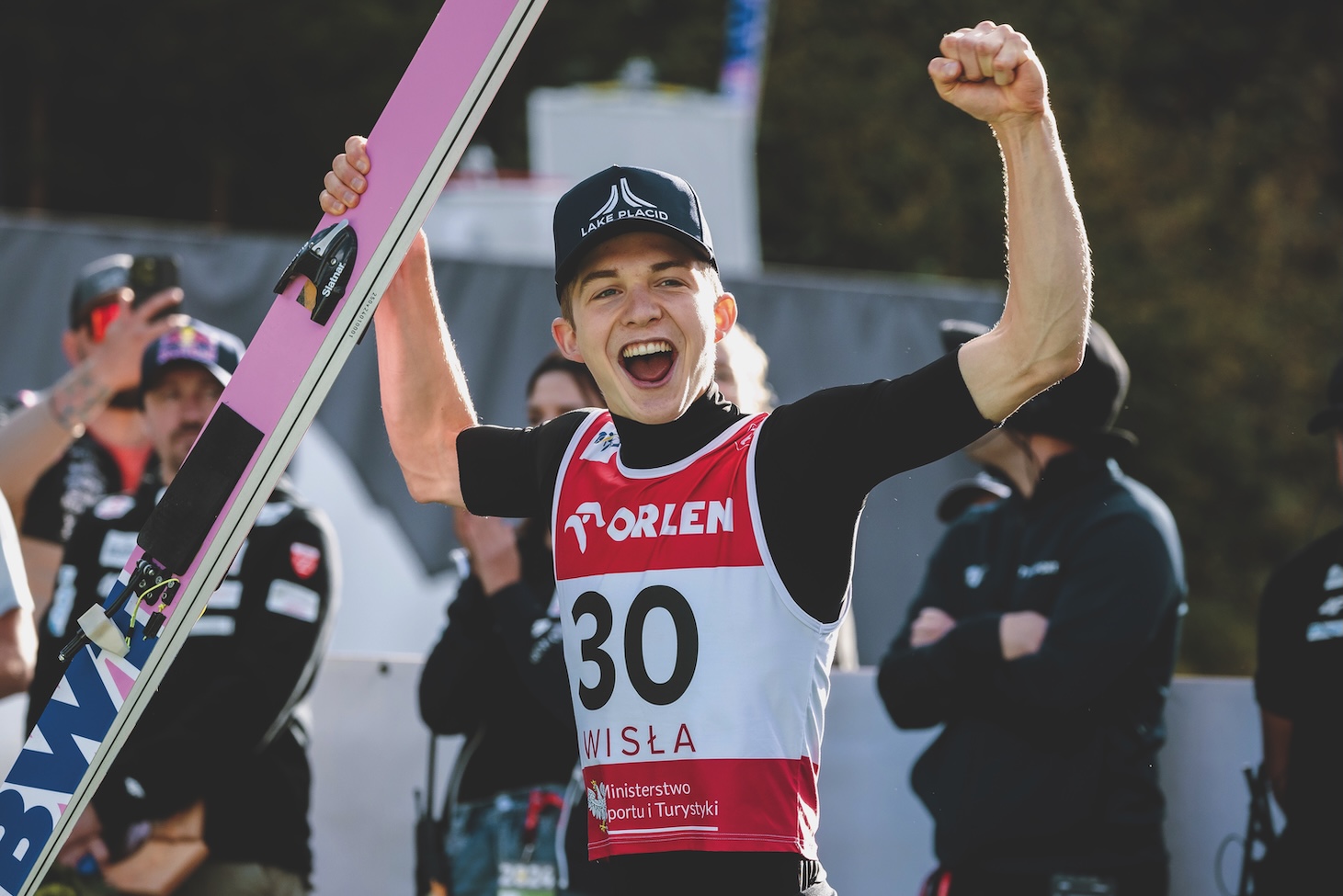
On a blustery fall afternoon, after a series of wind delays, Mimi Wacholder leans out from a watch stand on the ski jumps in Lake Placid. She looks on as her son Tate Frantz launches himself into space, his body angled sharply forward over his skis.
Frantz is a boyish-looking 20-year-old who grew up here in the village. Over the last year, he has emerged as the most successful American male ski-jumper ever to compete on the World Cup circuit. “It’s pretty astounding,” Wacholder says. “He’s kind of come onto the scene as a young gun.”
The expectation is that Frantz will build on his current momentum through this winter’s World Cup competitions, capping it with a spot on the U.S. ski-jumping team that will travel to the Milan Cortina Olympic Games in February.
Wacholder says her son writing a new chapter in Lake Placid’s winter sports story would be “very special. There’s just such an Olympic pride in this very small community.” But she also says his World Cup success has already turned him into a rising sports celebrity in Europe, where ski-jumping draws big crowds and strong TV viewership.
“I watch him signing autographs,” Wacholder says. “He can’t really walk on the jumping hill without being stopped.”
Bill Demong, an Adirondacker who trained in Lake Placid before winning Olympic gold and silver in the Nordic combined—a sport that involves ski-jumping and cross-country skiing—says Frantz has a real shot not just to reach Milan, but to medal.
“Tate has been really fun to watch ascend,” Demong says. “He’s got a level head, he’s super focused. That makes him a really dangerous athlete and he could really do something in these Olympics.”
On this day, every time Frantz jumps, the announcer hails him as a hometown hero, the latest bearer of Lake Placid’s Olympic hopes.
Ski-jumping is one of the most technical winter sports. Athletes launch from the jumps and literally fly, gaining aerodynamic lift from the plane of their skis and the cut of their suits.
Despite a side-shearing wind, Frantz sticks each landing gracefully on the dry hill, which is surfaced with textured plastic, used for training and competition during months when it’s too warm to manufacture snow. Colin Delaney looks on with obvious satisfaction. He was one of Frantz’s early coaches, from the years when Frantz attended Northwood School, in Lake Placid.
“He’s a very talented physical athlete. I don’t like to call [his jumps] fearless, but it’s controlling the fear,” Delaney says. “You have to acknowledge the risk of what you’re doing, then tell your body, This is what you need do to.”
In 2021, when still a teenager, Frantz took another big risk. He left Lake Placid, attending a winter sports–focused school program in Lillehammer, Norway, home to many of the best ski-jumpers in the world. “Going into a system that has experience producing so many top international athletes, that was really valuable for him,” Delaney says.
Frantz agrees that making the move and surrounding himself with the toughest possible competition was a game changer. “I’m in an environment with 50 elite athletes, competing and training daily,” he says.
Frantz now anchors a young team of American jumpers, most also training in Norway, who show growing promise in World Cup competition, gaining ground on the Scandinavian athletes who dominate the sport.
“Tate’s young, but he’s already on a really high level. His flying skills are really, really good,” says Tore Sneli, the Norwegian jumping veteran who is now Frantz’s head coach.
According to Frantz, he first realized his jumping instincts and physical talent might lift him into the highest echelon of winter sport when he was 12 years old. He won a juniors’ competition in Anchorage, Alaska, besting athletes as old as 18. “That was a turning point,” says Frantz.
He describes ski-jumping as fun and thrilling, but he points to his passion for technical refinements, hitting the jumps exactly right, angling his body just so, as giving him an edge. “I’m fixated on small details. Those small changes add up over time.”
Coaches and athletes who’ve worked with Frantz talk about his calm, his precision, his level head. For a 20-year-old on the cusp of qualifying for his first Winter Olympics, he seems remarkably unfazed. But he says he often has to put the pressure and expectations out of his mind. “When someone mentions the Olympics, I get goosebumps. I don’t like to talk about it, to be honest. I don’t want to jinx anything,” he says.
Asked about Lake Placid’s legacy of sending young athletes to the Olympics, Frantz nods and says he wants to be part of that history.
“It’s pretty incredible. A few years ago, I was one of the little kids here, looking up to other athletes. To be one of the faces of winter sports in this town would be a huge honor.”
Follow Tate Frantz at www.fis-ski.com or on Instagram @tate_frantzz.
Brian Mann is a correspondent for National Public Radio and a frequent contributor to Adirondack Life. He lives in Westport.