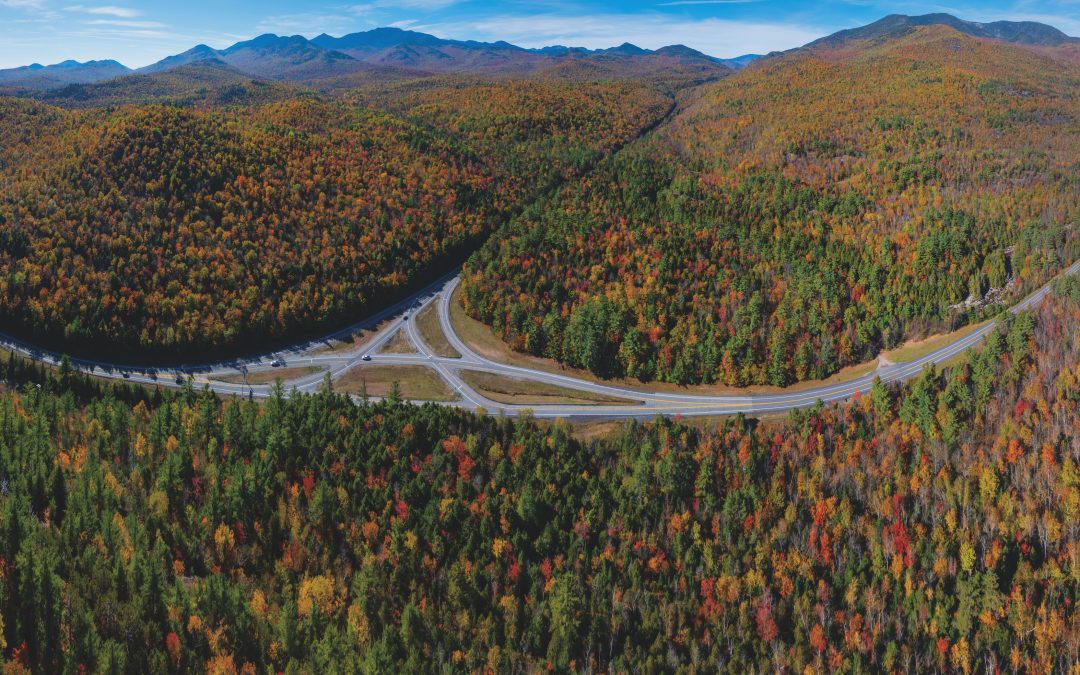
Norman Ridge Road during the ’98 Ice Storm photograph by Mark Kurtz
Ever since Adirondackers began keeping track, they’ve recorded hamlet-swallowing blizzards that socked folks behind snowdrift-jammed doors, downpours that ravaged river valleys, and hurricanes with jet-speed winds that uprooted chunks of forest. The Blue Line may protect most of the Adirondacks’ six million acres from manmade destruction, but it’s no barrier from Canadian arctic blasts, Nor’easters that push in from the Atlantic, and Lake Ontario’s lake effect precipitation. And there’s plenty more atmospheric drama headed our way, says meteorologist Darrin Harr: “As long as we have weather, there’s always potential for an extreme event.”
Harr, who maintains a National Weather Service field station by the Indian Lake dam, should know—if there’s Adirondack storm data he hasn’t recorded himself, he’s analyzed it. And Harr is always game to talk and interpret meteorology.
Following are 10 of the Adirondacks’ most extreme weather events in chronological order.
1816: Year Without a Summer
June 1816 “was the coldest ever known in this altitude,” according to an 1894 Plattsburgh Republican article recalling the Year Without a Summer. On July 5 there was ice the width of “common window glass.” In August “ice was formed half an inch thick…. The sun’s rays seemed to be destitute of heat through the summer, all nature seemed to be clad in sable hue.” A lack of “wheat, rye, oats and vegetables, except [marble-size] potatoes” made harvesting impossible, recounted Amslem Lincoln, of Malone, whose recollections of that year appeared in a 1933 edition of Au Sable Forks’s Record-Post.
When the local general store had no flour for the men waiting with sacks to carry home, Lincoln witnessed “strong, hardy men cry like children, sobbing that they could bear hunger themselves, but that it was hard to see their children starve.” It was yet another blow after surviving the War of 1812.
Experts now blame the climate catastrophe on volcanic activity in the South Pacific, particularly Mount Tambora’s eruption on Java. “Wind circulation patterns distributed the ash miles high into the atmosphere around the world,” explains Darrin Harr. In this case there was enough debris “to reduce the amount of energy coming from the sun, reducing sunlight enough to change the climate temporarily.”
According to Discovery Channel’s Extreme Earth website, the event wreaked global chaos: starving Europeans ate moss and baked bread of straw and sawdust, a cholera epidemic ravaged India, and rice crops withered in China. Farming failures nudged Joseph Smith and his family from Vermont to Palmyra, New York, where the founder of the Latter-day Saints movement was said to have unearthed the faith’s sacred golden plates. A lousy harvest that year also pushed Abel Wilder, grandfather of Almanzo, from the Green Mountains to the North Country town of Burke, where he established the backdrop for Laura Ingalls Wilder’s Farmer Boy. In Fort Ann, near Lake George, farmers without feed for their pigs grazed the animals northwest of town where chestnuts and acorns were plentiful—the nuts gave their meat a tasty flavor and, to some locals’ dismay, the place became known as Hogtown.
September 20, 1845: The Great Windfall
In 1845, almost half a century before the Adirondack Park was formed, the region was being built up: Dannemora’s Clinton Prison was completed; the first wooden dam was constructed on the Indian River for easier log cruising; a plank road to transport ore connected Westport and Elizabethtown.
But that year, on the 20th of September, what’s been described as a tornado leveled everything in its 275-mile-or-so path, from Antwerp, near Watertown, across Edwards and Russell, through Sevey, over Union Falls, Keeseville and Peru, across Lake Champlain—even sucking up the steamer Burlington’s deck planks—and into Vermont. Thousands upon thousands of acres of timber were toppled.
An excerpt from the 1892 Annual Report of the Forest Commission of the State of New York describes the “most marked destruction” by the Great Windfall “occurring about six miles north of Lake Massawepie…. The path of the cyclone is still to be seen here, extending for twenty-five miles in length and varying from a half to over a mile in width. Its appearance was
described by those who observed it at a little distance as awfully sublime, it being a cloud of pitchy blackness from which vivid lightnings and deafening thunders incessantly proceeded, while the air was filled to a great height with materials carried up from the earth and branches torn from the trees.”
“Not a single tree was left standing,” wrote Frederick J. Seaver in Historical Sketches of Franklin County and its Several Towns. “All were snapped off or uprooted, with a result a tangle of trunks and limbs and tops that was impenetrable.”
Old maps depict the scarred swath as a stripe that runs from Newton Falls to present-day Windfall Pond, north of Tupper Lake. Writer Paul Jamieson commented in his guidebook Adirondack Canoe Waters: North Flow that the storm’s course can be traced by names such as the “Windfall Road … three Windfall Brooks, and two Windfall Ponds.” Post-Civil War pioneers, drawn to the windfall’s clearing, settled in Franklin County. Today there’s barely evidence of the destruction, though it’s believed that Route 3
from Cranberry Lake to Tupper Lake follows the storm’s path. Back then “meteorology was in its infancy so there’s no archived data to piece together the cause of this event,” says Harr. “But since tornadoes are rare in the Adirondacks, it’s possible this was the result of supercell thunderstorms usually found only in Tornado Alley—Texas, Oklahoma, Kansas and Nebraska.”
July 12, 1947: Saranac River Flood
That the Saranac River spilled its banks was nothing new to the residents of Moffitsville, Saranac Hollow and Picketts Corners in the 1940s. For more than a century the water that flowed alongside these Clinton County settlements allowed prosperity—mills, forges, fertile farmland, fine fishing, a liquid highway to float timber to Lake Champlain. Despite a history of floods, the people accepted the Saranac’s unpredictable ways, each spring clearing culverts and ditches, moving livestock to high ground and reinforcing banks just in case.
But they weren’t prepared for a flash flood on the afternoon of July 12, 1947. It had been a wet summer, so the ground was already saturated, the river already high, according to Saranac historian Jan D. Couture’s “The Controlling of the Saranac River: Floods and Freshets 1830–1947.”
Training thunderstorms, says Harr—“when several move over the same area over a short amount of time”—likely hit the region with lightning and thunder, pummeling a three-to-four-mile section of the river valley in torrential rain. By evening, according to the Plattsburgh Press-Republican, every brook had overflowed and new ones had formed, rushing into the raging river. Roads were submerged in water or eroded to depths of 30 feet; homes normally 80 feet above the water were undermined; trees were uprooted; and thousands of tons of topsoil and subsoil were washed away, devastating orchards, potato fields and corn crops. In Moffitsville a wooden bridge collapsed, plunging a 1941 Chevy sedan and its passengers into the Saranac. Three were drowned, including an eight-year-old boy, found seven miles from the broken span.
Harold Ryan, who was 16 at the time, told Couture the rain came down “in buckets” for 45 minutes before turning into a ready downpour. “The air was so charged with electricity from the lightning that he could feel the charge in the air making his hair stand on end,” she writes.
November 25, 1950: The Big Blowdown
Sixteen-year-old Richard “Bud” Brownell was scoping the woods around Russian Lake, near Big Moose Lake, on the last day of hunting season, November 25, 1950. He had split from a hunting party, when a hurricane crashed in “from he east around noon, felling huge trees that had survived for centuries,” according to Big Moose Lake in the Adirondacks: the Story of the Lake, the Land and the People, edited by Jane A. Barlow.
Brownell crouched “alone under a large tree for what seemed like an eternity while the [100-mile-per-hour] wind howled and trees all around were snapping like matchsticks, flying through the air.” Later that day the young hunter was reunited with his party, though it took them hours to negotiate through the jumbled trees to safety. Scenes like this played out from the High Peaks to Herkimer County, some hunters and hikers barricaded for days behind the blowdown.
Networks of roads were impassable, fire towers had fallen, telephone and power lines were wiped out, dozens of public campsites and private residences were destroyed. And the forest was ravaged: Barbara McMartin, in The Great Forest of the Adirondacks, reported that the blowdown “affected 420,000 acres and was said to have caused a loss that ranged from a quarter of the trees to the entire forest cover. The loss was estimated at two million cords of softwood and forty million board feet of hardwood. The Cold River country between Seward and Santanoni experienced the greatest destruction, followed closely by the Moose River Plains,” and private lands of more than a quarter million acres were also wrecked.
Celebrity hermit Noah John Rondeau was forced to leave his Cold River settlement. Hikers would have to wait five years until trails could be cleared to scale more than a half dozen High Peaks. Even Article XIV of the state constitution, which protects the Forest Preserve, had to be circumvented to allow lumberjacks in to clean up the mess. Otherwise the fallen timber posed a fire hazard: one spark and the entire park could be torched. Most of the cleanup was finished by 1956, though you can still find blowdown across the region.
The term “storm of the century” is overused, says Harr, but “that’s what I’d call this one. Very few storms have reached the same intensity since. We usually think of colder weather coming from the north, warmer weather from the south. While the Adirondacks were on the warm side of the storm with temperatures in the 40s with hurricane-force winds, sub-zero chill plunged southward into Kentucky. The storm became so strong that cold air eventually wrapped all the way around and pushed into the Adirondacks from the south.”
June 30, 1963: Giant Mountain Landslide
The morning of June 30, 1963, Tony Goodwin looked to Giant Mountain from his family’s Keene Valley cabin and was shocked to see the 4,626-foot peak’s new appearance. For 90 minutes the afternoon before, a rainstorm pounded Giant, causing a landslide that gouged its slopes into new slides: six half-mile-or-so-long ones, some up to 1,000 feet wide, on its west face; one half-mile-long, quarter-mile-wide slide on its eastern face; and many smaller streaks of exposed rock on its other faces.
The deluge was caused by an unusual condition of stagnation of the local weather pattern, explains Harr. During most thunderstorms the center of the storm keeps moving. Here, it stayed put, fueled by hot, moist air rising up the mountain. When the six inches or so that hammered Giant’s peak-top washbowl—a glacial formation called a cirque—spilled over, it caused the already-saturated topsoil to peel away from the rock, sending an avalanche of mud, trees, boulders and other debris down the peak. “As the slides reached the head of Roaring Brook, they slowed momentarily and may have even formed temporary dams which, upon breaking, further increased the violence of the flood which swept down the valley,” over Roaring Brook Falls, covering nearly 400 yards of Route 73, “and forcing drivers and passengers of 10 or so cars to flee for their lives to higher ground,” wrote Goodwin in an August 1982 article in this magazine. (Because excavation would take time, rescuers held their breath that people—not otherwise missed—weren’t trapped inside one of the cars submerged in mud.) “For that brief period, a flow equal to 1/100th of that of the mighty St. Lawrence came down this one small mountain stream.”
March 13-14, 1993: Superstorm Blizzard
The storm of March 13–14, 1993, rocked a massive terrain, leaving death and destruction from Cuba to Canada. The New York Times called it “one of the most powerful storms of the century—a monster with the heart of a blizzard and the soul of a hurricane.” Harr recalls seeing “a hurricane-like eye” on the radar. At one point, he says, “nearly a third of the continental United States was in the storm’s grips.” During the event’s peak, four to six inches of snow fell per hour, ultimately dropping up to 30 inches onto the entire Adirondacks. People were trapped in their homes and most roads, including the Northway, were closed. Ticonderoga’s Grand Union grocery store lost part of its roof in gale-force winds; a Lake Champlain Transportation Company crew and passengers spent the night in a ferry lounge, using life jackets as pillows, when conditions anchored them at port; a man and his two-year-old daughter were discovered near Stillwater, hypothermic but alive, after snowmobiling into a whiteout; a pair of snowmobilers suffered frostbite after losing their way and spending the night near Cranberry Lake. Harr admits that he, too, rode his snowmobile near Indian Lake during the brunt of the storm. “It was really scary stuff—blinding snow and bitter cold,” he says. “I almost didn’t make my way back home after common sense kicked in.” At home he measured two fresh feet of powder that raised the snowpack to four feet.
Most places never lost power; cleanup was swift. For its size the blizzard was remarkably uneventful in this region, most likely because it was forecasted with amazing accuracy several days before the storm developed in the Gulf of Mexico, explains Harr.
July 15, 1995: Adirondack Derecho
The late Clarence Petty, who worked as a forest ranger with the conservation department in the 1950s, once said that the July 15, 1995, storm with 100-plus-mile-per-hour winds that felled 10 million trees in the park was “nothing like the hurricane we had back in 1950.” Still, the 1995 derecho—a Spanish word for “straight” that in meteorological terms means a violent, long-lived windstorm with sustained gusts of 8 miles per hour or greater—was a devastating event.
“When the atmosphere becomes very hot and humid, it’s like shaking up a soda can,” says Harr. “The longer you shake it, the more potential energy that builds up. When a cold front or atmospheric disturbance plows into a steamy air mass, it’s like popping open the can and soda spraying all over the place. Air rises rapidly with the eruption of violent thunderstorms.”
“The force of the storm’s fury struck a triangle of territory bounded by Blue Mountain Lake, Gouverneur and Lyons Falls, covering some 940,000 acres,” wrote Elizabeth Folwell in “Lowdown on the Blowdown” (December 1995). Near a High Falls campsite, a canoeist reported that nearly every tent “had been hit by huge trees and heavy limbs and a canoe was smashed.” A child was severely injured at Forked Lake; a man was killed at Eighth Lake campground and a woman died at Lake Lila. Getting to Lila required the ambulance squad and other volunteers hours and hours with chain saws to hack through the logs thrown across the road. Most highways were clogged with tree trunks and debris, making places like Star Lake, where homes were mangled and electricity was out, desolate islands of destruction. It took days to restore power.
Folwell recalls flying out of Long Lake on a helicopter with photographer Nancie Battaglia two days after the storm to capture birds’ eye views of the damage: “From the passenger seat I had topo maps to mark our locations; the rear doors had been removed so Nancie could dangle out for taking pictures, a web harness the only connection with the chopper. Heading northwest we flew over miles of flattened timber, huge pines and hemlocks tossed down like spilled toothpicks. The most impressive damage was in Five Ponds Wilderness Area, on eskers and around remote ponds where it seemed not a single tree was left standing. We were in the air for more than two hours and never were out of sight of real storm damage.”
January 5-9, 1998: Ice Storm
Ice Storm ’98, as it’s known, coated Quebec, northern New York and Maine in an inches-thick sheet of ice, killing power and people. President Clinton declared Jefferson, St. Lawrence, Franklin, Lewis, Essex and Clinton Counties major disaster areas. Soldiers, Red Cross volunteers and National Grid workers were dispatched—in some areas it took weeks to restore electricity to the 100,000 northern New Yorkers without it.
Inside the Blue Line remote hamlets connected by woodsy roads meant emergency service workers couldn’t get in and residents couldn’t get out. Arctic temperatures caused hypothermia and carbon monoxide poisoning from ill-ventilated generators—in this region four people died from toxic fumes. To make matters worse, the storm lingered day after day, bringing more frigid blasts and whiteout snow. The North Country looked like an icy torpedo had detonated against its landscape—the National Guard’s Humvees that chugged along tree- and powerline-strewn highways added to the scene. More than a decade later broken forests continue to heal from the ice storm—trees in Wilmington’s notch still look like a weed whacker lopped their crowns.
The infamous storm, says Harr, had much to do with elevation. “For days, warm, southerly winds in the middle and upper atmosphere delivered copious amounts of moisture over the North Country. Shallow, cold air from a Canadian high pressure system oozed into northern New York, where it got trapped in the St. Lawrence, northern Adirondack and Champlain river valleys. Rain froze on surfaces on impact as temperatures hovered between the middle 20s and lower 30s throughout the storm.”
September 16-17, 1999: Hurricane Floyd
Hurricane Floyd, which tore through the North Country September 16-17, 1999, often comes up in the context of the Wright Peak avalanche the following February. Six backcountry skiers were hurled down the mountain—one man was killed, a woman suffered life-threatening injuries. According to a February 21, 2000, article in The New York Times, “State officials said that Hurricane Floyd last September may have been a actor. Its rains caused a landslide that swept away vegetation and soil from the slope where the snow collapsed.”
Floyd cruised up the coast from North Carolina, “merged with a jet stream storm system and morphed into a Nor’easter,” says Harr. “Heavy rain—about three to five inches in a short amount of time—loosened soil enough that 40-mile-per-hour gusts easily brought down trees.” The storm caused some rivers to flood their banks, zapped power in Ticonderoga, Crown Point, Witherbee and other Essex County communities, and produced new slides in the High Peaks, including a 2,500-foot streak down Mount Colden.
Adirondack rock climber and guidebook author Don Mellor recalls scaling Dix after the event. “The rock, so typically grayed with age, was white and clean. I remember using the red garnets sparkling against the white background as friction for my feet.” So many new slides—Basin, Armstrong, Wright, Dix—so far apart in the High Peaks “indicated the furious nature of the event,” he adds.
February 14, 2007: Valentine’s Day Blizzard
As it is for most couples, February 14 is a special day for Harr and his wife, Penny. But after 2007, it also marks Darrin’s love for snowstorms. He describes the blizzard that affected the eastern half of North America as being “the most awesome display of winter firepower that I’ve ever witnessed.” For days a storm system produced tornadoes, including one that touched down in post-Katrina embattled New Orleans.
It blanketed the Midwest in heavy snow and blasted freezing rain onto Baltimore, Washington DC, Philadelphia and New York City. Throughout it all Harr stuck to his radar, tracking a heavy vein of snow that moved up through the Catskills and Mohawk Valley, hoping it would reach Indian Lake. It finally crept into Hamilton County on Valentine’s Day afternoon, darkening the sky and “snowing so hard, I couldn’t tell how fast it was piling up,” he says. In three hours he’d shoveled his driveway six times—it was “as though a white curtain” enveloped the house, which shook violently from blasts of wind. The blizzard churned above for several hours, also ravaging Blue Mountain Lake and Piseco. By the time the storm rolled on to sections of northern New York and Vermont, up to 40 inches had dropped; along Routes 28 and 30 snowplows had created eight- to nine-foot-high snowbanks. The highway department brought in bucket loaders to move the piles so people could leave their houses, recalls Harr. A Blue Mountain Laker reported seeing snow reach the feet of the walking man silhouette on a pedestrian-crossing sign at the town beach. The icon soon disappeared, covered up to his scalp. Across the North Country whiteouts wreaked havoc. There were reports of shoveling-related heart problems and carbon-monoxide poisoning from backed-up generators; barn roofs caved, killing cattle—but there were no human fatalities. What the National Weather Service calls a “blockbuster event” was “nothing short of amazing,” says Harr.