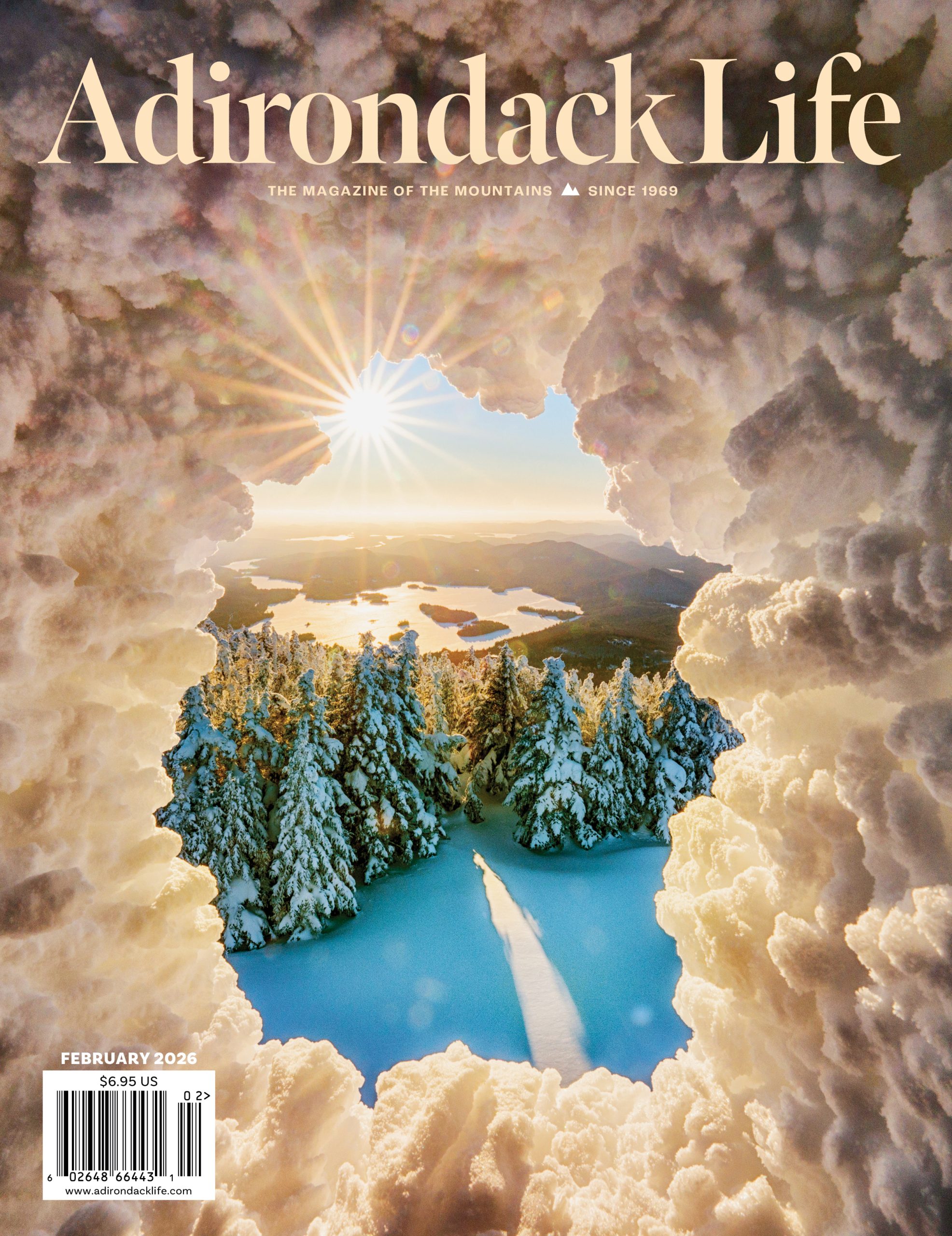
Photograph by Nancie Battaglia
When I travel around the Adirondacks, I sometimes squint my eyes, trying to imagine how the landscape looked before it was settled: Wild, tangled woods. Unencumbered rivers.
But looking out at Lake Champlain from Essex’s ferry dock, I go back 13,000 years, when the freshwater lake as we know it was an inland sea. Whales swam here. Across the lake, in Charlotte, the skeleton of a beluga was discovered.
Today’s 120-mile-long Lake Champlain is bordered by two countries and two states. And from Valcour Island, off the coast of Plattsburgh, all the way south near Lake George, it’s part of the Adirondack Park.
Last year, in an Adirondack Life article about Adirondack lakes, we included Champlain. Later, a reader sent us a note that said, “I have never heard of Lake Champlain referred to as being in the Adirondacks.”
Half my life I’ve lived in a landlocked part of the park. I’ve crossed Lake Champlain again and again for live music, medical appointments and to see friends, but, like that reader, it’s easy to think of the lake’s shoreline, what’s sometimes called the Adirondack Coast, as a boundary that separates what is Adirondack and what is not. And if you spend most of your time in the park’s interior, the Champlain Valley that rolls down to the water—with its open meadows and farms and, in communities like Essex, clusters of boxy 18th- and 19th-century buildings—also seems out of character. It’s nothing like the lofty peaks and rustic cabins that some people associate with the Adirondacks.
Chris Maron, cofounder and former executive director of Champlain Area Trails (CATS), has lived in Westport for 25 years. He can see Lake Champlain from his front door. He says that when he and his wife, Michelle, go out on the water, “there are no other boaters, just an unexplored wild place.”
That’s because much of the focus in promoting the Adirondack Park is on the High Peaks, says Maron. Lake Champlain, its pastoral valley and lower-altitude mountains are often overlooked.
“Maybe people just think of the lake and the valley as a gateway,” an area you have to pass through to reach the central parts of the park. “If you drive the Northway, in North Hudson you’ll see the High Peaks Welcome Center. It should be the High Peaks and Champlain Valley Welcome Center,” he says. “There’s crowding and overuse in the High Peaks, while the Champlain Area Trails are an undiscovered part of the park that should be explored.”
He’s right. CATS has created more than a hundred miles of trails in the eastern Adirondacks that meander through forests, farms, fields and up and down mountains. They’re accessible and family-friendly.
And Lake Champlain? This vast recreational playground can be experienced from one of many public beaches, by boat or, if you scuba dive, beneath its depths, where remnants of a vibrant maritime history remain. Anglers make big catches and birders spot herons, egrets and other species.
Again, I squint my eyes, this time from a spit of land facing Valcour Island. I’ve been here before to imagine the chaos of the 1776 naval battle that happened in this bay and, a century after that, the free-love commune that took residence on Valcour. But what I see now is a protected island—no condos, no bright lights. Just another part of the Adirondack Park.