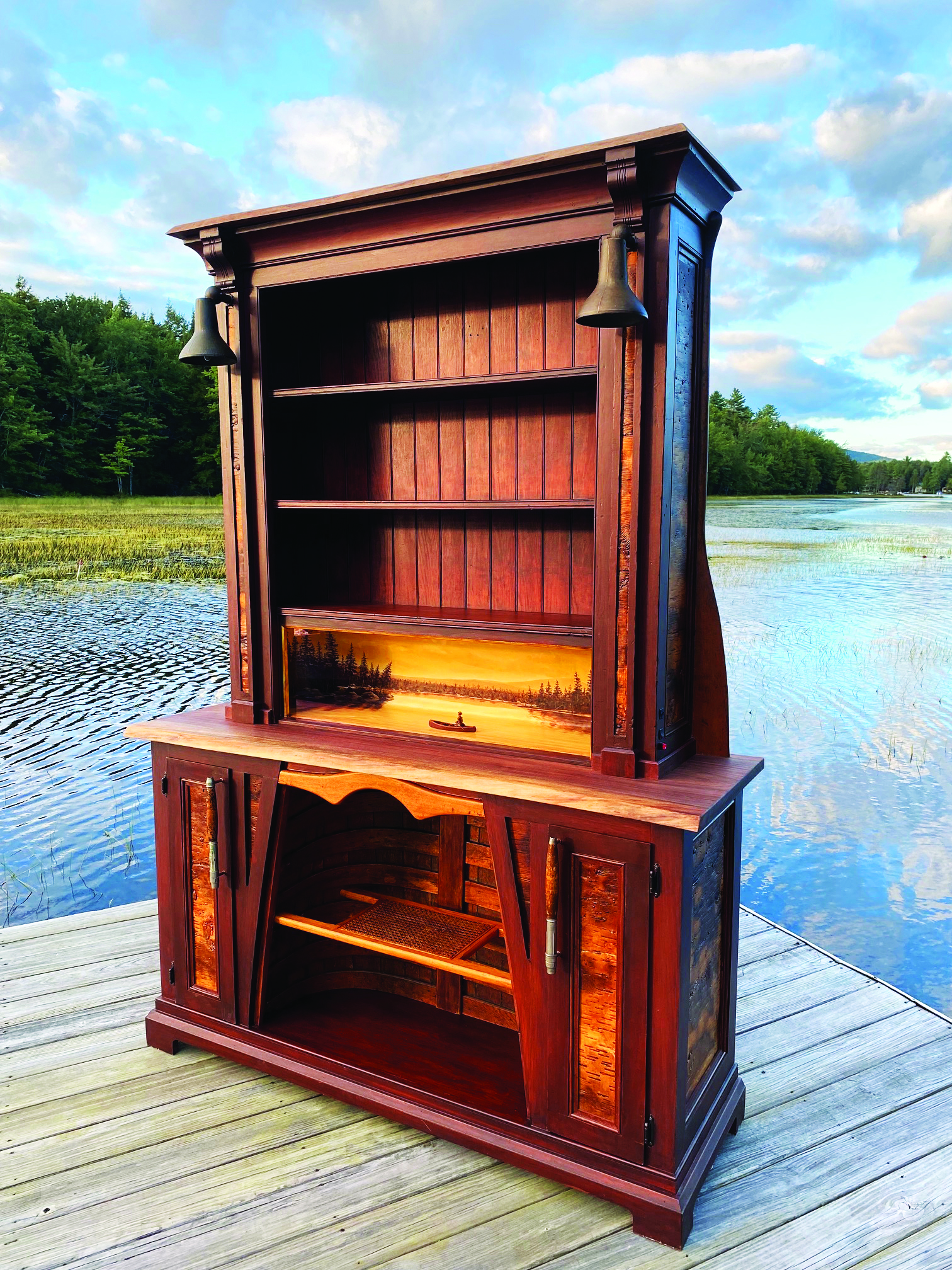
Artist Paul Lakata brought home one of the most coveted honors at the Rustic Furniture Fair in September 2024. The annual exhibition, mounted by Adirondack Experience, in Blue Mountain Lake, showcases artisans who specialize in crafting classic and contemporary rustic furnishings. Lakata received the People’s Choice Award for his cabinet entitled Peaceful Paddle, an honor the public votes on in recognition of outstanding work.
Lakata’s cabinet features a diorama of a canoeist paddling an Adirondack lake. The scene’s whimsy made it a hit among fairgoers, who gladly stood in line throughout the day to gaze in wonder at the miniature display.
“Paul always brings something exceptional and surprising in his work,” says Rustic Fair coordinator Liz Belyea, the public programs manager at Adirondack Experience. “It can be challenging to make rustic work stand out, but Paul has done that.”
Lakata has been a regular fair exhibitor since the mid-2000s, when he first turned his talents to creating rustic art. The Johnstown native isn’t sure exactly how many awards he’s garnered over the years, but enough. His website features images of his cabinets and consoles, made largely of pine and trimmed in hemlock or black walnut. Each piece is eye-catching in its detail. His oil paintings, too, are reminiscent of the storied past of the Adirondacks: rugged, romantic, wild.
The artist’s enduring excellence led museum administrators to purchase one of his pieces for their permanent collection in 2024.
Lakata has long been drawn to art. Even as a child, “I always liked drawing and often had a pencil in my hand,” he says. At age 12, Lakata painted a race- car mural on his bedroom wall and it turned out so well, a classmate asked to have one for his bedroom. “That sort of started it all,” he says. Lakata went on to earn a bachelor of fine arts degree from Goddard College, in Vermont.
Lakata works as a graphic designer and sign-maker at Barney’s Sign Company, a business he co-owns in Johnstown with his brother, John. Since the mid-1990s, they’ve produced signage for companies around the region, often incorporating distinctive artwork into their pieces. Their reputation eventually led to Cooperstown, where Lakata was hired to create wall-sized murals for the National Baseball Hall of Fame and Museum. He also began painting sepia-toned portraits of baseball’s early greats, such as Mickey Mantle and Lou Gehrig. While handsomely rendered, the paintings didn’t sell well among collectors. “Because I didn’t have a name,” notes Lakata. “And I was so busy with the Cooperstown work, I didn’t have time to do anything else.”
So in the early 2000s, fellow artist Barney Bellinger suggested his friend check out the Rustic Fair, where Bellinger was a participant. There, Lakata encountered distinctive examples of handcrafted rustic decor. The style captured his imagination and he began considering what he could contribute to the genre. He started with frame-building as a way of enhancing his oil paintings. Bellinger gave him tips on how best to work with bark.
Lakata uses native woods, largely yellow and white birch, hemlock and pine. But instead of applying the bark’s outer layer to frames as many artists do, he discovered that the wood’s darker underside, particularly when aged and rotted, made a handsome counterpoint for his sepia-toned paintings. “No one else was doing that kind of work, so my paintings were well received.
He then moved on to furniture building, though today Lakata doesn’t consider himself a master cabinetmaker.
“My work is more free form,” he observes modestly. Working without plans, “I simply build as I go.”
The beauty of Lakata’s cabinetry is how each piece reflects his ingenuity and know-how. Some include nostalgic paintings, an interesting use of bark and twigs, or moving elements, details that place his work in a category all its own. For example, a stout, two-door wine cabinet is capped with a diorama of an Adirondack lake at twilight. It features a tiny steam launch, with an American flag at its stern, that magically motors around the lake as the golden hour turns the scene a shimmering amber. The effect is charming.
To create the niche, Lakata starts with a Styrofoam base he hollows out. This gives the diorama its depth. He covers the surface with joint compound, then sands and preps it for painting. The mechanism that moves the launch is actually a magnet with a small motor that’s hidden beneath the shelf. The project took him a year to complete.
“I rebuilt the boat three times to make it scale and to make everything seem believable,” he says. “I wanted it to have the feel of an Adirondack scene.”
To capture those scenes, Lakata reads and studies historic photographs from the Adirondack Park’s early years. One of his influences is painter and photographer Seneca Ray Stoddard, who was among the first to capture the Adirondacks in pictures, popularized by his guidebooks published in the late 1800s. Some of Lakata’s more traditional landscapes arise from his own photo references or plein air renderings, others are a composite of elements: a canoe from a painting or a fly-fisherman from a magazine cover. Lakata’s contemporary images reflect what he calls impressionistic realism and are sometimes shown
frameless, with the canvas simply attached to a tree limb or a rugged piece of bark.
The 65-year-old artist makes his home on Caroga Lake, north of Johns-town, where he and his wife raised two sons. His garage functions as his studio space, a generous, well-lit room filled with power tools, tree limbs and furniture in varying stages of completion.
Inspiration strikes rather unexpectedly, it would seem. During a visit to the Orvis sporting goods store in Queensbury, Lakata spied a media console with a beautiful guideboat sitting beside it. Wouldn’t it be interesting to marry the two? he mused. Soon he was sketching ideas, and in the finished piece, the television screen rises from beneath the guideboat.
In another cabinet that incorporates a guideboat, the completed vessel was cut into three sections. But the results are equally inspiring. Each part of the boat bookends the cabinet, the interior lined with a dark birch bark. The cabinet is crowned with a sign that reads “Guide Services and Supplies” and is connected with an oar on either side. The center section features a landscape as a focal point, and here, the craft’s hand-woven seat serves as a shelf on the lower half of the cabinet.
“Using the guideboat was a surprising element,” says the Adirondack Experience’s Belyea. “I love that about Paul’s work, his attention to detail is really exquisite.”
That attention to detail is what keeps collectors and fans coming back for more, says Lakata. “People look forward to seeing what I’ll come up with next.”
And truth be told, so does he.
See more of Paul Lakata’s work at paullakata.com. Watch the artist’s Peaceful Paddle in action here.