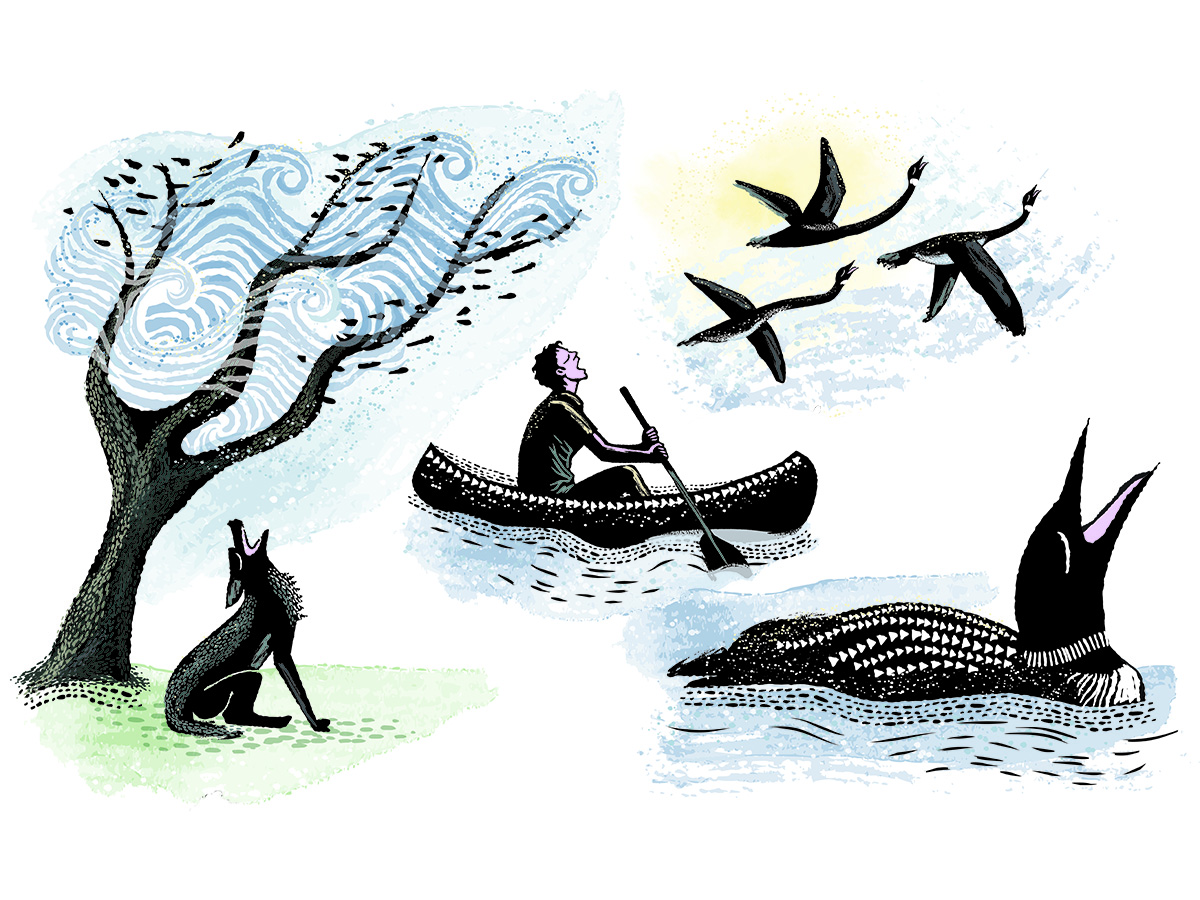
Illustration by Gwen Jamison Vogel
It is easy to imagine that spring in the Adirondacks is a concert. The trills of toads and background refrains of frogs and the choral fervor of coyotes. The staccatos and crescendos of waterfowl and the tremulous songs of meadow and forest birds. A white-throated sparrow whistling “Taps” at dusk while I sit in a rocking chair on the porch of my Long Lake cabin. Surrounded by the sounds of wildlife in spring, I tend to forget that if it is music I hear, portions express more than the joy I frequently feel at the passing of winter, including aggression and sexuality and probably various urges and needs beyond my comprehension. I mostly guess at the meanings of vocalizations by wildlife. I react to them and try to make them my own. I call them songs. I write the lyrics.
Archaeologists in Europe uncovered a flute that was made from a swan bone around 35,000 years ago, a discovery that leads me to wonder whether a Paleolithic musician used the bone solely because, like most avian bones, it was hollow, or also because the musician hoped to play the flute as beautifully as swans whistle. Yet was it the musician who killed the swan?
What might the flute tunes have evoked about the natural world and the humans who survived in it many millenniums before my foraging in supermarkets? If I could hear the singing of the first hunter-gatherers who entered the region now called the Adirondacks, it might be so unfamiliar that I wouldn’t recognize it as music. Yet when I was in a small canoe loaded with food and camping gear and caught in a sudden windstorm on Little Tupper Lake, I began singing a traditional Siouan song I sometimes listen to on my computer back home. I knew little about the meaning of the lyrics, but my ignorance failed to matter while I belted out and mangled music in rhythm to whitecaps lifting and dropping the canoe. I didn’t wish to hear the wind and water: I desired to hear my life.
Although the overall rhythms of nature are cyclical, I tend to translate them into meanings that parallel my linear and finite life. Migrating geese are making more or less the same calls regardless of the season, but to me the flocks sound ecstatic in coming and bittersweet in going. From my cabin porch one night, I heard what sounded like a distant beeping of a car alarm, but it seemed to be pulsing from unbroken forest; I heard it again the next night, though coming from a different location in the forest, and finally, after going inside to consult a guidebook, I realized I had been hearing the leitmotif of a saw-whet owl. I then automatically assumed that the bird was seeking a mate, its call expressing a longing with which, on that particular night, I had cause to commiserate. In a letter included in a posthumously published collection of his correspondence, the neurologist and author Oliver Sacks observed, “Everything we build is an allegory of ourselves: the whole human world a metaphor of the human state.” He could have added—with equal accuracy—“including every story we construct about nature.”
I needed such a story in winter a decade ago when my wife first had brain cancer. Arctic cold had dipped into New York State. While taking a walk in the woods, the trees clattering and moaning, I paused to stand still and close my eyes. The wind gusts began to sound like ocean surf and transfigured my location to a warm beach. I was soon back in the woods, of course, a somewhat long hike home still ahead, but felt changed by my short seaside hiatus. The moaning of the trees began to sound like bassoon music. I constructed a story of endurance: boles bending and straightening and crowns twirling, a few silent birds perched and swaying with the dance of the wind and trees as if overly enthusiastic balletomanes. Yet that story wasn’t quite enough. I needed more encouragement, perhaps a foreshadowing of spring to help me endure a sadness that verged on despair, which is one reason why in late winter I thought to check the health of my honeybee colony in the Alleghenies of New York, the region where I reside for most of the year. I tapped at the hive body and listened with an ear pressed to the wood and heard the whirring of bees clustered for warmth, a sound that meant the colony was likely to survive long enough to gather sustenance from the blooms of pussy willows in early spring; and a month later, as the field bees foraged, I set up a lawn chair close to the hive, opened a bottle of beer, and sat down to see and listen to rejuvenation. The colony was humming. To me, on that sunny afternoon, a hosanna.
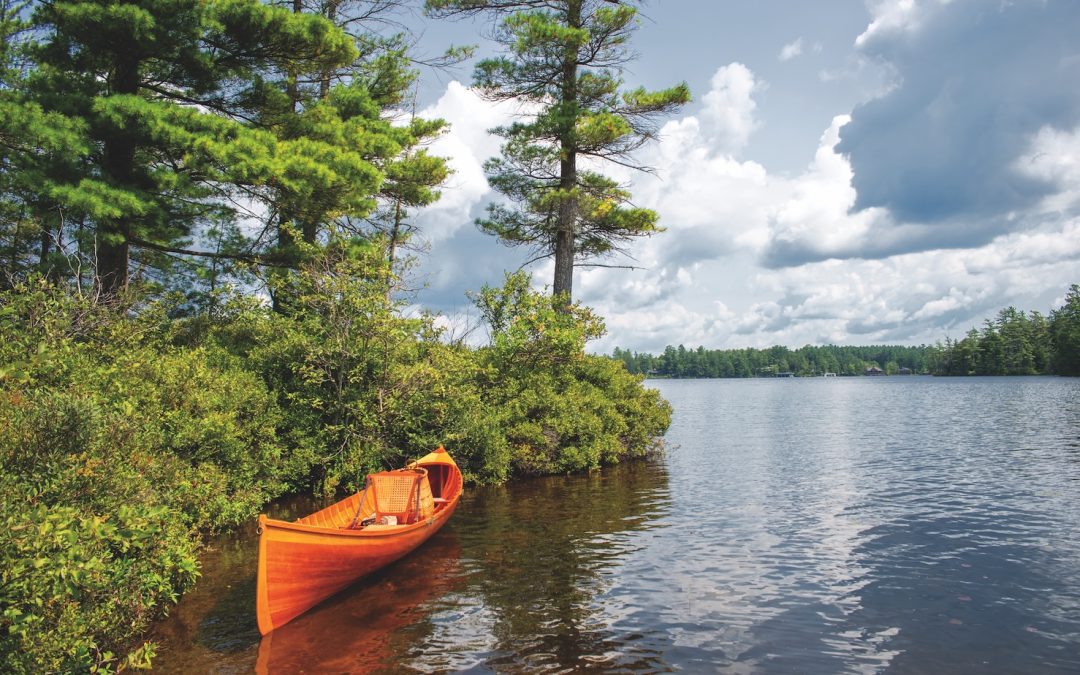
On one of the final mornings of last spring, I drove several miles from my cabin to fish for bass in Forked Lake. A loon called in the mist out on the water. I answered from my canoe, and we went on exchanging yodels even after we were near enough to see each other. I told myself the bird was an incarnation of my wife, who had died the previous spring, and she had returned to a place we loved to say that she missed me as much as I did her. The loon dove and surfaced several times while I casted and retrieved a fishing lure over submersed boulders and waterlogged tree limbs. Eventually, a different loon called from elsewhere on the lake, prompting the departure of my musical companion, which was, after all, just a bird, just life.
Mark Phillips is the author of the 2001 memoir My Father’s Cabin, which Arcade Publishing will reissue this May.