Last spring, after months of deep freeze, the East Branch of the Ausable River still choked with ice, a neighbor caught a bobcat on his backyard trail cam. In the grainy footage, the creature saunters forward again and again on a seven-second loop, like those clips you see on the news that track the last movements of a missing person—or a criminal.
A bobcat in Jay, with its rock ledges for dens, and meadows and woods for hunting, isn’t unusual. They’ve been spotted crossing back roads and the frozen river.
From my front porch I can see what made this a desirable place for permanent human settlement more than 200 years ago. Nathaniel Mallory, the first to stay awhile, likely saw the river tumbling down over the heap of boulders in the heart of our hamlet and envisioned prosperity. Mallory’s Bush, as Jay was called until it was renamed after a Founding Father, grew like so many other communities that straddle rivers, givers of life and industry.
But before that built world, the foothills, peaks and valleys were owned by no one, an interspecies free-for-all shared by deer, cougars, lynx, moose and bobcats, who moved with the seasons to eat, mate, birth and parent.
Today that open wildway is mostly gone. Now there are houses, farms, fences, bridges, roads and gas stations. About 2,500 people live in the town of Jay. We buy land. We pay money for ownership of dirt, trees and views.
Some years ago, in Jay, a colleague let the family dog—a 10-pound, fluffy type—outside at dusk for a pee. When the animal was called, he didn’t come. The next day his lifeless body was spotted on the property in the maw of a bobcat. It was heartbreak for the family, but also an accepted truth in country living, where raptors and weasels sometimes swipe housecats, and coyotes can wipe out a chicken coop.
Bobcats are usually nocturnal, and, like most wild felines, elusive. Prey are deer, snowshoe hares and other small mammals; predators are mostly humans, who hit them with cars and, in season, can legally trap or shoot as many cats as they’d like.
After the trail-cam discovery, neighborhood rumors swirled about the bobcat. One person worried it would eat children while they played outside. There was a threat to kill it.
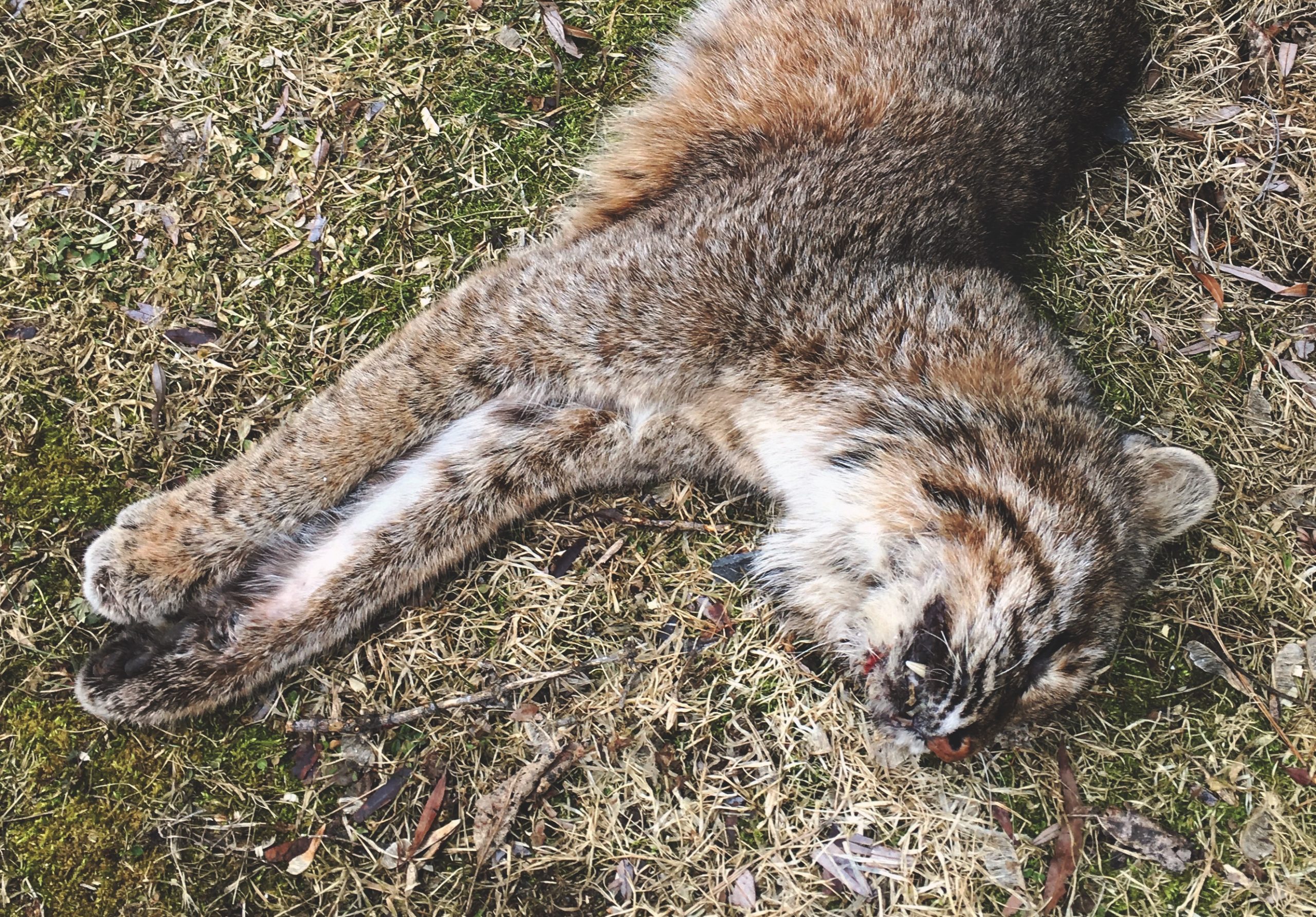
A day later my husband found a dead bobcat beside our garage.
The animal was stretched out, eyes shut, like a super-sized housecat napping on a sofa. On its chin was a thin, cherry-red scrape. The bobcat’s wildness—its paddle paws and bobbed tail—seemed at odds with the familiarity of its kitty face and fuzzy fur.
My daughter cried. We flipped a wheelbarrow over the animal to protect it from scavengers and called the Adirondack Wildlife Refuge, based a town over. When a rehabber came, she told us the cat was a female, obviously starving after a long, hard winter, and that it might have been nursing. Without their mother, the kittens, wherever they were, would likely die. The bobcat was dragged away by a rigid leg—undignified in the same way you see a doe carcass or a heap of porcupine on the side of a road. We can speculate, but the cause of the bobcat’s death was never determined.
My husband and I have discussed putting a fence around our yard—cordoning off a space for our dog, where in summer, passersby can’t see our kids throwing a football or running through the sprinkler, and so the deer can’t criss-cross, leaving their Lyme-infected ticks in the shrubs and grass. For us, though, that defeats the purpose of living here—like bringing a flat-screen TV on a deep-woods camping trip.
Some say the Adirondacks, the size of Yellowstone, Yosemite and Glacier National Parks combined, is one of the last wild places in the country. And that our state park, with its mix of public and private lands, is a great experiment gone right. That may be. But the debate of who deserves to live here, of who came first and truly belongs, wages on.