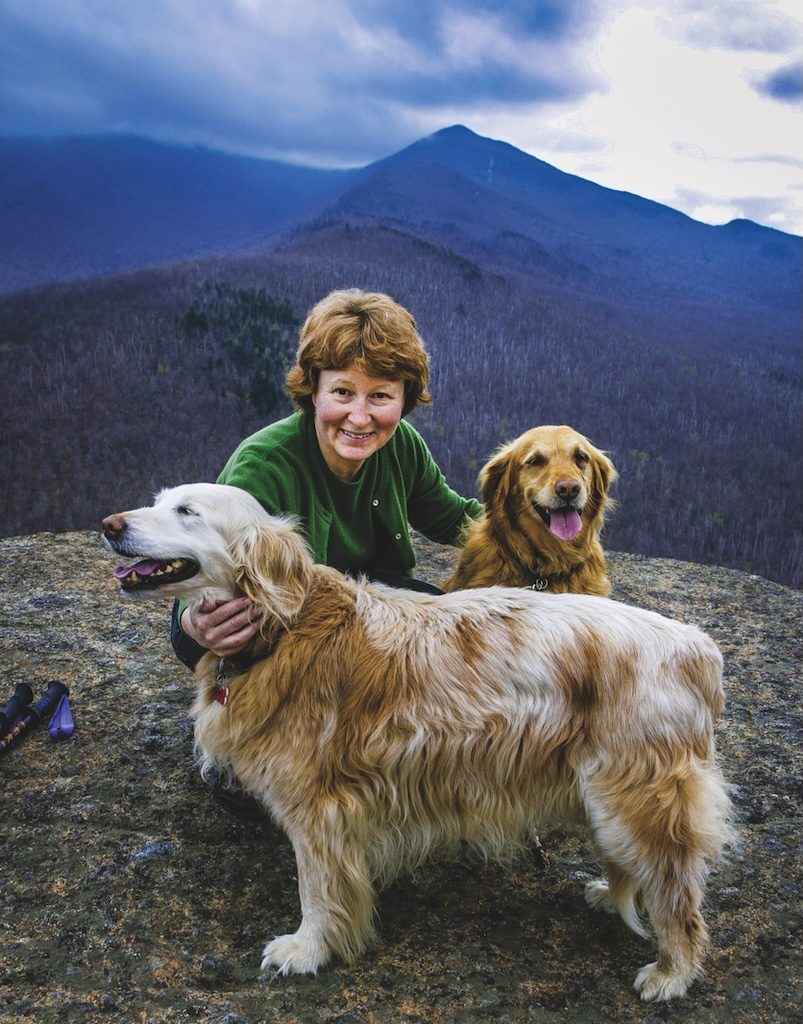
Photograph by Nancie Battaglia
I was four years into ski bumming and two years out of college when I met Betsy in the summer of 1993. I got tipped off that she was at Desperado’s, in Lake Placid, eating dinner; I walked in and asked for an internship. Never mind that she only accepted undergrads. She took pity and made an exception.
Betsy schooled me up on widows and orphans, kerning and leading, the Chicago Manual of Style, the passive voice (tsk), and words and phrases to avoid (“very,” “unique,” “very unique”). She hated lazy, clichéd, predictable writing; she weaned me off almost all my bad habits except procrastination.
My internship ended; I got lucky again and was hired as assistant editor and stayed another dozen years. On her watch we went from seven issues a year to eight. Deadlines loomed. We’d put the magazine to bed—packing actual physical things like galleys and slides and original artwork, and then shipping it to the printer—then a bunch of us from art and edit would go to High Peaks Base Camp, in Upper Jay, for pizza and beers. I made lifelong friends in the Brick Church.
Betsy was fearless and protective, nurturing both editors and writers. She made good ones great and great ones truly shine. Her prose was economical, understated, sublime; her pitch-perfect, lyrical essay “Why We Bagged It,” about her and Tom’s foray into small-town storekeeping, remains one of the finest pieces of magazine writing I’ve ever come across.
It’s not in the least bit shocking to those who knew Betsy that her contributions to the Adirondacks—in both word and deed—will still be measured many decades hence. At the risk of sounding cliché, she may have lost her sight, but her vision never wavered. —Galen Crane
Betsy lived pretty much at the geographic center of the Adirondacks, which makes sense because she was in many ways the Park’s beating heart. No one, I think, had traveled these communities more widely, knew more people, helped with more projects, provided more links. Even—or maybe especially—as blindness limited her wanderings, it seemed to intensify her ability to connect with this place. If the Adirondacks is, as I’ve always thought, a great experiment in whether people and nature can make their livings in the same place, then she was the researcher guiding that experiment, interpreting its results—and doing everything she could to make it come out right. It’s not just the people who knew her that are pausing in memory; the hemlocks bow their tops a bit in recognition, and the waters of the lakes ripple with unseen breeze. The great loss of her passing is proof of the great power of her life. —Bill McKibben
I never heard Betsy complain about her sight being taken away—imagine a lifelong writer who suddenly can’t read what she’s writing—but she did complain about the primitive text translator she had to use, the robotic voice she said couldn’t read any rhythm in the work. So the next story I sent her I made a tape of myself reading, and to jazz it up I drove to Santa’s Workshop, in Wilmington, and did the reading there, with the elves of summer singing behind me. It got a laugh, which is all that mattered. Betsy could be all business, and then that laugh would hit you out of nowhere. Like the best writers and editors I’ve met, she matched a ruthless attention to craft with a love of all that’s unbalanced in the world, the quirks of nature, both human and not, that give those elves their song. —Joe Connelly
“So, what do we know?” Betsy would ask, her kickoff to a car ride or dinner. At Adirondack Life Betsy was arbiter of all that was officially known about the Adirondack Park. As someone who lived deep inside the park and one of few people to travel all of its 92 towns, Betsy was also the merry pollinator of the unofficial Adirondacks.
She had the scoop on everything—the best dish at the best restaurant in Old Forge or Olmstedville, what billionaire paid how much for what camp, who their caretakers were, how to find an obscure canoe put-in, where pink water lilies bloom. Once I offered what I thought was mint gossip about a local politician. Betsy’s sly reply, “I knew that in November.”
Betsy had friends far and wide, and after she lost much of her sight she stitched rides together along the 80 miles from home in Blue Mountain Lake to work in Jay. I was part of that thread, and there was no better Adirondack travel companion. She was funny, irreverent and omniscient. Her writing will continue to delight and awe, but I wish we could talk. There are still so many things I want to ask her. —Mary Thill
We like to think our destinies are ours to choose, but Betsy’s death has got me thinking. If she hadn’t edited my first story for Adirondack Life, and kept on as my editor for my first decade, would I have made this region my home? I’m guessing probably not. But because the Adirondacks that intrigued me beguiled my new editor as well, I had, from the beginning, an advocate who gave me so much room to root around in under-the-radar social history I not only got lost in it, I’m still getting lost, and still indebted to the gift of my first editor’s good faith.
And now multiply my experience by all the writers she encouraged and improved over so many years, and add to them the editors she brought along and boosted, and then the non-writers, the friends (so many!), neighbors, educators and environmentalists who also felt the easy light of Betsy’s influence, the boon of her keen interest.
If you are reading this, you know just what I’m talking about—what it meant to have Betsy in your corner, pointing out the angle, the strategy, the language that could make a project more achievable, more winning. And not by arguing or preaching or command. Not her style. In that low, steady, sultry voice of hers, she just made sense. Couldn’t help herself! It was always, thrillingly, enough. —Amy Godine
Between her work at the Adirondack Center for Writing and her legacy at Adirondack Life magazine, Betsy was the pivot point around which the Adirondack literary community revolved. She knew every Adirondack book, no matter how obscure, and the history behind it. The Adirondack Literary map that we produced came mostly from Betsy’s memory. She knew it all; I just had to write it down.
There is a concept called “shared memory” in a relationship, where one person doesn’t bother to learn certain facts because it’s a given that the other person knows them. I suspect it isn’t just true for me—there must be so many others in this region who relied on Betsy’s uncanny ability to always have the answer. What are we going to do now?
Betsy was brilliant, witty, talented, dedicated to her community, and had limitless energy. But her most outstanding trait, the thing that made Betsy Betsy, was her curiosity. She was curious about everything. This made her outstanding company, the best, really, to know as much as she did about everything but to still be thirsty for more. —Nathalie Thill
Betsy Folwell—educator, editor, businesswoman, writer, friend to just about everyone, booster of all things Adirondack—has been a fixture on the Adirondack scene for so long it’s impossible to imagine our culture without her. She had irons in a lot of fires, starting when she was Director of Education at the Adirondack Museum, decades ago, and more recently at the diner in Blue Mountain Lake, which she helped establish, and where I saw her walk in the door one day a couple of years ago and immediately start bussing tables, unasked but much appreciated. Mostly I knew her as an editor. She suggested or worked over (or both) most of my articles for Adirondack Life, which she edited with a sharp eye but a light touch. No slip of punctuation, no poorly chosen word, no vagueness got past her. And what a terrific writer! Her Short Carries, a collection of essays she wrote for this magazine, remains a gem of polished prose and insight into some of the quirkier corners of our park, a place she knew as well and treasured as much as anyone ever has. —Philip Terrie
She gave good banter, a necessary survival skill in the central Adirondacks, where she had lived since the 70s. We first started talking on the phone when I was the assistant editor of this magazine in 1986 and Betsy was still the director of the Adirondack Lakes Center for the Arts, in Blue Mountain Lake. The magazine, in its perennial seat-of-the-pants way, would send Betsy edited stories for final fact-checking and proofreading before they went to the printer. Her margin comments, years before she edited here or had even written a story for us yet, were acute, the wit attached to them acerbic, knowing, wise. Her opinions were unvarnished. And on the phone she fell easily into the kind of back-and-forth conversational jousting you only got from years of immersion in frequent exchanges with Adirondackers of the deepest, oldest, most traditional stripe. You had to bring your A game. Anybody who could, while keeping a straight face, give as good as they got, getting in some clever licks of their own, would be accepted and admired, as she was. —Chris Shaw