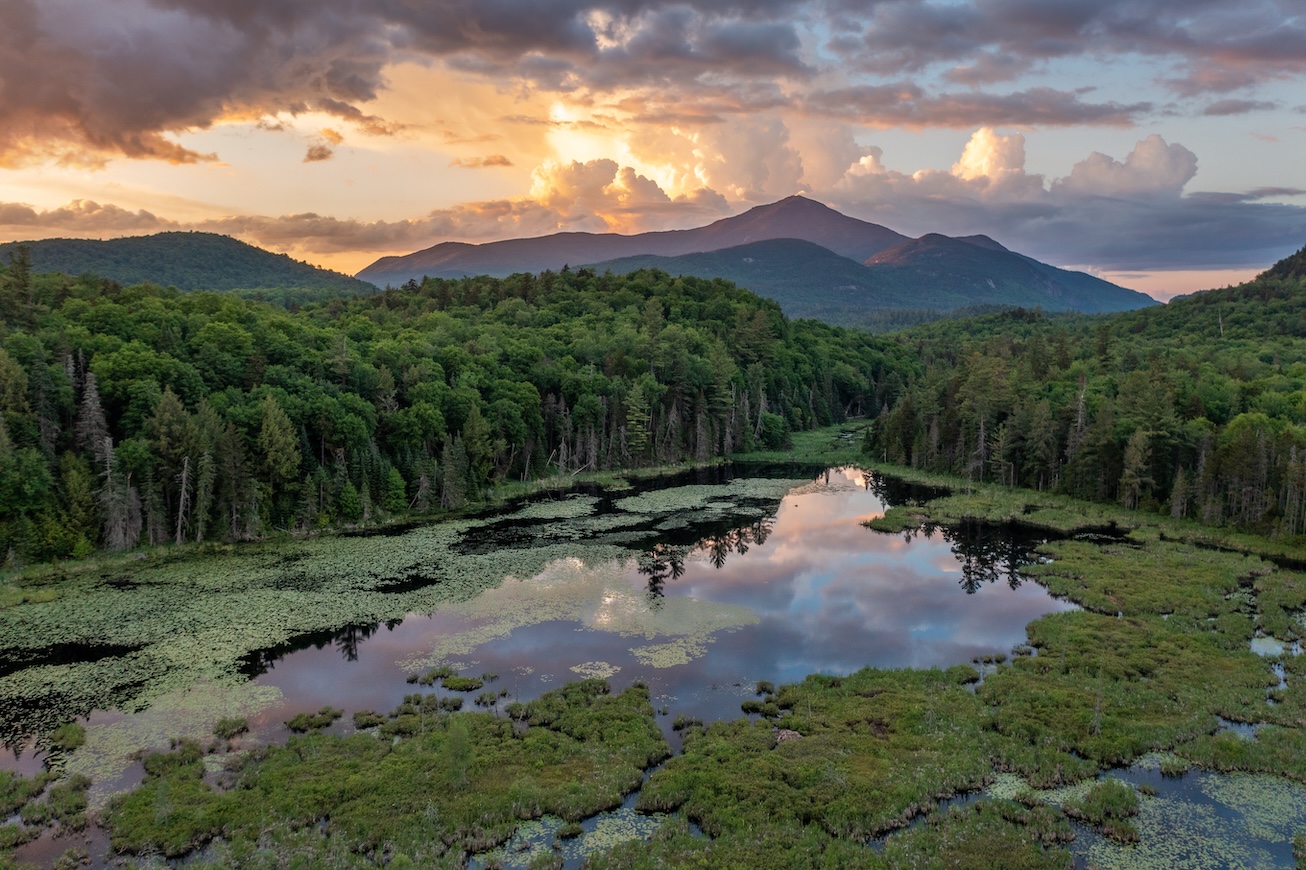
Cherry Patch Pond photography by Johnathan Esper
Light has remarkable, changeable qualities in the Adirondacks. In winter it can be pink, floating warmth over a chill landscape, or blue, tinting a blank canvas of snow to mirror an austere sky. In summer, light has depth and heft to it, a physical intensity that bears down like gravity or hauls a scene right into the viewer’s eyes and brain.
The best summer days are those glowing ones, when all disheveled nature stands out in brilliant gilt-edged isolation, when the longest, widest vistas are as blowtorch sharp as the silver-burnished blueberries at your feet. The scales of a red pine tree aren’t merely brown in this light, they’re umber, rust and raw sienna in distinct oblong plaques, with deep greenish-black edges where they overlap. Or study the delirious color scheme of red-osier dogwood; out of the ground rises a clump of shiny, smooth, slender canes, with lime-green bark that segues to yellow-orange, red and finally deep maroon. Comprehend for a moment that the vermillion edge outlining a painted turtle’s shell is close to the color of cardinal flower petals that ring the turtle’s pond or the back of a scarlet tanager as he darts away from the same water’s emerald border. Coincidence? Or reward for attending to detail? Think about the water of a favorite trout stream; the same gin-clear liquid that spills over your fingers transforms to weak tea, nut-brown ale and finally stout, complete with foamy head. Light connects, light separates.
There’s more than color to Adirondack vision on one of these days, there’s the orderly perspective of a chosen landscape, the way lumpy mountains pile up on each other, chaos at first sight, then foreground, mid-ground, background, sky. The topography emerges so that we can build a mind map; plot that, yes, this peak is before that one, or yes, that pond is nestled between those two hills. Imagine that view with the eyes of a dragonfly, each orb with fifty thousand facets, each dragonfly brain capable of processing a hundred hues to every nuance we pride ourselves on seeing. Try those mountains from a peregrine’s point of view, winging a hundred miles an hour above the highest trees—yet able to spot a chickadee darting past the forest margin. Vision must be true and trustworthy for that predator to succeed.
Sight is, of course, the prideful sense, the arrogant sense, and it’s only fitting for humans to be so dependent on it. Seeing is believing. It’s why we value eyewitness accounts. It’s how we prove something to be so. But vision is a quick picture. Light travels too fast.
When it comes to the other senses, we’re babes in the woods; our equipment is crude, our skills underdeveloped. A barn owl can hear a mouse’s footsteps and relies completely on sound to capture prey. Bats use sound not only to hunt but for navigation; sound distinguishes space from solid. These are specifics. Wild country is saturated with noise and song that humans are scarcely prepared to understand. The multitude of sounds in the woods contains as much meaning and complexity as a Mahler symphony, with bird notes filling in for oboe, flute, horn and percussion. I would love to stand in a clearing and hear the natural interplay with the same appreciation I have for music. It could be learned, I suspect.
One thing that probably can’t be learned, though, is to perceive scents like a dog. Smells exist in three dimensions for a beagle sniffing along a trail—up, down, over here, under there—but there’s also the element of time. Scent is ephemeral on the wind, yet lingers on the ground for nose-driven beasts. This fragrance is fresh, from a bobcat marking his territory only hours before; this smell is older, a deer’s bed of last night.
These clues are important to a dog, historical information to be sifted out from the kinds of scent we notice: the must of rotting leaves, the haylike perfume of balsam, the tang of pine.
“Viewshed” is one of those 20th-century words that has a certain usefulness but no real poetry. It describes a pristine vista that should not be defaced. Someday we may come to value wild country as sound garden or scent sanctuary, worthy of attention and respect.