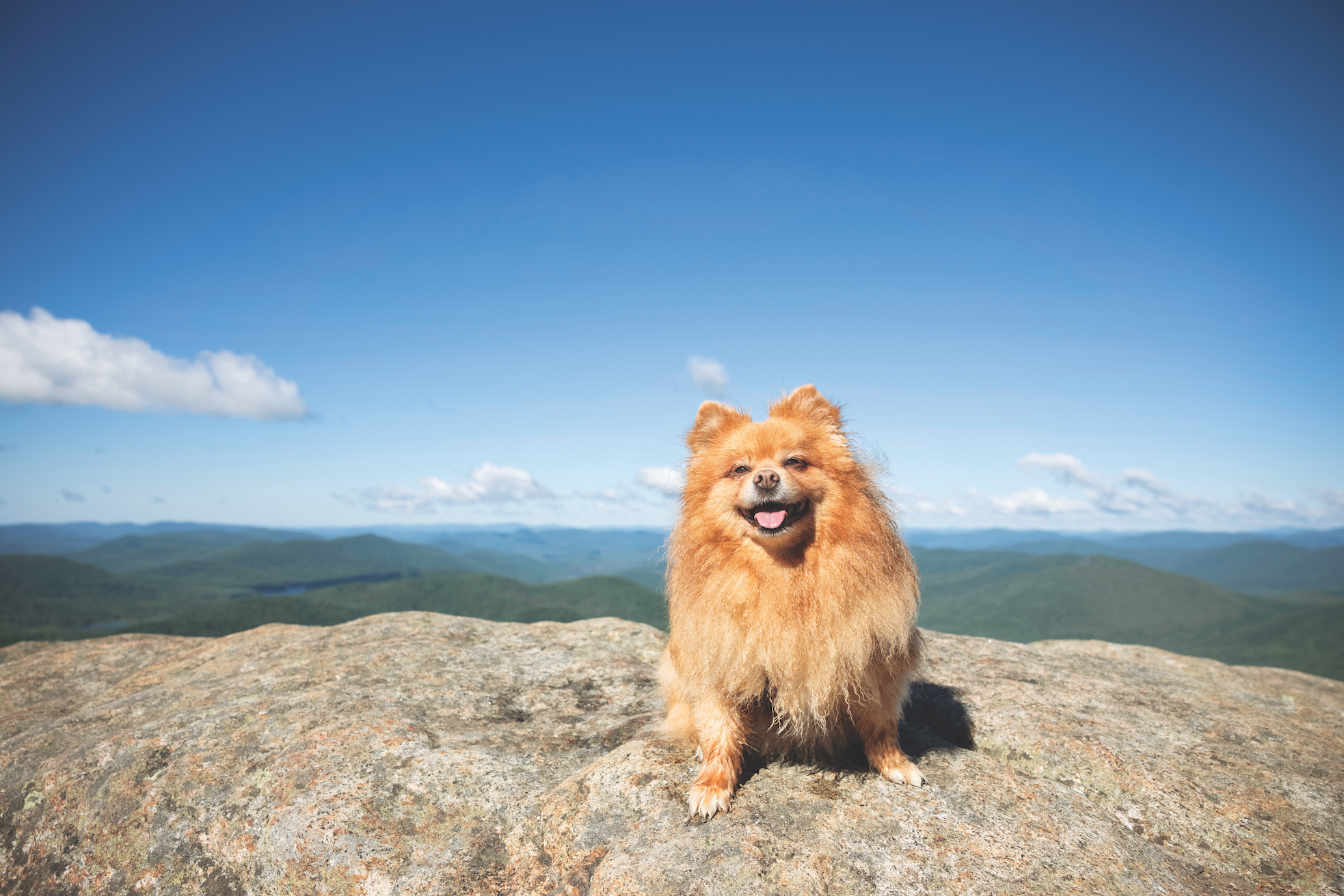
Photograph by Lisa Godfrey
Benny disappeared every few minutes, camouflaged by the brown leaves carpeting the forest floor. Unlike Star, who cannonballed through the trees, we couldn’t hear Benny coming—his stumpy legs and “fairy feet,” as one of my friends called them, practically floated above the duff.
This was my first time hiking with a miniature Dachshund and a Frenchie pug—one shaped like a cocktail weenie, the other like a baby potato. Twenty-some years ago, my companions in the woods were usually Lab mixes. These days, not so much.
What’s changed? Is there a true “Adirondack” dog?
When it comes to domestic canines, says Wendy Tibbitts, executive director of the Elizabethtown-based North Country Society for the Prevention of Cruelty to Animals, the most ubiquitous one she sees in these parts is the pitbull mix. “People take in dogs, have unwanted litters and don’t spay or neuter,” she says. Sadly, “pitbull mixes get a bad rap,” but they’re actually “babies.” Hounds, says Tibbitts, are also often blended in.
That makes sense. In the mid-1800s, hounds were depicted as the dog of choice in the Adirondacks. A. F. Tait, a popular artist known for his work with printmakers Currier & Ives, painted scenes of sportsmen, mostly in the Long Lake region, and almost always accompanied by hounds. In the decades that followed, Winslow Homer painted hunters and prey, often featuring eager hounds alongside their masters.
In 1896, Willett Randall, of North Creek, began breeding Patch beagles. The dogs, according to one of Randall’s brochures, “are strong in bone and muscle, nice type and long low-set ears; handsome to look at” and “their greatest asset is their ability to run a rabbit; they have the nose and brains and inbred wallop to give you an all-day’s hunt and repeat it the next.”
Huskies and other Arctic breeds, such as Malamutes, are another type of working dog, once relied upon for transportation over snow and ice.
French explorer Jacques Suzanne attempted to reach the North Pole via dogsled, but abandoned his voyage when he heard Robert Peary had beaten him to it. He then attempted to mush through Siberia, all the way to Labrador, but after 20 months, 5,000 miles and near death, he gave up. In the 1920s Suzanne settled in Lake Placid, where, at his ranch (which became a popular Hollywood movie set), he bred Alaskan huskies and other dogs, and ferried friends and tourists around the region via dogsled.
Today, when conditions allow, you can still glide by dog-power in this region; a couple of outfits offer rides on Mirror Lake, in Lake Placid.
Huskies have gone down in history for heroic feats. In 1925 sled dogs Balto and Togo led their teams through impossible elements to deliver diphtheria antitoxin to Nome, Alaska, during an outbreak of the disease.
In February 2000, an Adirondack husky/shepherd/terrier mix named Otis was also a hero. Following a deadly avalanche on Wright Peak, Otis ran down the mountain toward Marcy Dam, where he found and led rescuers back to the site.
My pups are hardly heroes, but Leona, a Chow Chow/Akita/pitbull/husky mix (she took a doggie DNA test) who came from the Malone shelter, brings my kids happiness. Then there’s my Spinone Italiano, Wally, whose siblings are scattered across the park. Spinones are bird dogs, but Wally prefers chasing butterflies and snoring in the sunshine.
My trek in the woods with Benny and Star proved that even little legs are up for adventure. Lake Placid–based photographer Jamie West McGiver agrees. Though she and her chihuahua mix, Bea, stick to “micro-adventures,” the dog doesn’t get tired, just sometimes cold. When that happens, Bea gets zipped into the front of West’s parka, still very much a part of this place, living her Adirondack life.