Illustration by AJ Smith
In the mid-1970s, my parents bought a small, run-down cottage on Fourth Lake, somewhere between Old Forge and Eagle Bay. It was a single-level clapboard building with a century’s worth of furniture down a mile of dirt drive from the main road. We had two neighbors but neither was visible from the cottage. Surrounded by a dense pine forest that grew right to the lake’s edge, the place was secluded.
It was a four-hour drive from our house in Fowlerville to the cottage, where we would go to clean the place between renters. Sometimes we’d stay three or four days at a time. At that age, around eight years old, nothing could keep me out of the lake, not even its freezing May temperatures. I was in the habit of bolting out of bed in the morning and running the stone path, down the dock, and leaping into the frigid water before anyone else was awake.
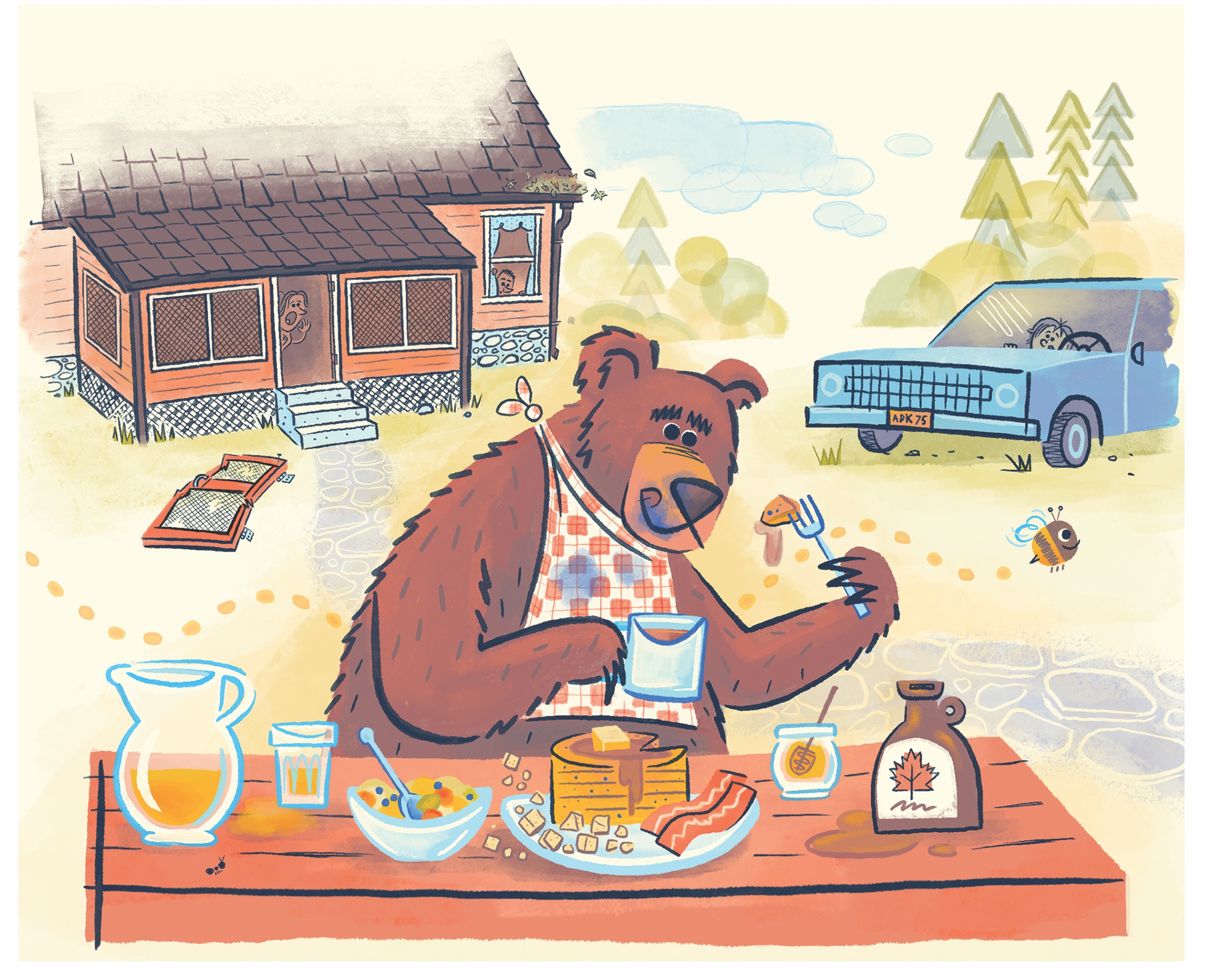
On one of those days, I walked back to the house half-frozen, expecting breakfast. From a distance, I thought I could see some of the family on the screened-in porch already tucking into blueberry pancakes, bacon and fruit salad.
I pushed the screen door and was half a step in when I realized the shape I saw from a distance wasn’t my father but a bear up on its hind legs eating the family breakfast right off the picnic table. My mother called to me through the kitchen door to walk, not run, to the car, shut the door and lock it.
From the front seat of the car I could see my family through the kitchen window watching the bear eating everything on the table and licking up the mess it made.
When the bear sauntered back into the forest to sleep off its big breakfast and we were re-gathered in the kitchen, my father announced we would head to Old Forge for breakfast, and a stop off at the hardware store.
We knew from the battle of the squirrels the year before to what degree our father was willing to go. At home he’d hung a bird feeder from a limb of a huge, draping maple tree perfectly framed by the picture window in our kitchen.
It took about two days for the squirrels that abounded in that tree to discover and clean out the seed mix in the feeder. My father customized the feeder by fixing two plexiglass shields that he thought only the birds could get under to get seed, but the squirrels just squatted on the ledge of the feeder and ate it by the pawful.
The squirrels were shimming down the wire the feeder hung from, so he fabricated a sheet-metal shield that hung over the top, and this stymied the grays for a bit. Until I saw one take the leap from farther up the branch to grab the feeder’s shelf, scurry up and go to town; the first squirrel was soon followed by others of the brave and able.
My father finally triumphed by planting a four-by-four post out of range of the tree, fitted out with more levels of sheet-metal shields. To this he added a frayed skirting of the same metal around the ledge. There was no climbing that post and no leaping from the tree.
The squirrels were left to scavenge from the ground, still occasionally trying a failed assault on the post.
At the lake our closest neighbor, Mr. Cain, had heard about our bear visitor and came over to advise us, thinking we were some sort of suburban dwellers. According to Mr. Cain, this bear was in the habit of fishing under our dock but had never approached the houses until some of our renters had lured it in by leaving goodies in the trash.
That afternoon my father rehung the screen door to pull out instead of push in and put a sturdy hydrolock hinge on it to be sure it wasn’t left half open. He also installed grills on the windows of the screened porch, windows that seemed far too small and high to accommodate the bear—but my mother, who was suddenly a wealth of bear knowledge, assured us weren’t.
My father decided that we should also be marking our territory. He told us all animals do this and bears would recognize it. We boys picked a corner of the house and made that our place to pee. Dad also thought that planting hot peppers around the property would deter the bear—jalapenos, Scotch bonnets and habaneros. Mr. Cain said that the bear would ignore our urine but might eat the peppers.
The bear, who on its next visit couldn’t push the door open, simply ripped it down.
My father replaced the irreparable old door with a heavy-duty one. It was pressed metal with a small screen window that hung on two spring hinges and a hydraulic arm. It seemed to me the kind of door one would see on porches in tough neighborhoods. Meanwhile, my mother started passing out random bear factoids; she told a cashier that bears can hold their breath for five minutes and run up to 30 miles an hour. To the mailman, she said if he ran into a bear, remember: if it’s black, attack; if it’s brown, lay down.
After a couple more weeks the bear bashed the door in, breaking the jamb. I heard my father muttering to himself, “OK, bear. OK,” as he repaired the doorframe, and I knew he had picked up the gauntlet in earnest now. Bears have excellent memories, my mother said, and will return to a potential food source regularly for years, just to check.
By midsummer, my father and I returned on our own for a quick clean-up of the place and to assemble the project he had been constructing for weeks in our garage at home. He’d kept it to himself, but most nights after dinner he spent a couple hours in there. Sounds of welding, grinding and drilling came through to the living room. What was he building?
It took us hours to assemble what was an eight-foot-tall, three-foot-wide rolling wall that rested on a weighted platform set on four 10-inch bicycle wheels. The idea was that when we were all in the house for the night the rolling wall would be wheeled into place and secured to the house with finger-thick hooks, bottom and top.
In the morning the monster would be unfastened and rolled off to the side. The rough-hewn eight-foot planks that made up the front fit right in with our forest surroundings. The quarter-inch welded steel frame was set in a concrete form on another welded steel frame that the axles ran through. From the driveway, it looked like a medieval war machine. The weight of it was tremendous and I couldn’t budge it alone.
No one else in the family could move it, either, and when I came with my mother to clean the place we didn’t even try. Before the end of the summer the sound traps, the motion-sensor lights and the territorial pissings had all been abandoned. My father chalked up the absence of the bear to the presence of his monster wall.
I saw the bear once more that year. It was getting near fall and hot for the Adirondacks. I had been in the forest behind our camp all day, working on a tree house I had been secretly building throughout the summer. I came down to the lake from a side trail that led straight to the water, with hardly any shoreline. I was about to dive into the still-cold late August water when I saw the bear. It was just lolling around—maybe fishing, but it seemed more like it was soaking, recharging, the same as I would.
It wasn’t much bigger than a large dog with its pelt soaked through, but its ursine movements made it seem closer to human than canine. Splashing and playing in the water, oblivious to all the sweat and blood my father had poured into his preventive measures, it swam about and then ducked under the water and was gone.