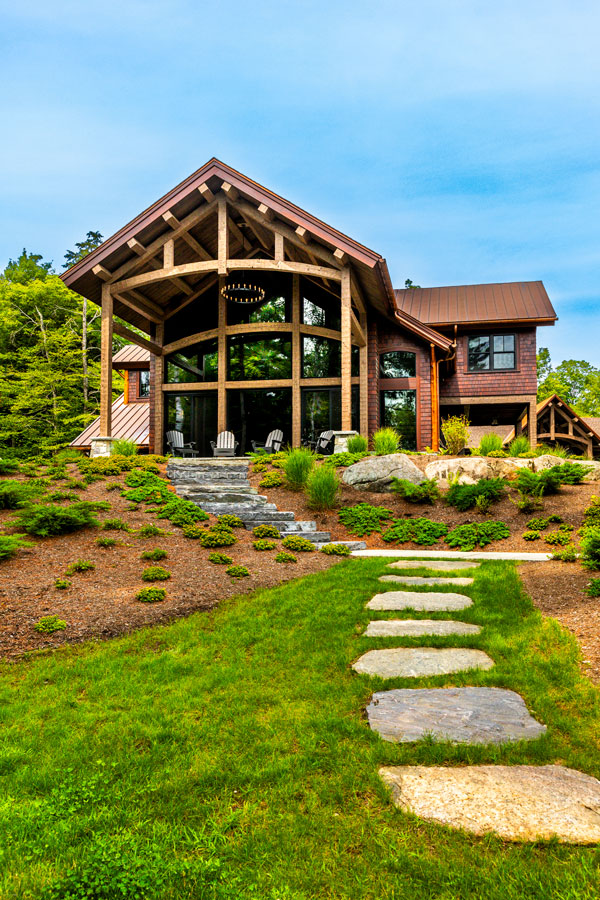
In its heyday, Skanendowa Lodge, a family compound of Adirondack cottages on Tupper Lake, drew high-society guests from Washington DC—writers, senators and presidents keen on escaping the sweltering summer in the city for the mountains.
Marshall Sheppey, who owned Berdan & Company, an Ohio-based wholesale grocery business, began work on his Great Camp in 1917, a project that soon swelled to dozens of buildings, including sleeping cabins, a barn, boathouse, dining hall and an ice house, nestled into roughly 120 acres of forest and rocky, wooded shoreline.
More than a century later, thanks to a nine-year renovation, owners Bob and Christine Fontana have restored Skanendowa Lodge to its turn-of-the-century glory. And then some.
The Fontanas tapped Andrew Ramsgard, of Ramsgard & Drumm Architects, for the ambitious project. Ramsgard, who lives in Skaneateles and has a second home in Tupper Lake, said he met the Fontanas when they were living in nearby Fayetteville. The couple wanted the renovation project to fit in seamlessly with the Adirondack landscape.
“They were saying all the right things,” said Ramsgard, who has worked on at least a dozen Adirondack camp renovations, and who explained that he’s drawn to the region in part because of the eclectic building style so often found within the Blue Line.
“People think it’s just logs, but it’s so much more than that,” Ramsgard said, adding, “there’s a thoughtful character and style to places in the park.”
In Ramsgard’s estimation, Skanendowa contains the finest components of the region. It has lakefront, rock outcroppings and cliffs. Beach. Rolling hills. Dense forest.
“To me, that’s the best character of the Adirondacks. Everybody gets their own little piece of heaven and really cares for it,” he said.
A downside of dense forests is that, without openings for sunlight, Adirondack camps tend to be dark. Not Skanendowa. Light coming across the lake pours in from the south, even in the wintertime, Ramsgard said. “The way the property faces, it has a long shot down the lake and the light just comes in—it’s fabulous.”
But bringing a historic property into the present gracefully is no small task.
It was important to the Fontanas and to Ramsgard that their new construction feel like it was always part of Skanendowa. That meant reinterpreting classic Adirondack log style for the 21st century. It also meant shrinking their plans.
“We were able to parcel out the functions into bite-sized chunks of buildings, so that we didn’t overpower the original design—we broke down the form into visually manageable pieces,” Ramsgard said.
“When you can create that kind of character, it gives it the feeling that it gets built over time.”
The project was a homecoming of sorts for Bob, who grew up in Rome. Bob’s grandfather, Alfredo, used to hunt at Tupper Lake, and when Bob was around 12, his dad and stepdad started bringing him along on hunting trips there. Too young to carry a gun, he spent the time tromping through the woods instead of tracking deer.
“It was freezing cold,” he said with a laugh. “I think I was there to wash dishes.”
Irksome as it then seemed, the experience proved prescient. Decades later, Bob hosts November hunting outings for friends and relatives in the same woods his grandfather, who founded the Rome Hunting Club, once roamed.
On the Hill
While Skanendowa’s brand-new bowling alley and gear room get top billing on Ramsgard’s Instagram account, Hilltop, at the northeastern edge of the property, holds its own as the camp’s original crown jewel.
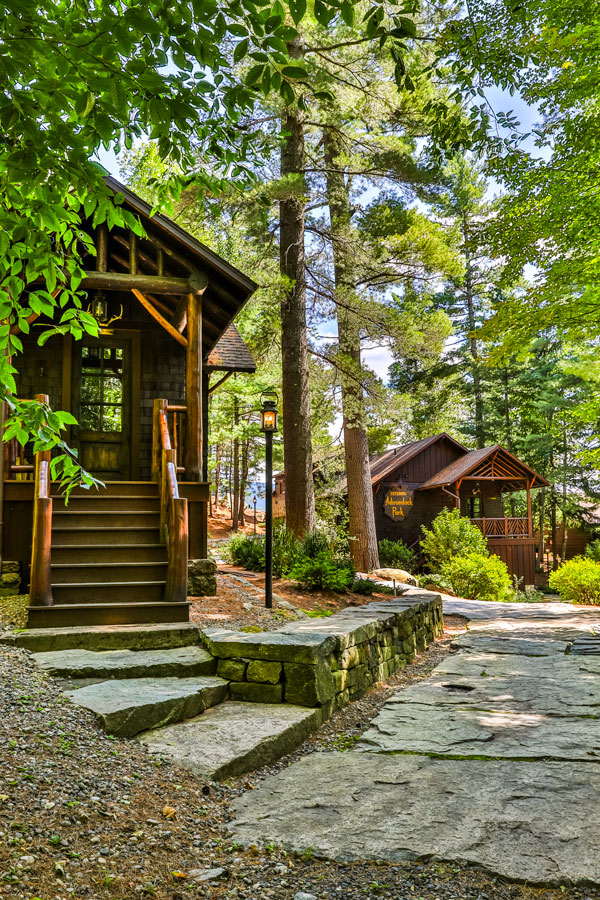
On a hazy July morning, mist rises off the water at Hilltop. The approach is up a series of wide stone steps terminating at a chocolate-brown cottage perched on a cliff overlooking the lake. Beyond the water is Mount Morris. A swinging daybed covered in faded pillows hangs out front. From this vantage, the lake seems to rise to meet the cottage, blurring the line between park and porch.
It’s an ideal spot for a mid-morning nap. No wonder three U.S. presidents— William Howard Taft, Warren G. Harding and Calvin Coolidge—took Sheppey up on visiting Skanendowa, according to family lore.
A framed copy of a 1926 letter Sheppey sent President Coolidge hangs in the camp’s main building. In it, Sheppey paints a picture for Coolidge. His camp on Tupper Lake is profoundly peaceful. The lake is dotted with beautiful, small islands. He’s built an enclosed park for viewing deer up close. Mountain trails for exercise are close at hand, and boats of every description are available to take out on the water. Crucially, the camp has ample space for the president’s entourage.
“The absolute freedom from curiosity seekers and even politicians would be to my mind most desirable,” Sheppey concludes.
In Sheppey’s time, guests stayed at Hilltop, then outfitted with bamboo chairs with satin-covered seats and large wolf skins covering the floors.
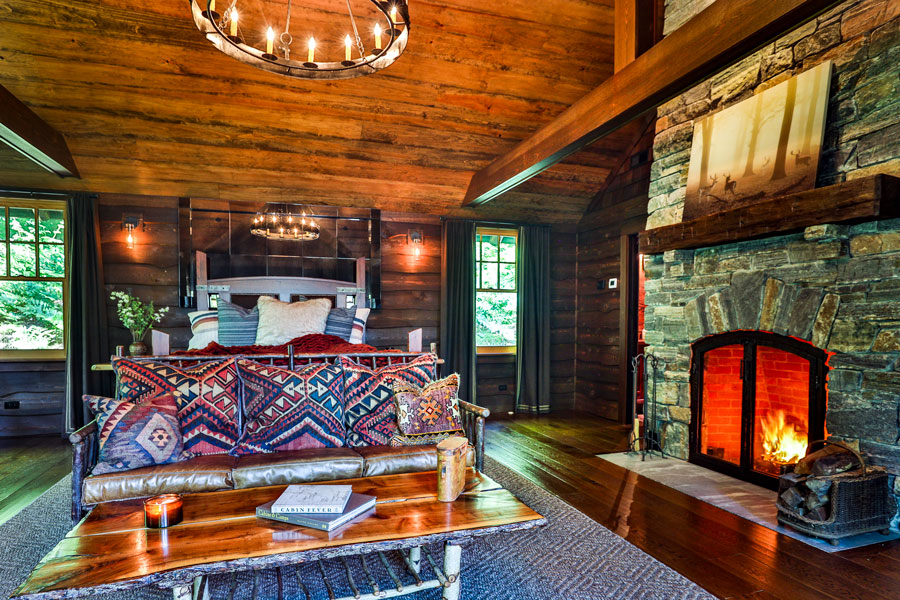
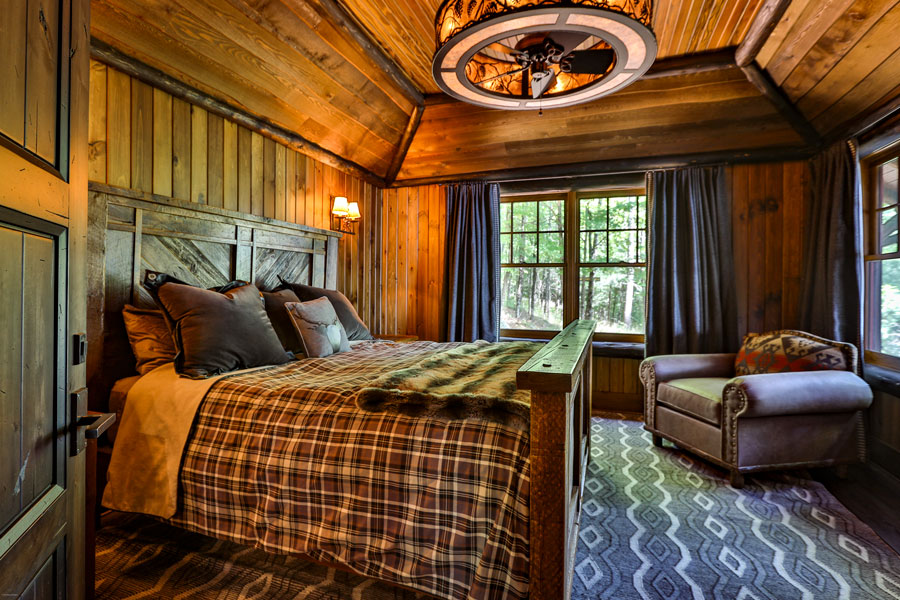
Christine has brought Skanendowa’s historic cottages into the present with modern upgrades inspired by camp-and-cabin style icon Ralph Kylloe. The renovated cabins feature dark, rustic wood, exposed beams and touches guests appreciate, like broad bunk beds and overstuffed leather couches.
Hilltop’s exterior remains modest, in keeping with an Adirondack style principle: the best camps utilize natural materials from the area—rustic logs, stone pulled from the lake and twig-work architecture—so well they blend into the landscape.
“Where it’s nestled in, you cannot see it from anywhere. You’ve got to know where it is, and even by boat, you’ve got to work hard to find it,” Ramsgard said of Skanendowa.
“The character of the existing buildings is that very natural chocolate brown color that fits into the surroundings and just disappears,” Ramsgard said.
“It’s almost like it’s so meant to be here that it’s Adirondack camouflage.”
Coming of Age at Skanendowa Lodge
Sister Barbara Whittemore, whose parents Sheppey hired as caretakers, spent her formative years at Skanendowa.
In an account published in the Tupper Lake Free Press in 2022, Whittemore, a Catholic nun, described having the run of the Skanendowa after moving to “camp,” as her family called it, in 1939, when she was nine years old.
Her parents, Charles Henry and Frances Whittemore, were Skanendowa’s live-in caretakers for the next 40 years.
An only child, Whittemore recalled playing tag with Tom, an ornery old horse who refused to work and who followed her father around like a dog until he was struck dead by lightning during a summer thunderstorm. Whittemore’s dad buried him near the tennis courts behind Hilltop.
Whittemore quickly adapted to childhood in the Adirondacks. She learned to shoot a .22-caliber rifle to keep the porcupine population in check. She traveled to school by boat each fall until the lake froze over, then boarded with families in town until spring. During a particularly hairy crossing by boat, Whittemore remembered her father smoking his pipe upside down to avoid having it extinguished by a rogue wave.
The staff harvested ice from the bay by the boathouse in the winter, packed it in sawdust and stored it in the ice house, which could hold up to 350 ice cakes, she remembered. Meat was shipped in by refrigerated train car, then boated across the lake to the ice house. If guests caught fish, the staff would quick-freeze them to serve for dinner.
“One of my childhood jobs was to clean the fish for the cook,” Whittemore wrote, for which she received a small stipend. But the best fisherman was Sheppey’s stepson, she added, “who went fishing every morning and usually got a good catch!”
When the Sheppey family was staying on the property, they flew the American flag alongside the boathouse, a signal to everyone on the lake that the owners were at camp.
Room(s) with a View
The Fontanas don’t get dressed up to go fishing, picnicking and sunbathing, the way Sheppey’s guests did. But they’ve carried on their predecessors’ tradition of inviting friends and family who are fond of the outdoors to stay with them at Skandendowa.
With their guests, the Fontanas spend summers swimming, boating and wakeboarding, and falls and winters hiking, hunting and skating. While Sheppey had horses and Model Ts, the Fontanas use ATVs to traverse the spiderweb of dirt roads that crisscross the woods and lead back to town.
When night falls, their guests retire to the same cottages Sheppey’s summer visitors did, each with its own unique character and name:
Hilltop
Of Skenandowa’s original buildings, Hilltop is Ramsgard’s favorite.
“I love how it’s perched up on top of the hill. I love that it has the porch all the way across, so it overlooks the water,” he said. Inside, there’s a 1917 keystone in the fireplace and an original Adirondack guideboat strung up near the ceiling.
The view from the wraparound porch, in Ramsgard’s words: “Spectacular.”
Bunk House
Christine is partial to Bunk House, which was the Skanendowa dining hall in Sheppey’s time. The Fontanas kept the building’s original footprint and vaulted the ceilings so guests who sleep there won’t bang their heads.
Like Hilltop, the cottage is right on the water, an aspect Christine loves. As for the spacious queen-sized bunk beds: “The hunters are grown men,” she said.
Spring Side
Nicknamed the “bishop’s cottage,” after a local bishop and childhood friend of Sheppey’s, who used to stay there, the original cottage featured brass beds and a deep-red carpet.
Today it’s called Spring Side, for the natural spring behind the cottage that flows when it rains.
RAAC
An eight-foot tall black bear and her cub, crafted with a chainsaw by Catskills-based carver Hoppy Quick, welcomes guests who pass through the porte-
cochère.
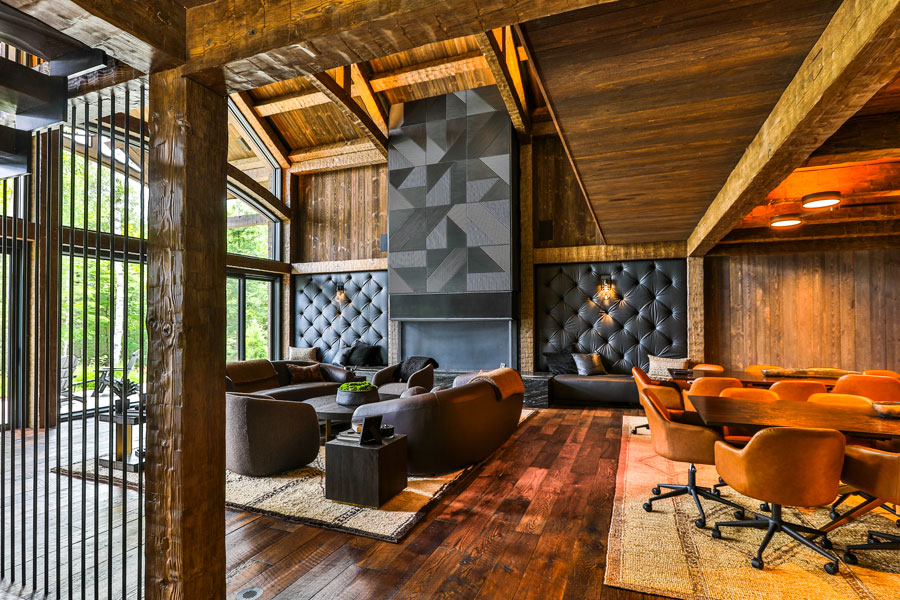
Once called Gardenside, for the Sheppey-era garden nearby, RAAC is now Skanendowa’s central gathering hub, dining hall and kitchen, where everyone meets for meals. With a full bar, pool and poker tables, it’s an entertainment hub, too.
The acronym RAAC combines the family’s first names: Robert, their two children, Adam and Alex, and Christine. The Fontanas love word play, Ramsgard explained. “It’s also RAAC because they love to hunt white-tailed deer.”
The family has since created a RAAC family logo that they’ve added to napkins, coffee cups and the railings over the stream that runs through the property. “We have it everywhere,” Christine said.
Skanendowa Lodge
Work on the brand-new Skanendowa Lodge wrapped this summer, just in time for hunting season.
Upstairs, the lodge is all business, with a conference room and space for Bob to host corporate offsites. Downstairs is a sports lover’s paradise Sheppey would have surely appreciated.
There’s a gear room, outfitted with lockers and showers, and a taxidermy-
filled trophy room. Sliding steel doors open onto the gun vault, with a six-foot-tall American flag made of 3,575 empty shotgun shells splashed across the back wall, which Ramsgard and his business partner Adrienne Drumm had to undergo background checks to acquire.
Down a level from the gear room, is the Fontanas’ pandemic-inspired investment: Aspen Alley, a two-lane bowling alley named after the Aspen Group, the dental company Bob founded, with a luminescent underground tunnel linking the alley back to RAAC’s basement.
“You have to be able to switch things up if you’re never leaving,” Christine said.
Writer Erin Schumaker’s work has appeared in Politico, HuffPost, The Guardian and New York Daily News.
To see more photos of Skanendowa Lodge, click on the slideshow below.