Photograph by Nancie Battglia
“Do you have a favorite?”
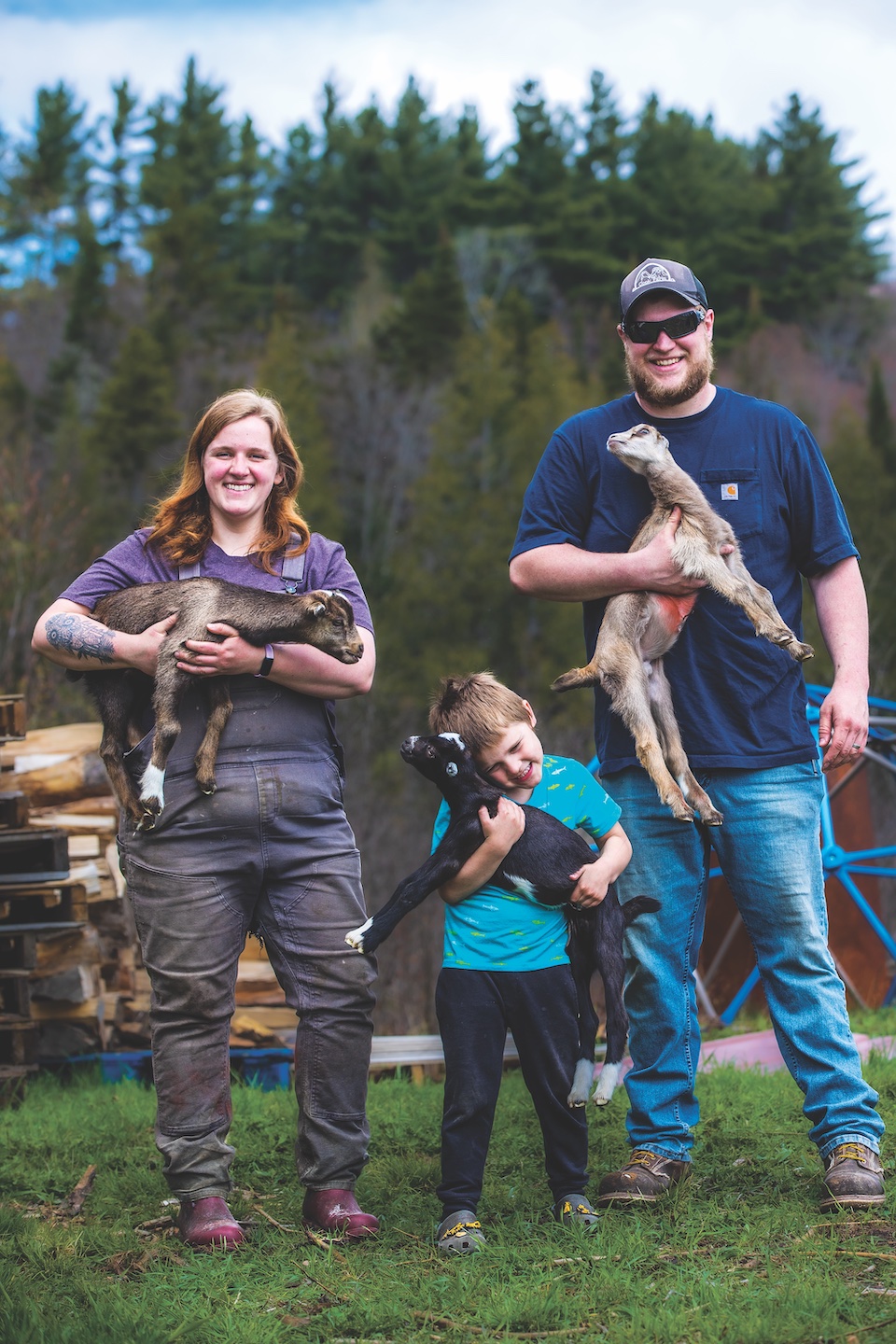
Five-year-old Ivan Cook considers the question, looking from goat to goat. After some thought, he rattles off the names of several of the herd, while all around him, the goats dance, sniff his small hands, and nudge him for attention.
There’s Ginger, the family’s very first milking goat, Luna and Elwood, as well as 11 others of varying shapes, breeds, and rock star–worthy coats of wool, all of whom are an important part of the sustainable, community-oriented operation that is the Cook Farm. Owned and operated by Ivan’s parents, Laura and Brandon Cook, the farm is tucked away in the northern Adirondacks, in the hamlet of Owls Head, on 26.5 acres that offer plenty of room for this farm to grow.
Brandon grew up in Owls Head, and he, like Laura, loves living in this corner of the Adirondacks. The Cook Farm began small in 2017—Brandon and Laura bought their first calf four days after moving in together—and relocated to the current location on Ragged Lake Road in 2019. “We needed the land to expand on a reasonable scale,” explains Laura, a New Hampshire native with degrees in agribusiness and sustainable agriculture.
Laura and Brandon found the farmland by chance. “We were riding around on a four-wheeler in the summer and we happened to see the sign,” says Laura. “It was so perfect when we stopped, with a lot of purple flowers and a pretty sky.” Ever since, the Cook Farm has grown with each passing season, offering more produce and unique farm experiences. They’ve built it all together, from the barn to the new greenhouse.
Today the farm is a hub of activity, where visitors can meet the animals, learn about farm life, buy handcrafted products and even camp on the property. Livestock—pigs, chickens, ducks, turkeys and goats—are all part of the farm’s ecosystem. It’s like a big neighborhood where everyone helps each other.
April through September, the goats are milked on a 12-hour schedule, providing milk for both soap-making and to feed the pigs. The pigs, in turn, create compost to enrich the soil for veggies, while the chickens, ducks and turkeys keep away slugs and other small pests, lay eggs (broken shells are another porcine treat), and are butchered for meat.
The Cooks have a genuine love for the animals on their farm, as well as a realism about what the animals represent. Transparency is crucial to both, Brandon explains. “We’re trying to show people that you can care about the animals and eat them. It doesn’t have to be one or the other.”
Humane treatment is key. Animals are selected thoughtfully, such as the kunekune pigs, a breed from New Zealand. Kunekunes, with their thick coats of hair, are ideal for the Adirondack climate, and the breed loves room to roam, which they get plenty of here. Their smaller size makes them more manageable, and they are also fun to interact with, their noses pointed skyward, their chins ready for a good scratch.
Brandon and Laura practice what is known as “regenerative agriculture,” being in sync with the land rather than working against it. Diversity of crops and soil health are in, monoculture and over-tillage is out. Neighbors and visitors can bring food scraps to the farm as part of the Cooks’ Community Composting program, designed to keep as much waste out of landfills as possible. “We want to inspire people to care about sustainable farming,” Brandon says.
And then there’s the eating. Four times a summer, the Cooks welcome visitors for a free breakfast made with food from their farm as well as other North Country producers, such as Brandy Brook Maple Farm, Pat & April’s Pork and Summit Farm. The breakfast is a lot of things: a showcase for regional food, a social gathering and a way to make local food more accessible to the community. “We feel strongly that customers are more than customers,” says Laura.
Laura and Brandon understand local food can be expensive and it’s not always an option for everyone—they note the presence of a low-priced big-box store just a short drive away in Malone, which has had a major impact on local businesses and food culture. The Cooks set their prices as reasonably as they can, while paying themselves a living wage. And they accept SNAP benefits and partner with the Fair Food Program run by AdkAction. “People don’t know how much you can eat local,” Laura says. “We want to introduce people to local food.”
At the farmstand, goat’s-milk soap and mohair ornaments crafted from their Angoras’ fiber share space with fresh eggs and, depending on season, fresh berries, flowers and vegetables. Ivan helps lead tours of the farm, at home among the animals, poking his head into this nook by the piglets and that cranny under the chicken coop, cheerfully suggesting new names for the pigs. Lulu and Thor, a pair of Great Pyrenees, watch over the herd. “We don’t think what we’re doing is cool or special,” says Laura. But the tag on her homemade soap disagrees: “Like No Udder.”
Find Cook Farm at 189 Ragged Lake Road, in Owls Head. To learn more about events, tours and other experiences, visit www.cookfarmny.com or call (518) 353-6026.