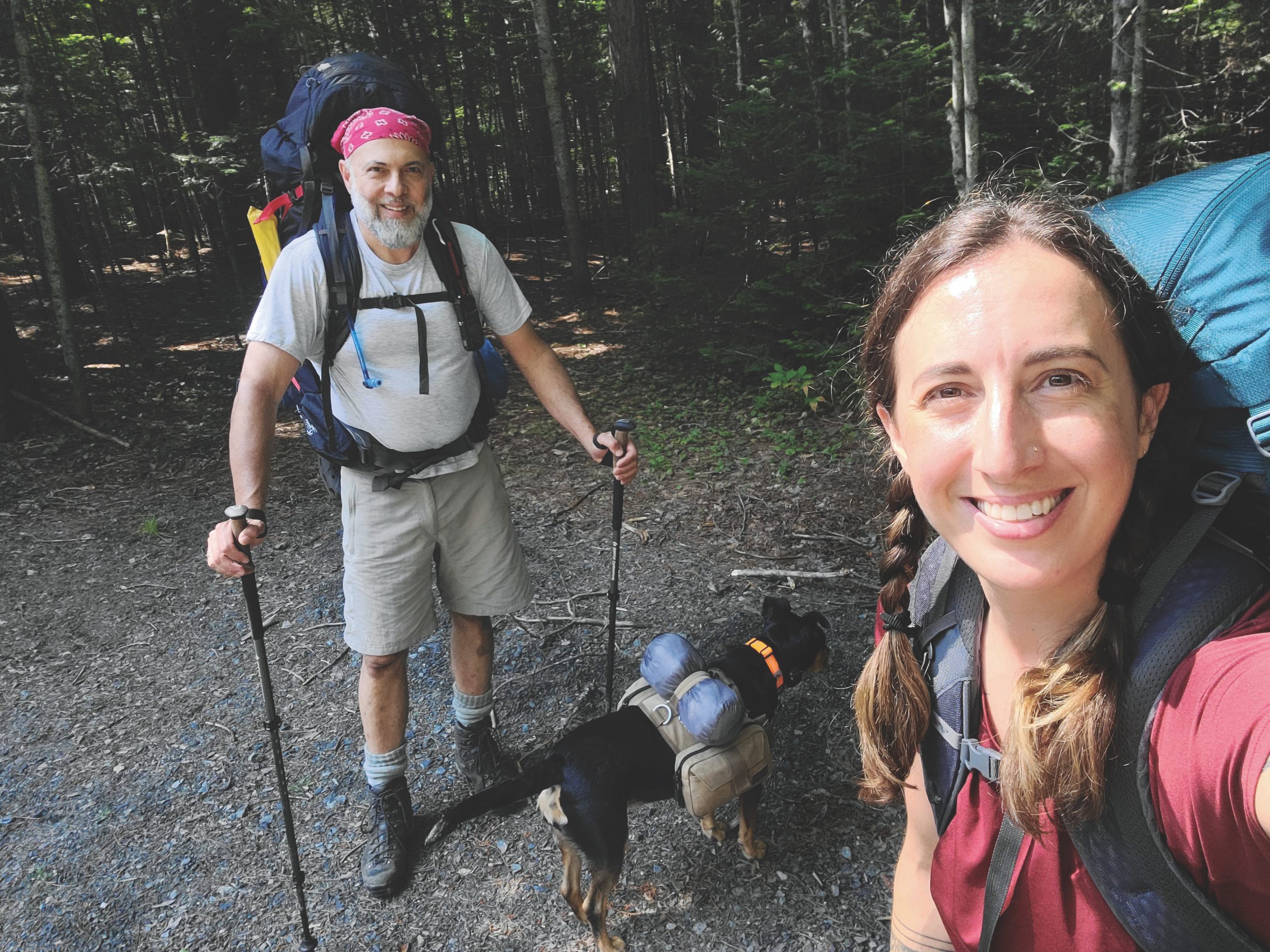
Photograph courtesy of the author
The Northville-Placid Trail cuts through the West Canada Lakes Wilderness in some of the most remote terrain in the Adirondacks. It’s about as far from human hubbub as one can get. But one rainy July morning, it’s anything but placid.
Deep in a blowdown-filled beaver swamp, the woods reverberate with the voice of my daughter, Rae, who at the moment has—let us be frank—quite the potty mouth. As her backpacking guide, I just made the strategic misstep of laughing as she waded into knee-high slop, followed by my request that she hold that pose while I fish out my camera. Hence, the profanity.
It’s day three of what I thought would be a leisurely four-day itinerary on the French Louie Loop, a seemingly ideal starter trip for Rae after she blessed me with the plea every backpacking father hopes for: Please take me on a trip and show me how to do what you do.
Her request came 18 years after I nearly turned her off from backpacking forever. I had dragged her along for some father-daughter time when a horrid week at work sent me impulsively packing for a weekend getaway to clear my mind. All it really made clear was that a hot, uphill “death march” (her words) was not the best way to spark a teenager’s passion for this sort of thing. It took her this long, well into her 30s, to give it, and me, a second chance.
So far the trip hadn’t gone as smoothly as I’d hoped. She rejected my advice on what not to pack and suffered the consequences with an overly heavy load on legs and a back unused to backpacking. The temperature our first night, at the Pillsbury Lake lean-to, dropped into the 30s. She discovered that a cold lean-to floor instead of a tent can make for a restless night (I warned her!). On day two, high winds made fire-gazing at the South Lake lean-to an exercise in dodging burning embers. The next morning’s quagmire traverse, followed by an intense thunderstorm and downpour, tested the tolerance of even a seen-it-all veteran. Not exactly the best way to erase those old memories of backpacking’s hardships.
More than 150 backcountry overnights and countless all-weather day hikes might qualify me as an expert, but I always felt more comfortable as a follower, happy to let others plan hikes and help me with chronic problems with gear and the occasional pratfall. I never fully appreciated how much I had relied on others for my enjoyment and safety until I donned the mentor mantle.
My first three multi-day trips with Rae presented ample opportunities for friction. But the more we hiked, the more we found our rhythm, boundaries, and companionship as peers rather than as parent and child. Call it wilderness family therapy. What I didn’t anticipate was that the student would become the teacher on matters far more consequential than where to pitch a tent and filter water.
New York has thousands of licensed, professional outdoor guides, plentiful classes teaching outdoor skills, organized hikes galore, and busy online forums offering tips on trails and gear. The weekly forest ranger search-and-rescue reports illustrate how many people ignore all those opportunities and venture into the backcountry unprepared for the potential pitfalls.
Much of New York’s boom in post-pandemic hiking popularity has centered on High Peaks day hikes. Backpackers tend to be more experienced and of course carry more gear that might keep trouble at bay. But, when lack of preparedness rears its head in the backcountry, it’s often due to untested gear like those new, blister-aggravating boots, or from a lack of cold-weather, non-cotton clothing, said Nancy Ganswindt, a forest ranger captain. Rangers have a saying: “Two is one and one is none,” meaning that gear you’re counting on can fail, so backups are a must. And then of course, there’s always the risk of a debilitating injury, which can strike even the most experienced hikers. “People get hurt,” said Ganswindt. “It’s the nature of going out in the backcountry.”
Mary Glynn, the Adirondack Mountain Club’s education programs manager, said ADK’s beginner backpacking guided trips have longer wait lists these days. But the president of the New York State Outdoor Guides Association, Scott Locorini, said there isn’t as much call for professional backpacking and backcountry-camping guides as there once was. Fly-fishing, whitewater rafting, day hikes up the peaks, and rock climbing power much of the business of guiding in New York, he said, while “the people who are doing backpacking these days are mostly do-it-yourselfers.”
That includes me, but I used the wisest DIY strategy: doing it with a more experienced backpacker—in my case, my younger brother Todd. Starting with a motley collection of ancient gear from my Boy Scout days and hand-me-downs, and gradually upgrading as the years went by, I relied on him to help me check off my 46er list and roam widely within the Blue Line on trips ranging from two to 12 nights on the trails. Aside from his trip planning and sharing his packing list and tips on gear to buy, most of the advice I got from Todd and other backpackers came on the fly, as I watched them repack a pack, choose between micro-spikes and snowshoes, hang a bear bag (I never did quite master that), and show off a new stuff sack or sleeping mattress.
None in my crowd embraced an ultralight ethos. My default packing method might best be called ultrahabitual. I took advantage of advances in lightweight technology, but I couldn’t quite imagine doing without my trusty basics. That always managed to tip my pack weight over the 50-pound mark, counting water and the requisite wine (one of said basics). Then, as I struggled to keep up with my marathon-hardened brother, I had a tendency to grow surly, letting my inner prayerful voice (“Oh god, please let the lean-to be over the next hill”) turn into a plaintive howl (“You promised we would be there by five o’clock!”)
It wasn’t pleasant or pretty. But, over the years, I developed a dogged approach that works for me and eventually keeps me more or less on pace with my hiking companions. One foot in front of the other, as the saying goes. The more Todd and I and a small circle of friends backpacked, the more we synced up with each other in setting or breaking camp and on the trail.
Those habits of mind and body needed some adjustment when I became my daughter’s guide.
Around the time Rae asked me to be her backpacking guide, she got serious about her fitness: cardio, weight lifting, the works. But, on that first outing on the French Louie Loop, she quickly realized this was a new kind of workout. She declared the trip a success, but her eyes told me it was harder than she’d hoped. Maybe all those aches and pains, I suggested, would ease once she heeded my advice on leaving that shovel and those extra meals at home.
I set what I thought was a good beginner pace for that hike, with each day’s mileage never topping six miles. What I didn’t count on was how slow my mentee would be in breaking camp in the morning. Or how my top priority—hitting the trail to earn an early quitting time and grab the best lean-tos—might not be hers. One morning, I paced and eyed my watch, my pack at the ready, wondering when she would be set to go. Then I realized: Where’s Rae?
I spied her sitting in the lotus position on the lakeshore, meditating, and seemingly unaware of the sound of my watch’s second hand.
I held my tongue, remembering the point of the trip was to bathe her in the restorative delights of the wilderness, not turn the hike into a job.
Our next trip was another three-nighter, this time to my favorite spot on the Cold River, Miller’s Falls and the Seward lean-to. With lighter packs but somewhat longer, tougher hiking and a route that required full-pack hiking all four days, Rae fared a little better physically, with the spectacular payoff of a blissful afternoon lounging on the river at our destination.
Despite taking a nasty fall in a stream on our hike out that injured her shoulder, Rae was game for another trip, this time in the rainy summer of 2023. I chose another three-night hike on the NPT, from Upper Benson to Piseco.
“This isn’t gonna be a soggy death march, right?” Rae texted beforehand. Not constantly, I lied. But pack your gaiters, just in case!
We managed to squeeze in our trip between epic multi-day rains. The mud met my dire expectations, and high heat and humidity turned up the deerfly and mosquito dial to 11. But because we started midweek and knocked off midafternoon each day, we got all three lean-tos I aimed for, and saw no other hikers on three of our four days—my definition of bliss.
Rae brought along her squat, bulldozer of a dog, Annie, who got particularly irritated by the bugs. Between tending to Annie’s needs and rescuing red-spotted newts on the trail, Rae stopped so frequently that my impatience began to show. “If you keep a steady pace, the bugs won’t be as bad,” I suggested in my best imitation of a tolerant person. Rae countered by chiding me for “rushing” to reach the day’s campsite, giving me the old “it’s not the destination it’s the journey” argument. “If two-thirds of your day you’re in grind mode,” she informed me, “you’re missing part of the point of being out here.”
Grinding along has always worked for me, so I silently disregarded her advice—until I glanced back to see her bent over to nudge yet another newt out of danger. In an instant, I was transported back 30 years, watching my little nature lover doing her thing. I vowed then to go with her flow.
At the gorgeous Canary Pond campsite, we took a midday rest and swim. I’m grateful that my daughter isn’t the squeamish type, considering the six-inch leeches that we stirred up. While Annie and I complained about the bugs, Rae took a more Buddhist-inflected look at our situation. “All you can do is accept that you’ll get a few bites and hear nonstop buzzing. Focus on the good things.” She pitched her tent so Annie and I could nap out of bug-bite range. During the interlude, she fed dead deerflies to a line of ants that delivered the corpses to a nearby anthill.
Back on the trail, Rae shared more of her philosophy. So many people, she said, have a “surface-level appreciation” for the outdoors and hiking. What we were doing, she exclaimed, is the “hard-core” way to have experiences unavailable to the hoi polloi. She gets it, I thought to myself. The same thought came to me when we arrived early to our final campsite, at Hamilton Lake Stream lean-to. It’s less than four more miles to our car, I told her. We could get a burger and beer at the Oxbow Inn, in Piseco, and retreat to the comforts of our respective homes by tonight. No, she replied. Let’s stick to the plan and stay another night. She wasn’t looking for an opportunity to quit.
The next and final day, we took our only break, at Buckhorn Lake Outlet, a pretty campsite and swimming hole barely a mile off Route 8. Rae looked around and deemed it the perfect place to bring a friend who’s interested in taking baby steps into backpacking. She felt ready to pay the mentoring forward.
We emerged from the woods, got that burger and beer, and jumped in the car to head back to Upper Benson. On the drive, I asked Rae if she felt a sense of accomplishment. No, she said without hesitation. She talked about the challenges of it, the beauty and solitude, and how the good outweighed the bad. But accomplishment? Not really.
I felt deflated to hear that the experience wasn’t as profound as I’d hoped it would be for her.
She wasn’t done thinking about her answer, though. A few days later she poured out her thoughts in an email.
It’s not so much about chasing fun or pleasure as it is about being OK with the daily back-and-forth swing from comfort to discomfort and back again. It’s about the beauty of seeking out experiences that put you outside your comfort zone, and not powering through those moments so you can get to the comfortable moment, but training yourself to be comfortable with the discomfort.
These extended walks in the woods are excellent practice for when discomforts arise in everyday life. Life isn’t about holding your breath and toughing it out until the next comfy pleasurable moment arises. It’s about learning how to be OK with whatever arises.
It’s not something I’ll get a participation award for, or rounds of applause when I show off the miles I’ve walked or my deerfly bites or the mud behind my ears. It’s always just me against me—a conscious stretching of my own personal limits. I guess you’re right—knowingly putting yourself outside your comfort zone (and into your growth zone) IS something to feel a sense of accomplishment for.
Mission accomplished.
Mark Obbie is a freelance journalist whose work has appeared in The New York Times, The Atlantic, Politico, Longreads and Slate.