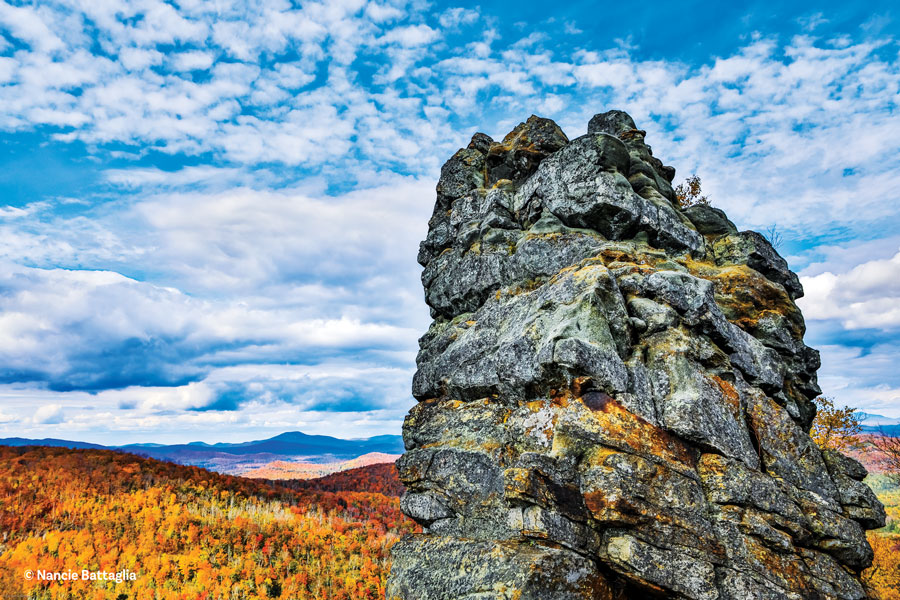
Last summer, a landowner abruptly closed public access to the Chimney Mountain trail, a popular day-hike in the Indian Lake area that crossed a section of private property.
“After much deliberation, we regret to inform you that the Chimney Mountain trailhead is temporarily closed to the public,” wrote the landowners, who own Cabins at Chimney Mountain, in a post on Facebook. “We had a hiker’s unleashed dog attack a cabin guest’s dog. … This was only one of the many incidents we have had to manage.”
They’re not the only property owners closing or limiting public access to popular trails that cross private land. In 2017, neighbors of a popular trail in Keene to Owls Head closed all public parking on their private road and restricted access to the short hike to weekdays only.
“Due to increasing congestion, the landowners have reluctantly decided to limit public access across their land,” residents said in a sign, still posted near the old trailhead. State and local officials promised to build an alternative trail to access the small peak, which is part of the state Forest Preserve, but that hasn’t happened.
Meanwhile, in 2021, owners of the private Adirondack Mountain Reserve (AMR) in St. Huberts implemented a reservation system, setting a quota of just 70 hiking parties per day from May 1 through October 31st. The new rules—the first of their kind in the Adirondack Park—sharply limited access to some of the most popular publicly owned lands in New York State, including the vista from Indian Head.
“It’s their land and they worked with the state [Department of Environmental Conservation] to come up with that permit system,” said Ben Brosseau, director of communications for the Adirondack Mountain Club (ADK), whose property also serves as a key entry point for a chunk of the popular High Peaks Wilderness.
According to Brosseau, private landowners often wind up dealing with members of the public who are less than cheerful. “People are pretty good mostly, but they can be quite rude to our staff. We train for that. Off-leash dogs can also be a challenge, but not a big problem in recent memory,” he said.
Brosseau noted that, so far, ADK hasn’t felt the need to curtail access over their land. “We’re committed to keeping it as open as possible. It’s not that we haven’t had challenges—you’ve seen the traffic—but we have a lot of the infrastructure, the staff and the restrooms.”
Many of the most high-traffic foot trails in the Adirondacks transit over private land. ADK and AMR serve as gatekeepers for trail networks in the northern High Peaks, while the southern High Peaks and the Dix Mountain region are fronted by land owned by Elk Lake Lodge and the Open Space Institute (OSI), an organization dedicated to keeping protected land accessible.
Elk Lake Lodge offers extensive public access across what the owners describe as a “12,000-acre privately owned forest preserve in the heart of the High Peaks.” Trails are protected by a 2013 conservation easement with New York State that includes provisions for hiking trails. Access is limited, however, by seasonal road closures and a complete ban on hiking during hunting season.
“It’s overall been really successful,” said Robin Shaver, one of the managers at Elk Lake Lodge, but she said the increase in hikers has raised issues. “At times we’ve had so much traffic we had to assign a parking attendant.” There are no plans yet for a permit system like the one at AMR, but Shaver said it might be necessary if foot traffic continues to grow. “We are watching the success of [the AMR permit system] and have it on our radar in case we have to move to something like that.”
OSI, meanwhile, owns land that includes some of the busiest trailheads in the southern High Peaks, including Mount Adams, East River and the Indian Pass–Calamity Brook hiking routes. Access to those trails has been historically preserved with no conservation or recreation easements in place—though Peter Karis, OSI’s vice president for parks and stewardship, said that an easement is currently being finalized with the Department of Environmental Conservation (DEC).
Karis said OSI hopes to eventually pass ownership of the property that includes the trailheads to the town of Newcomb, so it likely won’t be added to the Forest Preserve.
There have been some big wins for hikers gaining access to private lands over the last year. A company called Cedar Heights Timber allowed construction of a 1.2-mile trail to the fire tower on Buck Mountain, in Long Lake, that opened in September. Champlain Area Trails (CATS) also opened two new trails that cross private property this summer, the Long Pond trail in Willsboro and a new route linking the Wildway Overlook trail to North Boquet Mountain.
But the Champlain Valley is perhaps the area of the Adirondacks where trails are most vulnerable to landowner decisions. Over the last two decades activists have built an extensive network of hiking routes that cross a patchwork of private farms, forests and meadows.
“This is something that keeps me awake at night,” said Chris Maron, executive director of CATS. “We’ve got these great trails and a lot of them are connected. If a landowner comes in and cancels a trail, we can lose all that.”
According to Maron, one property owner has already withdrawn from the CATS network, citing a desire for more privacy. But the concern for the Champlain Valley trail system isn’t clashes between property owners and hikers, like the ones at Chimney Mountain and Owls Head. Maron said what worries him most is that a new generation of owners can buy in and simply decide to cancel agreements.
“Most of these are revocable and we really need to make them permanent,” he said.
Steve Feinbloom, a town of Essex landowner with a public trail across his property, said he’s enjoyed seeing people use his property for day hikes. But he, too, balked at the idea of making the route permanent. “I don’t see an upside to that. I don’t want to put an encumbrance on my property,” he said.
Many of the most popular trails that cross private land are protected by some kind of easement established with New York State or one of the region’s land conservation groups. But as the AMR permit system showed, those easements can be altered. Everyone interviewed for this story voiced worry that as hiking traffic grows, more landowners may feel the need to curb access.
“For the places that have the tools in place to work with the explosion of visitors, it’s working relatively well,” said ADK’s Brosseau of the park’s private-land trail crossings. “For other places where the set-up was more informal, I do think they’re experiencing some challenges.”
Brian Mann is a correspondent for National Public Radio who lives in Westport.