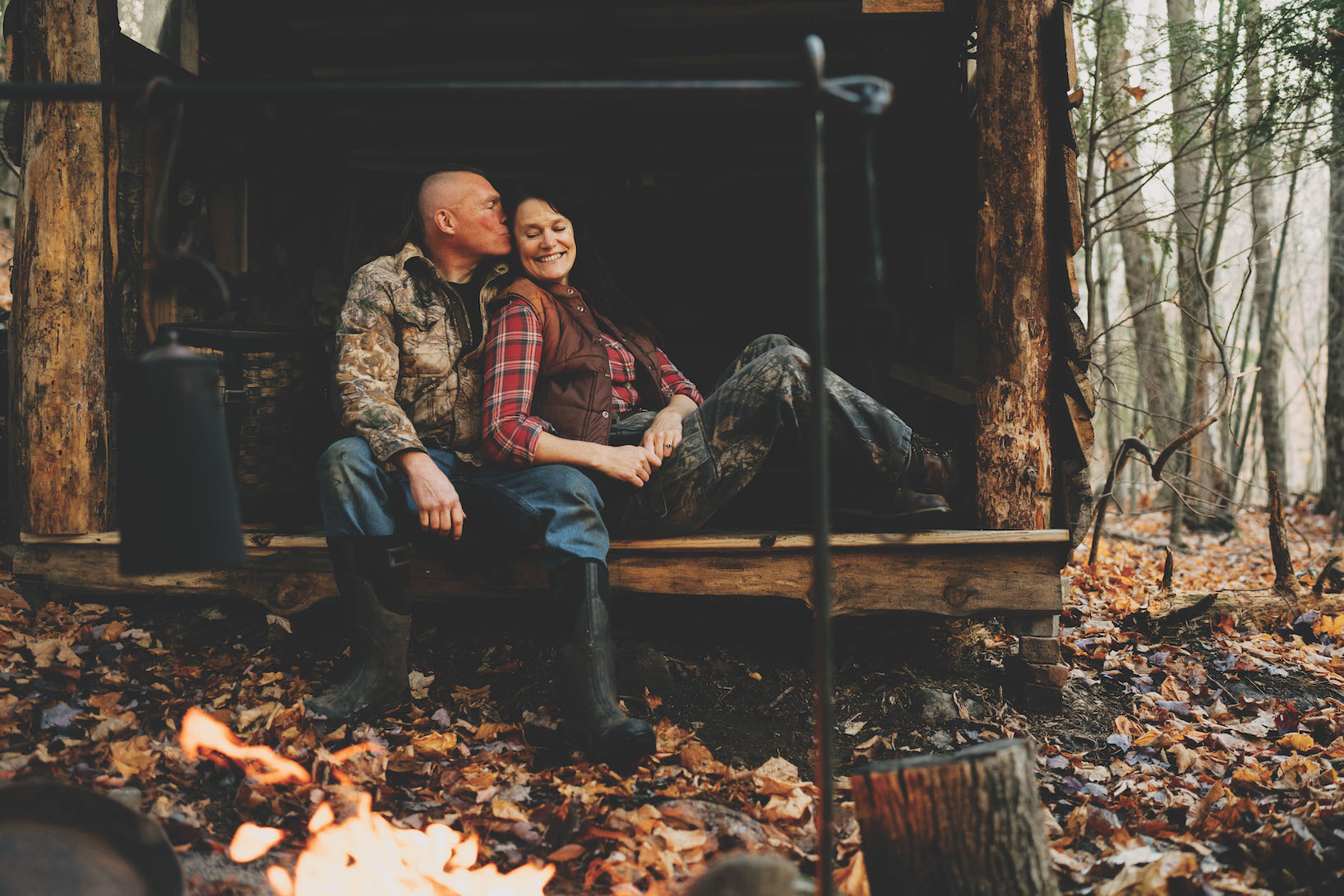
Photograph by Jamie West McGiver
A seaplane dropped Melanie Sawyer onto a spit of land along northern Saskatchewan’s Reindeer Lake. Sawyer’s challenge, like that of nine other competitors deposited across the Arctic, was to survive the longest. Alone.
She built an A-frame shelter with spruce and pine boughs, chinked with clay. For sustenance she foraged for mushrooms, berries and mosses, and ate squirrels, voles, mice and a goose she took down with a bow and arrow. Temperatures dipped below zero, 50-mile-per-hour winds blasted through, and snow blanketed the landscape.
The History Channel’s reality series Alone is, according to its promo, “the ultimate test of human will.” Contestants, handpicked by the show’s producers, are permitted 10 essentials to aid in their survival—for Sawyer, that included an ax, sleeping bag and cooking pot. They’re required to self-document their actions for at least seven hours a day, and when they’ve had enough of trying to stay alive—usually because of starvation, illness or loneliness—there’s a button they can push that sends a ride home.
Sawyer made it 43 days, 23 days shy of the winner.
Long before she was eating rodent kabobs on the desolate tundra, Sawyer worked as a model. She’d won a modeling competition in her native England—UK’s Face of ’88—which meant insuring her never-ending legs and traveling all over the world for shoots for magazines such as Harper’s Bazaar, Marie Claire and Cosmopolitan. Ultimately it landed her in New York City. There, she says, “I realized this was the country I wanted to live in.”
Modeling, says Sawyer, “is draining,” and “the progression with that work and getting older is one you have to come to terms with.” She became a mom, first to Felix—Lucas arrived three years later—and Sawyer found herself more comfortable behind the camera as a “baby wrangler.” (It’s really a thing.) Her husband at the time was a photographer, working for parenting magazines and ad campaigns, among them FAO Schwarz, Toys“R”Us and Bergdorf Goodman. Kid models require “wranglers” to make them smile, but also to keep them safe on set and help achieve the client’s vision.
In those days Sawyer and her children lived in Brooklyn, and their needs were shifting. “I was a single mom and realized I could grow mushrooms as big as a table to supplement our food—the kids were rapidly approaching six feet.” So she cultivated mushrooms in her basement for her family and as a side business. They turned out to be Sawyer’s gateway to foraging and led to learning what she could identify in parks throughout the city. “I was fascinated that you can fill your belly just by walking in nature and knowing what you’re looking at.” She discovered edible plants; then came traditional skills such as fire-making.
Sawyer posted her finds and techniques on social media. Bushcraft, she says, “had a kind of machismo.” She wanted to encourage women interested “in that genre” to “get out there and feel empowered by making fire and feeding yourself and making shelter.”
Sawyer’s base at that time was her apartment by New York’s Williamsburg Bridge. She says it was “a crack den haven,” with the “outlines of bodies” on the sidewalk. “I had no clue about the Adirondacks until I met Brian. And once I stepped over the Blue Line, I knew I was home.”
Historical reenactment is a logical extension of wilderness skills and survivalism. It’s what pushed Brian McCormack, who is part Bear Clan Mohawk and speaks the Mohawk and Lakota languages, into continuing his understanding of primitive hunting and camping. He grew up near Albany and got into reenacting the 18th century as a kid, joining his uncle and friends at historic sites such as Fort Niagara, on Lake Ontario, where they would represent their heritage. McCormack’s childhood also included trips to the Adirondacks with his dad and grandparents, who taught him how to hunt, fish, trap and live off the land. What followed was a career in the Army, then work as a licensed hunting and fishing guide in Alaska and Montana, leading packhorse trips in remote, rugged country.
Always calling, though, was McCormack’s ancestral Ganienkeh homeland, some nine million acres stretching across much of northeastern New York State into Vermont and Quebec. In 2004 he bought a 120-acre spread in Moriah, in the Champlain Valley, and named it Thunderhawk. He built an off-the-grid cabin atop a mountain, all the while sharing his wilderness skills on social media.
That’s how McCormack and Sawyer met.
In 2020 they began talking and “we got on really well,” says Sawyer. “Then he slipped in that he lived in New York State. Most wilderness survival people live in Georgia or Wyoming or Canada. I came up for a battle reenactment, we grinned at each other….”
About two years later they were engaged.
“I’m his Mary Poppins,” she says.
“I’m a chimney sweep,” adds McCormack.
They both laugh, but it’s true. McCormack, who learned the trade in high school, runs Adirondack Clean Sweep Chimney, serving the entire North Country.
Who you portray in historical reenactment is called a persona, based on a person living and, usually, fighting during a specific time period. You might be a tradesman, war chief or captain, but accuracy is everything.
Most participants in events at Forts William Henry and Ticonderoga and other sites, says McCormack, are archaeologists, historians or war college professors who are experts in the era. So serious is their dedication to authenticity that an inaccurate kit—what you wear—and accouterments—what you carry—will get you kicked out. Weapons, thread count, rations, language and battle choreography matter.
Sawyer’s persona is an Englishwoman married to McCormack, a ranger of Mohawk and Scottish blood under British Army officer Sir William Johnson. “Women in the fort would be owned by fathers until owned by husbands,” she explains. “A woman adopted into Native society has a more relaxed and powerful position. She has rights in Native culture. No corset, head uncovered, working alongside men, shooting on the battlefield with a flintlock.”
Sawyer focuses on what people ate when walking fort to fort 250 years ago—knowledge that helped her survive so long on Alone. (Thanks to pemmican and jerky, she never ran out of food.) She calls herself a historical forager, which involves digging deep in the archives to discover, for example, that during the 1777 Battle of Valley Forge, when Washington’s troops were running low on rations, they ate rock tripe lichens. She says that in the Adirondacks that abundance is everywhere and often overlooked. “You cannot starve if you know what to look for,” she says.
During the pandemic there was renewed interest in self-sufficiency and survival skills. Sawyer embraced the trend and, by incorporating “the depth of history that’s here,” particularly an awareness of indigenous culture and practices in the 18th century, created Thunderhawk Living History School. Now she and McCormack, with Alex Warrington, Cody Van Buren and Scott Reed, guide 18th-century immersion programs and instruct workshops on wampum-weaving, moccasin-making, flint-knapping, fire-starting, foraging and more at community centers, schools and events. Sawyer also shares her knowledge with Girl Scout Troop 3602 of Southern Essex County and was recently given the Gold Award, the Scouts’ highest honor.
On an early winter afternoon at home on Thunderhawk, envelopes of tea are spread across the kitchen counter, ready to be shipped—Sawyer also runs Wild Foods & Wilderness, harvesting and packaging the bounty from her backyard. She says the health benefits from the natural world are bottomless, and she “wants to make people fall in love with the idea of taking care of themselves.” McCormack’s easel and paints—he portrays scenes of indigenous people and the landscape—are propped near glass doors that expose the muted palette of the mountains beyond. Their dogs Addie and Peanut snore on the couch and, outside, chickens peck and ducks squabble. Here, Sawyer says she’s found a life and partner that fulfill her, though she still travels to New York every month or so to baby wrangle for Ralph Lauren.
Her stretch on Alone was about challenging herself, but, she emphasizes, also about “representing females and the Adirondacks.” The show’s demands can be grueling on the body—other contestants lost teeth and suffered debilitating physical and mental issues—but her only lingering effect is an inability to feel the cold.
She says, “Coming out of the Arctic, I knew that family is the most important thing. I’m determined to make us stronger and more cohesive.” Her now grown kids (and Ollie, an honorary third child) visit often, especially appreciating the venison they get to take home.
Sawyer’s journey has been wild in all sorts of ways. What she has now, she says, “is real. This is the life I want and it’s a good one.”
The Show: The 10th season of the reality TV show Alone, in which Melanie Sawyer was a contestant, is currently available on the History Channel. Learn more at www.history.com/shows/alone.
The School: Learn more about Thunderhawk Living History School and its offerings, which include immersive 18th-century programs, reenactments at historic sites across the Northeast, and workshops at www.thunderhawklivinghistoryschool.com.
The Tea: Sawyer harvests and sells teas made from what she forages in her backyard under the brand Wild Foods & Wilderness. Her teas come in a variety of flavors, such as mint and yarrow; reishi and cinnamon; mullen and bee pollen; sumac; and chaga. Learn about the teas and their health benefits and see Sawyer’s Foragers’ Guide to Wild Foods from the 1700s at www.wildfoodsandwilderness.com.